Wildfire dark brown carbon has strong global warming effects

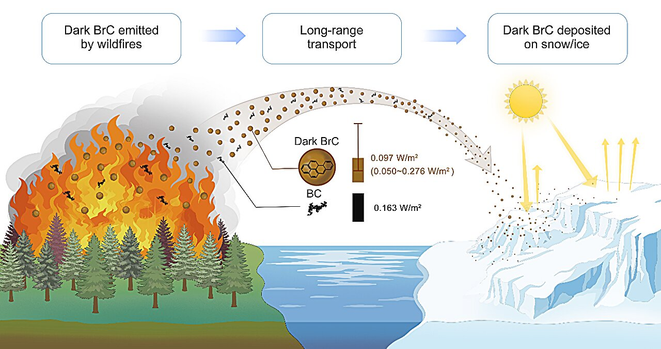
Conventional understanding has held that brown #carbon—a type of organic #aerosol from #biomass burning—mainly absorbs sunlight in the near-ultraviolet range, giving it only a limited #climate impact. However, growing observations show that some #wildfire-derived #BrownCarbon appears dark brown or nearly black, absorbing light well into the visible spectrum. This "dark brown carbon" has been largely missing from global climate assessments.

The results show that wildfire-derived brown carbon has a global direct radiative effect of +0.097 W/m², with an uncertainty range of +0.050 to +0.276 W/m². Notably, the upper bound of this estimate (0.276 W/m²) exceeds the radiative contribution of black carbon (0.163 W/m²).

https://phys.org/news/2026-05-wildfire-dark-brown-carbon-strong.html
#ClimateScience

9/

#Smoke by #wildfires may also be connected with #"Earth’s radiation budget through absorption of incoming shortwave radiation" with potentially underestimated effects [3]. "Wildfires emit large amounts of #BlackCarbon and light-absorbing organic carbon, known as #BrownCarbon, into the #atmosphere" and [3] suggests that "a type of dark brown carbon contributes three-quarters of the short visible light absorption and half of the long visible light absorption"

#ClimateChange

Brown carbon from aromatic pollutants is emitted during combustion and wildfires

Tiny aerosol particles that are suspended in the air can absorb and scatter sunlight radiation and contribute to create clouds affecting climate, reduce the visibility over cities and affect air traffic, and lower air quality. Aerosols in large pollution plumes, called brown clouds, can be transported long distances by the wind and reach other continents from the originating one. The variable composition of particles in brown clouds includes an unhealthy mix of organic molecules and ozone found in smoke.

Phys.org