What's great about the Dapschauskas paper is the way they test models against this record (huge apologies for misspelling the lead author's name earlier. This should be correct).
Notably they focus on our own FCC model.
For analysis of the southern African record, they rely heavily on the pioneering work on MSA pigments by our colleague Ian Watts. Ian, now in the #UCL Anthropology dept, has worked on collections of ochre at #Blombos #PinnaclePoint and #Wonderwerk and is preparing work on #BorderCave, all key sites in Southern Africa.
Ian did not just pioneer close examination of ochre, he was also way ahead of the field in the early 90s -- before we got major evidence from Blombos and Pinnacle Point -- in arguing that the human symbolic revolution was an African phenomenon. At that time this was NOT the fashionable view, with the 'Human Revolution' predicated on the European #UpperPaleolithic at 40,000 years ago. Ian simply knew that was wrong.
6/
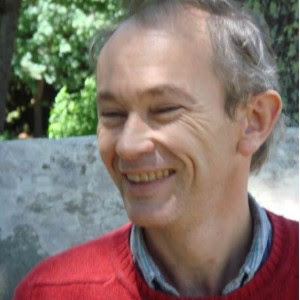
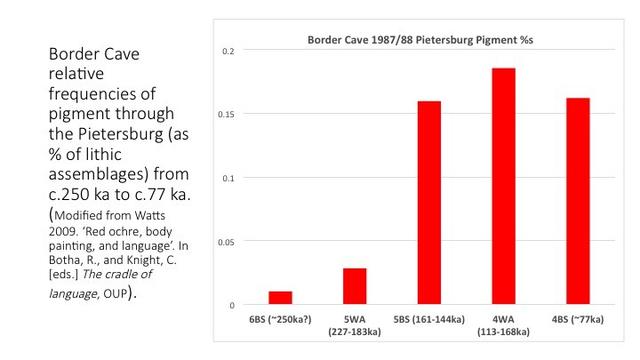
Images: archaeologist Ian Watts, and a slide of his analysis of ochre frequency at Border Cave, which jumps between c.180 to c.160 ka
 MU-Peter Shimon 🀄
 Radical Anthropology