Like a Million Pounds…

I’ve come down with some sort of lurgy and had to cancel a tutorial that was due to take place today, which I am sorry about. I did, however, manage to rise from my sick bed earlier this morning to publish a paper at the Open Journal of Astrophysics. When I checked the publishing dashboard I saw that this one is paper No. 425. This is a significant figure if you reckon by the cost of an Article Processing Charge (APC) at Monthly Notices of the Royal Astronomical Society. The current APC is £2356 per paper. If you multiply this by 425 the result is just over a million pounds (£1,001,300 to be exact). The Open Journal of Astrophysics, being a Diamond Open Access journal, is totally free for authors.

I mentioned a couple of weeks ago, that this is a small fraction of the money being wasted by the astronomical community worldwide on publication charges but if even a small operation like ours can save a million pounds, just think of what could happen if we all published this way! For one thing, there would certainly be more money available for actual research. That doesn’t only go for astronomy, of course: almost every scientific discipline is being ripped off by publishers who have hijacked the Open Access movement to generate income from APCs.

I’ll repeat the quotation I posted yesterday about a scandal relating to corporate publishing giant Elsevier

The scandal exposes the windfall profits of scientific publishers, who in recent years have amassed billions of dollars in earnings from public funds earmarked for science.

It’s a shocking idea, I know, but what if we spent public funds on what they are supposed to be spent on rather than handing millions to greedy publishers?

#apc #articleProcessingCharge #diamondOpenAccess #mnras #monthlyNoticesOfTheRoyalAstronomicalSociety #openAccess #openJournalOfAstrophysics #theOpenJournalOfAstrophysics

Money and Open Access

I was thinking when I did Saturday’s update of the week’s new papers at the Open Journal of Astrophysics that I should convey some idea of the amount of money being saved by using Diamond Open Access.

So far this year we have published 181 articles in the Open Journal of Astrophysics. That’s a very small fraction – a few percent – of the output of the established journals in the area, Astrophysical Journal, Astronomy & Astrophysics and Monthly Notices of the Royal Astronomical Society, MNRAS.

I will take MNRAS as an example for comparison. Last time I looked, the Article Processing Charge (APC) (i.e. publication fee) for a paper submitted there is £2356. Our 181 papers published this year would have cost their authors £426,436 had they had to pay the MNRAS APC. Some – especially in the UK – do not pay directly, but have an equivalent amount taken from their institution(s) via Read-and-Publish agreements. The charge therefore does not come directly from the authors’ funds but from their institution, but that is just splitting hairs. The point about OJAp is that neither authors nor their institutions have to pay.

For comparison, a year’s stipend for a PhD student outside London at UKRI rates is £20,780. That means that the total amount saved by publishing in OJAp rather than MNRAS (£426,436) would be more than the cost of 20 PhD students. It might even be enough (just) to pay your Vice-Chancellor’s salary…

You might well think that is a trivial amount of money compared to the total circulating in science funding, but the real point is that it represents only a tiny fraction of the money being siphoned off from astrophysics research into other activities. Taking all the APCs paid (or page charges or other words that mean “publication fee”) to all the journals, the total figure is probably at least 50 times the £426,436 obtained above. That would be a figure in excess of £20 million. That is not a trivial amount of money. Even for a Vice-Chancellor.

Wouldn’t you and your institution rather keep your grant funds to spend on research than hand it over – directly or indirectly – to publishers? I know I would!

#apc #articleProcessingCharge #diamondOpenAccess #mnras #monthlyNoticesOfTheRoyalAstronomicalSociety #openJournalOfAstrophysics #scientificPublishing #theOpenJournalForAstrophysics

The Global Cost of “Article Processing Charges”

There’s an article on arXiv with the title Estimating global article processing charges paid to six publishers for open access between 2019 and 2023 and the following abstract

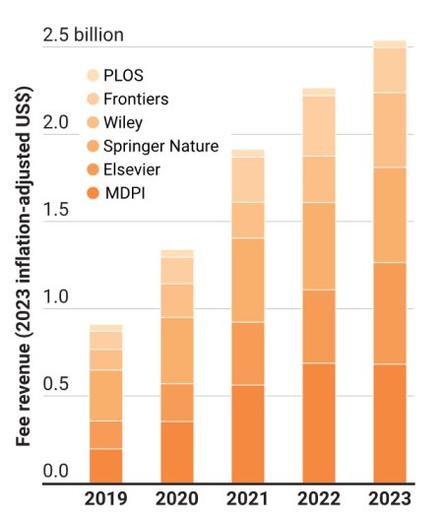
This study presents estimates of the global expenditure on article processing charges (APCs) paid to six publishers for open access between 2019 and 2023. APCs are fees charged for publishing in some fully open access journals (gold) and in subscription journals to make individual articles open access (hybrid). There is currently no way to systematically track institutional, national or global expenses for open access publishing due to a lack of transparency in APC prices, what articles they are paid for, or who pays them. We therefore curated and used an open dataset of annual APC list prices from Elsevier, Frontiers, MDPI, PLOS, Springer Nature, and Wiley in combination with the number of open access articles from these publishers indexed by OpenAlex to estimate that, globally, a total of $8.349 billion ($8.968 billion in 2023 US dollars) were spent on APCs between 2019 and 2023. We estimate that in 2023 MDPI ($681.6 million), Elsevier ($582.8 million) and Springer Nature ($546.6 million) generated the most revenue with APCs. After adjusting for inflation, we also show that annual spending almost tripled from $910.3 million in 2019 to $2.538 billion in 2023, that hybrid exceed gold fees, and that the median APCs paid are higher than the median listed fees for both gold and hybrid. Our approach addresses major limitations in previous efforts to estimate APCs paid and offers much needed insight into an otherwise opaque aspect of the business of scholarly publishing. We call upon publishers to be more transparent about OA fees.

Haustein et al., arXiv:2407.16551

I must have missed when it was submitted last July, but it has recently been doing the rounds on BlueSky which is how I noticed it. Here is the salient figure:

The paper estimates that over $8 billion has been wasted on “Article Processing Charges” (APCs) in the 5-year period covered. I put “Article Processing Charges” in inverted commas because, as I have said on many occasions, these fees have nothing to do with the cost of processing an article. They are simply charges levied by publishers to increase their profits.

The last sentence of the abstract “We call upon publishers to be more transparent about OA fees” is nowhere near as forceful as it should be. These charges are a scam and academia should not be feeding these parasites. A tiny fraction of that $8 billion would be enough to set up repositories similar to arXiv for all academic disciplines which would make OA publishing free to authors.

#ArticleProcessingCharge #arXiv240716551 #OpenAccess

Estimating global article processing charges paid to six publishers for open access between 2019 and 2023

This study presents estimates of the global expenditure on article processing charges (APCs) paid to six publishers for open access between 2019 and 2023. APCs are fees charged for publishing in some fully open access journals (gold) and in subscription journals to make individual articles open access (hybrid). There is currently no way to systematically track institutional, national or global expenses for open access publishing due to a lack of transparency in APC prices, what articles they are paid for, or who pays them. We therefore curated and used an open dataset of annual APC list prices from Elsevier, Frontiers, MDPI, PLOS, Springer Nature, and Wiley in combination with the number of open access articles from these publishers indexed by OpenAlex to estimate that, globally, a total of \$8.349 billion (\$8.968 billion in 2023 US dollars) were spent on APCs between 2019 and 2023. We estimate that in 2023 MDPI (\$681.6 million), Elsevier (\$582.8 million) and Springer Nature (\$546.6) generated the most revenue with APCs. After adjusting for inflation, we also show that annual spending almost tripled from \$910.3 million in 2019 to \$2.538 billion in 2023, that hybrid exceed gold fees, and that the median APCs paid are higher than the median listed fees for both gold and hybrid. Our approach addresses major limitations in previous efforts to estimate APCs paid and offers much needed insight into an otherwise opaque aspect of the business of scholarly publishing. We call upon publishers to be more transparent about OA fees.

arXiv.org

Page Charges at A&A

The journal Astronomy & Astrophysics (A&A for short) announced last week that it was increasing page charges on longer papers. The table of new charges to be implemented is here:

A&A is published on behalf of the European Southern Observatory by EDP Sciences (Édition Diffusion Presse Sciences) which began life as a joint venture of four French learned societies in science, mathematics, and medicine. The company was acquired in 2019 by  China Science Publishing & Media (which has headquarters in Beijing). Judging by its social media activity, EDP Sciences sees A&A as a flagship journal; for a list of other journals it runs see here. I gave some background on A&A here.

A&A publishes papers through a curious hybrid model called “S2O” (Subscribe to Open; not to be confused with “420”). This is not fully Open Access because it requires libraries to pay a subscription to access the journal. For this reason it is not compatible with some institutional open access policies. Unlike some journals, however, A&A does allow authors to place their papers on arXiv without restriction, so they can be read there for free. Previously A&A required authors (or their institutes) to pay “Page Charges” – essentially an Article Processing Charge (APC) – if they were not from a “member country”; this policy was introduced in 2020. Authors from a member country will now have to pay APCs to publish (if their paper exceeds the page limit) but their institutional libraries still have to pay a subscription if they are to access the paper. In other words, A&A is double-dipping.

According to A&A,

… the average length of papers has also been increasing. Too often, papers are longer than necessary, leading to increased workload for authors, referees, and editors, and hindering the reader’s ability to efficiently grasp their content. As well as needing logistical consideration, the challenges related to the journal’s growth have financial implications that must be addressed to ensure long-term sustainability.

I agree that many papers are far too long. As a journal Editor myself I know that it is much harder to find people willing to review very long papers, a fact that some authors seem reluctant to recognize. On the other hand I very much doubt that any of the funds generated by page charges will be given to the refeees who do the most important – indeed I would argue the only important – work of a journal.

If the desired effect is to reduce the number of long papers this policy may work, though I suspect authors who are incurably prolix will respond by splitting their work into several shorter papers to avoid the page charges and thereby generating even more work for the journal. I suspect however that the desired effect is really to increase revenue; so often in the context of academic publishing “sustainability” really means “profitability”. I would also bet that these charges will increase further in future.

The changing charges at A&A have widespread implications, including for the Euclid Consortium, most of whose scientific papers are published there. I’m sure the Euclid Consortium Editorial Board will discuss this development. I’m not a member of the ECEB so it would be inappropriate to comment further on publication policy so I’ll leave the discussion to them. I would say, however, that the publication process at A&A is rather slow. The main post-launch Euclid Overview paper by Mellier et al., for example, was accepted for publication in August 2024 but has still not appeared. It is, however, available on arXiv, which is all that really matters. That paper, incidentally, is over 90 pages long. According to the table above that would cost about €12,000 in page charges. It was submitted in May 2024 and accepted quite quickly but is planned to appear in a special issue Euclid on Sky the publication of which is being delayed by other papers still going through the editorial process.

(Incidentally, Mellier et al. has already acquired 157 citations despite not yet being officially published, which illustrates how little difference “official” publication is actually worth.)

#ArticleProcessingCharge #AstronomyAstrophysics #EuclidConsortium #OpenAccessPublishing #pageCharges #S20
Astronomy & Astrophysics (A&A)

Astronomy & Astrophysics (A&A) is an international journal which publishes papers on all aspects of astronomy and astrophysics

This morning I published a paper at the Open Journal of Astrophysics that brought the total number of publications there to 217. That may not seem a very significant number but I’ve had it in the back of my mind for some time. Some time ago Monthly Notices of the Royal Astronomical Society (MNRAS) decided to go Gold Open Access, charging a baseline APC of £2310 per article. I know that cost is not paid directly by authors from institutions with Read and Publish agreements with Oxford University Press (the publisher ofn MNRAS) but that doesn’t mean that it’s free: funds are still siphoned off from library budgets.

Anyway, taking the indicative cost of an APC to be the £2310 charged by MNRAS – some journals charge a lot more – the fact that we have published 217 papers means we have now saved the astronomical community around 217 × £2310 which is over £500k (€600k) in APCs. The cost to us is just a few percent of that figure.

The issue of University funding is a very live one in England, in Ireland and in The Netherlands. None of the financial crises can be solved completely by moving away from APCs but there is no justification at all for continuing to hand millions per year out of a shrinking pot over to greedy publishers. Surely this is an excellent time for Higher Education Institutions collectively to make a decisive move in the direction of Diamond Open Access?

https://telescoper.blog/2024/11/07/saving-money-via-diamond-open-access/

#ArticleProcessingCharge #DiamondOpenAccessPublishing #MNRAS #MonthlyNoticesOfTheRoyalAstronomicalSociety #OpenAccess #TheOpenJournalOfAstrophysics

Star formation in the high-extinction Planck cold clump PGCC G120.69+2.66 | Published in The Open Journal of Astrophysics

By Anlaug A. Djupvik, João L. Yun & 1 more. Using imaging and spectroscopy to identify sites of star formation in a molecular cloud.