 SnookerPRO
What are the reasons behind the rising of Snooker in China and the decline in the UK? Our guest author Mike Cormack offers some informed speculations. This is the first part of a loose series on several snooker related subjects by him.
Having lived and worked in China for fifteen years, I’d like to offer some speculations as to why China is rising and the UK declining when it comes to producing snooker talent. The issue isn’t simply population, for the Chinese national team still fails to qualify for football World Cups. That is an entire book-long story in itself, but suffice it to say just having the numbers and even ample finances is not enough. The issue is about culture and space – the extent to which a society fosters, accommodates, and values the conditions for mastery.
Firstly, snooker obviously demands intensive practice. We’re talking eight-to-ten hours a day, full-time, monastic devotion to the baize. Stephen Hendry writes eloquently in his autobiography how painful moving to professional level practice was, but how essential it was to elevating his game to winning tournaments. I sometimes wonder if, in the UK, there is less cultural space for such intensities. We still applaud sporting and artistic brilliance, but pursuits that require long, disciplined graft — chess, programming, poetry, Dungeons & Dragons, electronic music — are often treated as eccentric, even nerdy. Too often, their enthusiasts feel the need to apologise for caring.
Patience and focus in a fast world
This is not to say Britain lacks talent or hard work – far from it – but that our cultural vocabulary for celebrating discipline has thinned. Focus, patience, and the long, unglamorous work of mastery now struggle to compete with the appeal of instant gratification. It wasn’t always like this. Channel 4 once broadcast the Nigel Short–Garry Kasparov chess match live. Play for Today drew national audiences for serious drama, and Despatch Box was a far more mature and serious TV show on politics than The Daily Politics. Martin Amis recalls in Experience how Philip Larkin’s anthology of twentieth-century verse sparked fierce, public debate in 1973. That kind of intellectual engagement has become rarer. And in 2025, it is telling that increasing numbers of UK and US undergraduates say they cannot read entire books. By contrast, when I taught a top-set English class in a Chinese high school, in a single year we tackled Wilde, Forster, Shakespeare, Golding, lots of poetry, and creative writing. I adored that class. They worked their socks off.
I’m not trying to claim some kind of essentialism – to say that Chinese people work harder than lazy Europeans. I have certainly taught numerous lazy Chinese students. But I know that the Chinese who want to succeed understand that dedication is non-negotiable. They know progress is perspiration. Whereas the gifted people I’ve met in the UK have so often been reluctant to pursue their talent with the necessary devotion. Take myself as an example. At 15, I had a creative breakthrough in my writing. But I lacked the mentality and social encouragement to pursue it. It wasn’t until I moved to China that I found a writing opening. And once I had the opportunity, I worked like hell, doing columns, copy-editing, event coverage. In eighteen months I went from freelance contributor to editing a Beijing magazine. This wasn’t quite potting balls at dawn or running marathons before school, but it taught me what the Chinese already knew: talent without effort is nothing. In China, this is basic stuff. Competition is ferocious in every area. The acceptance rate at Tsinghua University, China’s equivalent of Oxford or MIT, is estimated at 0.1–0.3%. By comparison, Harvard accepts around 3.5%. The university entrance exam, the gaokao, is a national ordeal. Students are expected to study 16 to 18 hours a day for it. That’s not hyperbole.
Snooker clubs in China with high standard
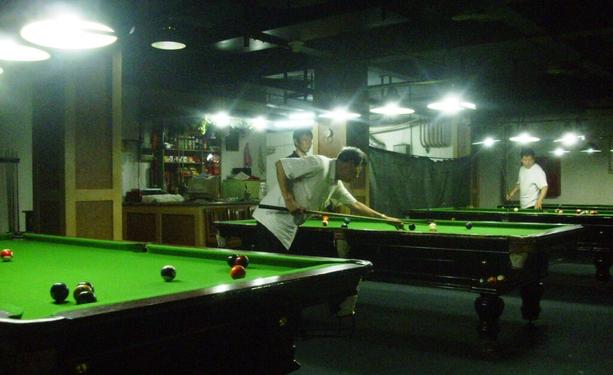
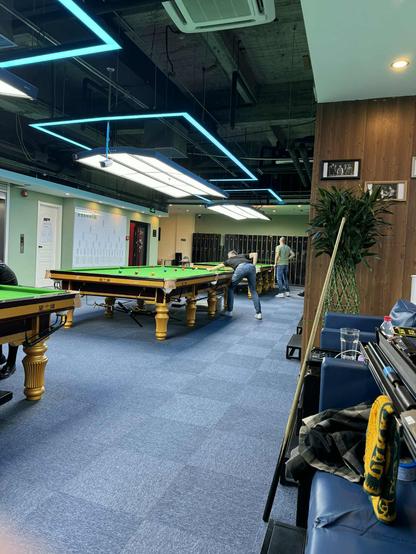
The other key factor is space. China has greatly overbuilt in the last twenty years. A residential and commercial bubble has left more buildings than businesses, which means commercial space is plentiful – and pool halls are everywhere. There’s one in every neighbourhood, pretty much. When I first arrived in China in 2007, the local one was a smoky, dank venue with actual spittoons, ageing tables and toilets that defy polite description. (We called it “the beer pit”, but that didn’t stop me playing eight hours a day there when I could). Nowadays they are generally clean, warm, with new tables, decent cues and unchipped balls. Normally there are around 10 pool tables and two or three snooker tables in the average club. Enough for everyone. Prices are reasonable, around RMB30 (£3.35) per hour. Alcohol seems to have vanished from most of them, for whatever reason. People come to play, not piss about. And they do.
The contrast with the UK is profound. Jason Ferguson, chairman of the WPBSA (the world snooker ruling body), noted in a recent interview with Stephen Hendry that the main issue affecting the game is facilities, and that “the average club is under threat of closure at all times. That is not because they’re not busy. It’s not because it’s not a good business. It’s because every landlord wants to turn it into flats.” Consequently, the WPBSA have been lobbying the government to protect some clubs as “buildings of community interest, and the number has actually grown each year in the past two years.”
While praiseworthy, that is from a very low ebb. In the 1990s, venue operator Rileys had 165 snooker, pool and sports venues across the UK; its website today (August 2025) lists only fifteen. In “Changing Britain through the frame of snooker” (2024), Dr Alex Rhys-Taylor notes: “A survey of the last two year’s local news stories reveal more recent cases of doors being shuttered in Romford, Stoke, Glasgow, Belfast, Grays, Brighton, Stockport, Bury, Hornchurch, Southampton and Dennistoun. Online message boards report stories of further closures from Nottingham, Milton Keynes, Belfast, Edinburgh, Stevenage and Luton.”
Need for Cultural Space
We have so much to re-learn as a society. The issue is simple. Talent grows when it has non-commercial space in which to develop. Non-commercial space is the precondition of mastery. If we reduce the fabric of our villages, towns and cities to only profit centres, we are choking the lifeblood of every single cultural activity. The shuttering and gentrification of all those working men’s clubs, leisure centres and village halls has caused a slow cultural collapse. No wonder people in Britain seem increasingly unhappy. Orwell once noted that the British were a nation of hobbyists, but we increasingly can’t find the spaces for them. Lottery funding might have transformed athletics, but that requires dedicated facilities and funding. Snooker however has been left to itself and so has withered on the vine, like all other activities not at heart moneymaking pursuits. Even pool tables in pubs are becoming harder to find.
If we accept that property is only about commercial value rather than social utility, we are going to make UK towns and cities deserts of opportunity, not just for snooker but for anything sustaining communities. An endless vista of atomised, fragmented individuals cut off from each other in commuter towns or low-density cities, only to work, eat and sleep. What a grim thought.
Thank you, Mike, for sharing your thoughts with us and our readers.
Lula
Team SnookerPRO
Public snooker club in Beijing, China in 2024 © Chris Watts
https://snookerpro.de/artikel/snooker-in-china-and-uk-a-cultural-litmus-paper/