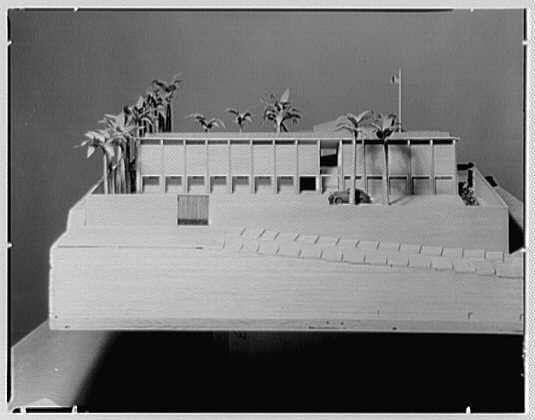
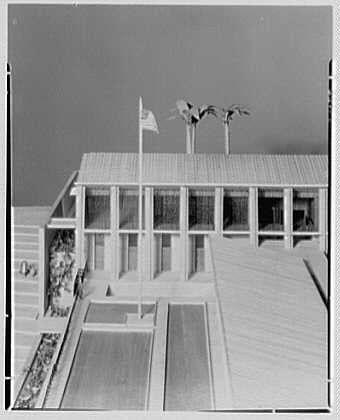
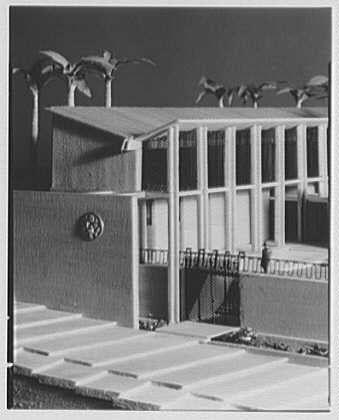
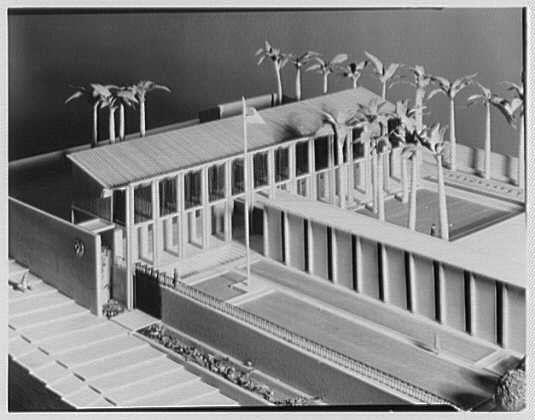
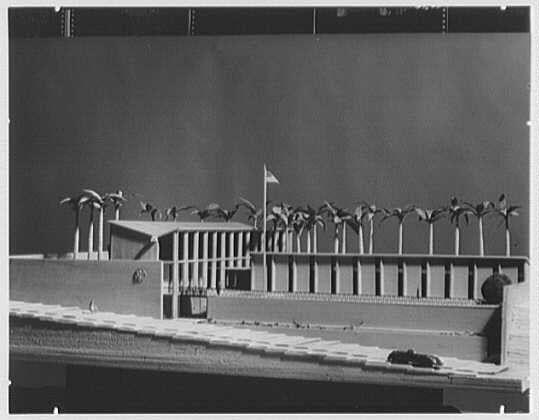
Hare and Hatch, 125 Broad St., New York City. Model of State Department embassy at Honduras V 1954 Oct. 13.
Gottscho-Schleisner, Inc.
1 negative : safety ; 4x5 in.

#Hatch #BroadSt #NewYorkCity #StateDepartment #Honduras #Gottscho-Schleisner #America #Architecturalmodels #Embassies #NewYork #NewYork(State) #UnitedStates #architecture #photography

https://www.loc.gov/item/2018727054/

Hare and Hatch, 125 Broad St., New York City. Model of State Department embassy at Honduras IV 1954 Oct. 13.
Gottscho-Schleisner, Inc.
1 negative : safety ; 4x5 in.

#Hatch #BroadSt #NewYorkCity #StateDepartment #Honduras #Gottscho-Schleisner #America #American #Architecturalmodels #Embassies #NewYork #NewYork(State) #UnitedStates #architecture #photography

https://www.loc.gov/item/2018727053/

Hare and Hatch, 125 Broad St., New York City. Model of State Department embassy at Honduras III 1954 Oct. 13.
Gottscho-Schleisner, Inc.
1 negative : safety ; 4x5 in.

#Hatch #BroadSt #NewYorkCity #StateDepartment #Honduras #Gottscho-Schleisner #theStateDepartments #Architecturalmodels #Embassies #NewYork #NewYork(State) #UnitedStates #architecture #photography

https://www.loc.gov/item/2018727052/

Hare and Hatch, 125 Broad St., New York City. Model of State Department embassy at Honduras II 1954 Oct. 13.
Gottscho-Schleisner, Inc.
1 negative : safety ; 4x5 in.

#Hatch #BroadSt #NewYorkCity #StateDepartment #HondurasII #Gottscho-Schleisner #theStateDepartments #Hare&Hatch #4x5inches #Architecturalmodels #Embassies #NewYork #NewYork(State) #UnitedStates #architecture #photography

https://www.loc.gov/item/2018727051/

Hare and Hatch, 125 Broad St., New York City. Model of State Department embassy at Honduras I 1954 Oct. 13.
Gottscho-Schleisner, Inc.
1 negative : safety ; 4x5 in.

#Hatch #BroadSt #NewYorkCity #StateDepartment #Honduras #Gottscho-Schleisner #Architecturalmodels #Embassies #NewYork #NewYork(State) #UnitedStates #architecture #photography

https://www.loc.gov/item/2018727050/

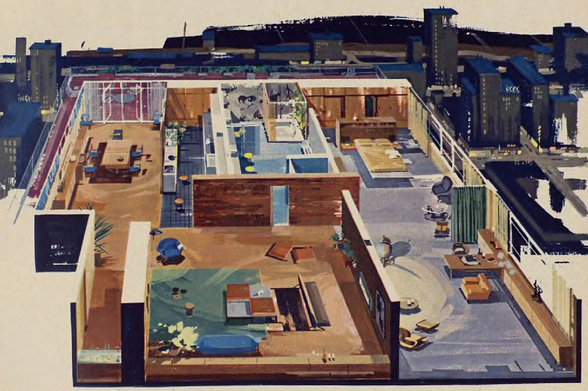
1956 Architectural Plans for a Building

The image displays architectural floor plans and elevations of a multi-story building, rendered in a detailed line art style.
It is presented as a collection of drawings on a white background.
The building features various rooms, including what appears to be living spaces, kitchens, bathrooms, and storage areas.
There are also indications of outdoor spaces such as balconies and courtyards.
The plans show different levels of the structure, with lines representing walls, doors, windows, and other architectural elements.
There is a clear representation of stairs, hallways, and rooms with furniture or other contents.

https://nocontext.loener.nl/fullpage/10-October1956-Page-062.png

#photography #illustration #madman #nocontext #sfw #architecture #floorplans #elevationdrawings #buildingdesign #constructionblueprints #layouts #engineeringdiagrams #urbanplanning #architecturalmodels #designsketches

A building imagined now a miniature model on a table. A complex feeling now written on a page. A crazy idea now scribbled on a napkin. Thoughts now ‘things’ to be pondered, touched and exchanged. All good to think with. From thought to thing and back again.

#architecturalmodels #architecture

Nicolas Laisnè imagines new type of high-rise that combines living and working

French architect Nicolas Laisnè has contributed to the Venice Architecture Biennale with a concept for high-rise buildings that combine live and workspaces, indoor and outdoor rooms, and various degrees of privacy.

One Open Tower explores how a new breed of tall buildings could help cities become better places to live, giving occupants greater flexibility in their environments, access to nature, and opportunities to interact with one other.

One Open Tower is a concept for a hybrid high-rise

Described by Nicolas Laisné Associés as an "allegory" rather than a specific proposal, the concept features a vertical structure where residential and workspace overlap, and outdoor spaces are as integral as indoor spaces.

Laisnè believes this approach to architecture is better suited to today's lifestyles, where the boundaries between home and work environments are increasingly blurred.

The concept combines live and workspaces and indoor and outdoor rooms

"Functions of buildings are changing a lot right now," explains Laisnè in a video produced ahead of the exhibition. "These are not just working spaces or living spaces. There are co-working, co-living, urban farming, a lot of new uses."

"And so these two types of building slowly come closer and closer to each other," he said. "And I think now, we could adapt these buildings to every function that we need."

The project draws from Anis, a flexible office building with outdoor workspaces

The concept draws on some of the architect's recent built projects, where expansive balconies and roof terraces are a key element of the building.

Examples include Anis, an office block that combines a co-working model with outdoor corridors and workspaces, and L'Arbre Blanc, a residential tower designed in collaboration with Japanese architect Sou Fujimoto, where homes spill out onto large cantilevered balconies.

L'Arbre Blanc, a residential tower with large balconies, is another inspiration

These designs take on greater resonance in light of the Covid-19 pandemic, which has fuelled both the work-from-home trend and the demand for healthier environments.

"I think architecture can support this new way of life," Laisnè told Dezeen. "People can work everywhere now, and they're used to it. So architects have to rethink ways we can work and live at the same place."

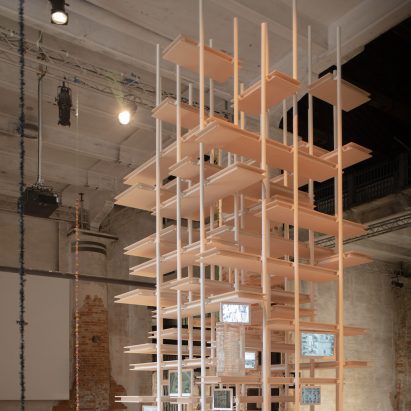
On show in the biennale's Arsenale venue, One Open Tower is represented by a five-metre-high scale model featuring dozens of crisscrossing platforms.

The overlapping nature of the platforms indicates a more multi-functional and open type of building layout. Many of the platforms also extend beyond the main building volume, suggesting that activities spill outdoors.

Video screens and models are slotted in between the floors of the model, showcasing the designs of Anis, L'Arbre Blanc and other Nicolas Laisné Associés projects.

One Open Tower is represented by a five-metre-high scale model

Together, the installation is intended to suggest "a building capable of vertically increasing the living area".

Laisné wants to show that moving out of the city – and the urban sprawl this creates – is not the best way to address our need for more space. He believes urban density offers a much longer list of benefits for people and the planet.

The model is accompanied by a sculptural work by artist Guy Limone

He also believes that as climate change ramps up, people will be increasingly living and working outdoors.

"This is a new generation of buildings," he said. "We need to answer three questions: global warming, opening our buildings up to neighbourhoods, and supporting news ways of living."

"With global warming coming, we are going to live more outside," he continued. "I propose buildings with very large balconies and outside spaces. These spaces protect the facade from the sun and allow people to live outside."

Limone's colourful, suspended characters represent data about household sizes

The exhibition forms part of As New Households, a section of the biennale's main exhibition curated by biennale director Hashim Sarkis. Also in this section is Bit.Bio.Bot, an installation that explores the potential of algae in the home.

One Open Tower is accompanied by a sculptural work by French artist Guy Limone, which imagines the people that might inhabit the tower. His colourful characters, suspended on pieces of string, represent data about household sizes.

By showing the growing trend for living alone, and the issues that this brings, Laisné hopes to show the importance of a rethink.

One Open Tower is on display at the Arsenale for part of the Venice Architecture Biennale, which takes place from 22 May to 21 November 2021.See Dezeen Events Guide for all the latest information you need to know to attend the event, as well as a list of other architecture and design events taking place around the world.

The post Nicolas Laisnè imagines new type of high-rise that combines living and working appeared first on Dezeen.

#all #architecture #installations #conceptualarchitecture #nicolaslaisnéassociés #venicearchitecturebiennale #architecturalmodels
Nicolas Laisnè imagines new type of high-rise that combines living and working

French architect Nicolas Laisnè has contributed to the Venice Architecture Biennale with a concept for high-rise buildings that combine live and work spaces, indoor and outdoor rooms, and various degrees of privacy.

EFFEKT plants 1,200 trees to grow during the Venice Architecture Biennale

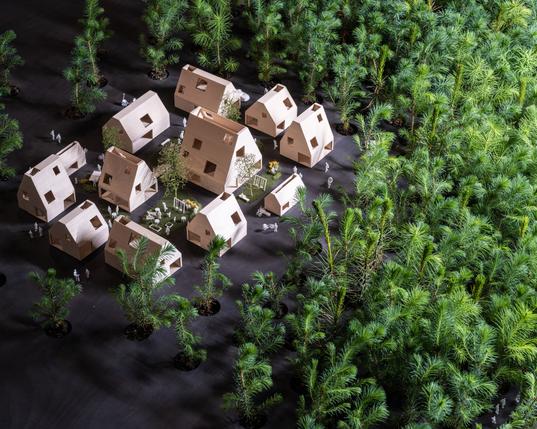
Danish architecture studio EFFEKT has planted hundreds of pine seedlings around seven architectural models at the Venice Biennale using a hydroponics system that's remote-controlled from Copenhagen.

The installation is called Eco to Ego and responds to the biennale's theme, a question posed by the Venice Architecture Biennale's 2021 curator Hashim Sarkis: How will we live together?

EFFEKT's exhibition is called Eco to Ego

The seven models represent different research and design projects by EFFEKT that the studio feels answers this theme.

EFFEKT planted 1,200 one-year-old trees of four different species for the exhibition – Scots Pine (Pinus Sylvestris), Norway Spruce (Picea Abies), Sitka Spruce (Pinus Sitchensisa) and Hybrid Larch (Larix Eurolepis.)

The 1,200 seedlings grow in a hydroponic system

These seedlings sit in a hydroponic growing system that circulates water and nutrients around their roots. Hydroponics is a system of horticulture that grows plants without using soil.

Excess water drains into a tank below the planter that holds the system, called a grow table.

An architectural model of EFFEKT's forest tower for Denmark

Sensors monitoring the pressure, humidity, and temperature allow EFFEKT to monitor and control the system in real-time from their office back in Copenhagen.

The trees will grow in the exhibition hall at the Venice Architecture Biennale for six months. After the biennale finishes, EFFEKT will take them back to Denmark and plant them as part of an urban reforestation project.

The studio estimates that these trees will be able to absorb over 1,000 tons of carbon dioxide over the next 50 years.

Water and nutrients is pumped through the tree roots

"Ego to Eco is built upon the idea of creating an exhibition with a lasting positive impact," said EFFEKT.

"Considering social, environmental and economic aspects of any project can help address some of the greatest challenges we face as a result of our human existence."

Models of the studio's projects featured in the exhibition include The Forest Tower, a 45-metre-high helical tower built from weathering steel that the studio built in Gisselfeld Klosters Forest.

There is also a model of The Urban Village Project, a design for a co-living neighbourhood with urban farms created by EFFEKT with IKEA's research lab Space10.

The pine seedlings will grow for six months as part of the exhibition

"These projects offer potential solutions to the challenges of today and depict what it means to think and design ecosystems," said the studio.

"They investigate new ideas for living and building, for producing, consuming and revitalizing the ecosystems we are part of and depend upon."

Afterwards, the trees will be planted as an urban forest in Denmark

Trees and nature have emerged as a major theme for the Venice Architecture Biennale 2021.

A rainwater system has been installed inside the Danish pavilion and a 12-metre-high frame made of pine has been erected around the US pavilion to highlight wood as a sustainable construction material.

Photography is by Rasmus Hjortshøj.

The post EFFEKT plants 1,200 trees to grow during the Venice Architecture Biennale appeared first on Dezeen.

#all #architecture #landscapeandurbanism #trees #effekt #venicearchitecturebiennale #architecturalmodels #pine

EFFEKT plants 1,200 trees to grow during the Venice Architecture Biennale

EFFEKT has planted hundreds of pine seedlings around seven architectural models using a hydroponics system that's remote-controlled from Copenhagen.