Anonymous credentials: an illustrated primer (Part 2)

This is the second in a series of posts about anonymous credentials. You can find this first part here. In the previous post, we introduced the notion of anonymous credentials as a technique that a…

A Few Thoughts on Cryptographic Engineering

#AnonymousCredentials #Unobservability #Unlinkability. #EU_ID_Wallet #eudi #EUID

I have been very sceptic, but recently some people could give me very interesting and convincing insights. And if even the talk at #38c3 and Anja and Thomas are in favor of this, then it can't be that wrong.
https://youtu.be/PKtklN8mOo0?si=DApn26hoxPDTNTVx

38C3 - EU's Digital Identity Systems - Reality Check and Techniques for Better Privacy

YouTube

Nice, in-depth article on anonymous-credentials and its challenges:

https://blog.cryptographyengineering.com/2026/03/02/anonymous-credentials-an-illustrated-primer/

Anonymous credentials and the related term zero-knowledge proof are core building blocks for privacy-preserving online age verification.

As I understand, the age verification Australia currently requires to upload a legal document (e.g. a driver's license or government ID), or requires proof by doing a "video self". Both techniques would not be privacy-preserving, because in both cases you are sharing personal information with a company (e.g. Meta).

Cryptography like anonymous credentials solves that problem. At least in theory. You can prove your age, and the other side does not learn anything else about you. Still, to roll it out in real-world scenarios there are many challenges (e.g. dealing with attacks like credential theft).

Side-note: the EU proposal is also built on the same type of cryptography: https://ageverification.dev/av-doc-technical-specification/docs/architecture-and-technical-specifications/

#crypto #AnonymousCredentials #ageverification

Anonymous credentials: an illustrated primer

This post has been on my back burner for well over a year. This has bothered me, since with every month that goes by, I become more convinced that anonymous authentication the most important topic …

A Few Thoughts on Cryptographic Engineering
Anonymous credentials: an illustrated primer

This post has been on my back burner for well over a year. This has bothered me, since with every month that goes by, I become more convinced that anonymous authentication the most important topic …

A Few Thoughts on Cryptographic Engineering
Anonymous credentials- rate-limiting bots and agents without compromising privacy

As AI agents change how the Internet is used, they create a challenge for security. We explore how Anonymous Credentials can rate limit agent traffic and block abuse without tracking users or compromising their privacy.

The Cloudflare Blog

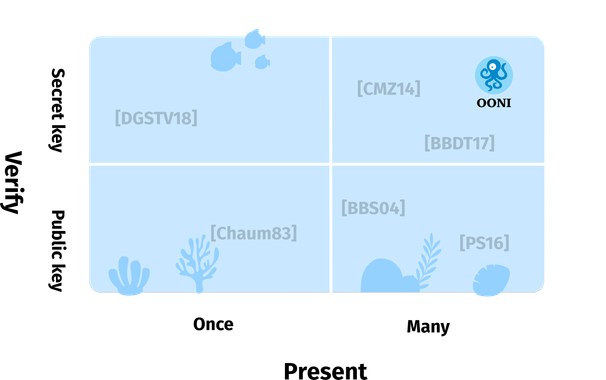
How to protect the OONI dataset from attacks, while preserving the privacy of OONI Probe users?

In our latest blog post, we outline some of the key requirements for OONI's anonymous credential system: https://ooni.org/post/2025-requirements-for-oonis-anonymous-credentials/

#AnonymousCredentials #ooniprobe #ooni

Requirements for OONI’s anonymous credentials system

Designing and implementing an anonymous credential system for OONI requires balancing trust in our measurements and the privacy of our users. Our goal is to enrich our measurements with metadata that strengthen their reliability, while maintaining the strong privacy guarantees our users expect.

We are excited to share that we are designing & implementing anonymous credentials within OONI Probe to protect and increase trust in OONI data. 🐙🛡️

Learn more through the literature review on anonymous credentials by Michele Orrù: https://ooni.org/post/2025-probe-security-without-identification/ 💫

#ooni #ooniprobe #anonymouscredentials #opendata #security

Probe Security Without Identification

An overview of the current literature on anonymous credentials and how we will be designing and implementing an anonymous credential system for use in OONI Probe.

Here we go again! This time we have a couple of interesting papers on blockchain-related vulnerabilities, an attack against a lightweight stream cipher, an attack against key-store values, a little something about how hard SBOM¹ can be and a couple of hardware security papers.

* "An Empirical Study of Impact of Solidity Compiler Updates on Vulnerabilities in Ethereum Smart Contracts"
* "Security Analysis of WG-7 Lightweight Stream Cipher against Cube Attack"
* "Prefix Siphoning: Exploiting LSM-Tree Range Filters For Information Disclosure"
* "How to Bind Anonymous Credentials to Humans"
* "Challenges of Producing Software Bill Of Materials for Java"
* "Security Analysis of the WhatsApp End-to-End Encrypted Backup Protocol"
* "The curious case of the half-half Bitcoin ECDSA nonces"
* "X-ray: Discovering DRAM Internal Structure and Error Characteristics by Issuing Memory Commands"
* "Benchmarking and modeling of analog and digital SRAM in-memory computing architectures"
* "(M)WAIT for It: Bridging the Gap between Microarchitectural and Architectural Side Channels"

#Ethereum #Solidity #WG7 #Cryptography #KeyStore #Privacy #AnonymousCredentials #SBOM #Java #SoftwareBillOfMaterials #WhatsApp #E2E #Bitcoin #EDCSA #DRAM #SRAM #SideChannelAttacks

__
¹ Software Bill Of Materials.