🧠✨ Season 2 · Episode 4 is live!
We dive into analytic tools behind arithmetic functions setting the stage for computation and code.
From theory ➜ algorithms.
🔗 Link: https://cortexdrifter.blogspot.com/2026/03/a-small-taste-from-my-new-book-season-2_14.html
#MathTalks #NumberTheory #AnalyticNumberTheory #Maths
A Small Taste from My New Book: Season 2 Episode 4

Explorations in analytic number theory, asymptotic analysis, and unsolved problems, written by a mathematician and software engineer.

🧠 Season 2 · Episode 3 is live!
What really lies behind formulas involving the zeros of ζ(s)? In this episode, we slow things down and unpack symmetry, convergence, and the functional equation—showing why certain identities aren’t formal tricks, but inevitable consequences of the analytic structure itself.
No steps skipped. No magic. Just clarity.
#Math #AnalyticNumberTheory #RiemannZeta #ComplexAnalysis #MathTalks
https://cortexdrifter.blogspot.com/2026/03/a-small-taste-from-my-new-book-season-2_8.html
A Small Taste from My New Book: Season 2 Episode 3

Explorations in analytic number theory, asymptotic analysis, and unsolved problems, written by a mathematician and software engineer.

The Riemann Hypothesis, explained - Cantor’s Paradise

You remember prime numbers, right? Those numbers you can’t divide into other numbers, except when you divide them by themselves or 1? Right. Here is a 3000 year old question: Present an argument or…

Cantor’s Paradise
The Search for Siegel Zeros - Numberphile

YouTube
Math folks, I don't know anything analytic number theory, but Yitang Zhang's preprint on Landau-Siegel zeros is up now at https://arxiv.org/abs/2211.02515. Should I be getting hyped or no?
#AnalyticNumberTheory #YitangZhang
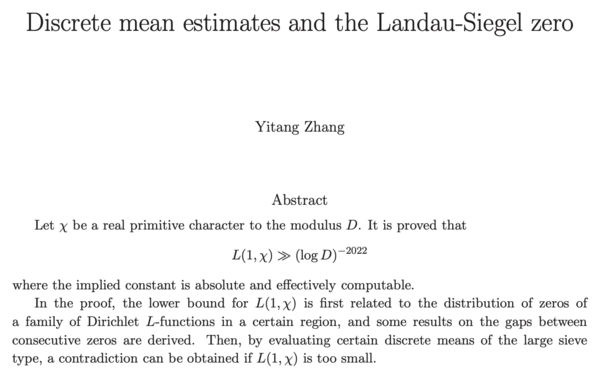
Discrete mean estimates and the Landau-Siegel zero

Let $χ$ be a real primitive character to the modulus $D$. It is proved that $$ L(1,χ)\gg (\log D)^{-2022} $$ where the implied constant is absolute and effectively computable. In the proof, the lower bound for $L(1,χ)$ is first related to the distribution of zeros of a family of Dirichlet $L$-functions in a certain region, and some results on the gaps between consecutive zeros are derived. Then, by evaluating certain discrete means of the large sieve type, a contradiction can be obtained if $L(1,χ)$ is too small.

arXiv.org