
3/
#References-2

[3] Latorre, S.M., Were, V.M., Foster, A.J., et al., 2023. Genomic surveillance uncovers a pandemic clonal lineage of the wheat blast fungus. PLOS Biology 21, e3002052+. https://doi.org/10.1371/journal.pbio.3002052

[4] Callaway, E., 2023. Wheat disease’s global spread concerns researchers. Nature. https://doi.org/10.1038/d41586-023-01043-8

#DOI #WheatBlast #PlantPests #AgriculturalResources

Figure 1 from [3] visually summarises the current status of spread https://journals.plos.org/plosbiology/article?id=10.1371/journal.pbio.3002052#sec002
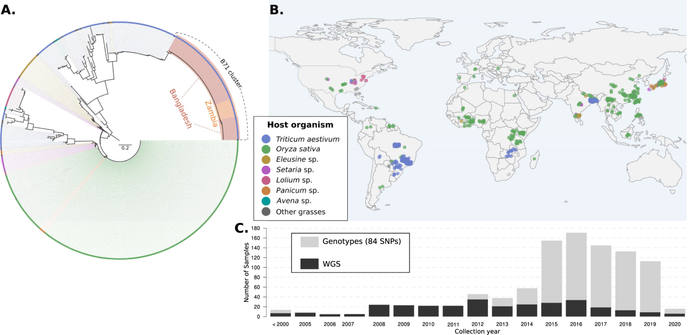
Genomic surveillance uncovers a pandemic clonal lineage of the wheat blast fungus

Wheat, the most important food crop, is threatened by a blast disease pandemic. This study uses genome analyses to track the spread of a clonal lineage of the pandemic blast fungus and to reveal its potential to evolve fungicide-insensitive variants and sexually recombine with African lineages.

2/
#References-1

[1] Callaway, E., 2016. Devastating wheat fungus appears in Asia for first time. Nature 532, 421–422. https://doi.org/10.1038/532421a

[2] Islam, M.T., Croll, D., Gladieux, P., et al., 2016. Emergence of wheat blast in Bangladesh was caused by a South American lineage of Magnaporthe oryzae. BMC Biology 14, 84. https://doi.org/10.1186/s12915-016-0309-7

#DOI #WheatBlast #PlantPests #AgriculturalResources