 Adrián Rico
Sabedes si é posible subscribirse aos podcast de #AGalegaAudio por RSS ou si existe algún workaround?
(Ou si é posible en #AGalega normal, teñen pinta de ser a mesma plataforma, polo que a solución de unha debe servir para a outra).
Sabedes si é posible subscribirse aos podcast de #AGalegaAudio por RSS ou si existe algún workaround?
(Ou si é posible en #AGalega normal, teñen pinta de ser a mesma plataforma, polo que a solución de unha debe servir para a outra).
"#Chido hit Mauritius’ #Agalega atoll last Wednesday at more than 200 kilometers per hour, a force that damaged equipment designed to record wind speed."
“Approximately 95% of buildings including homes, the hospital, the police and the national coast guards facilities in the north island have been destroyed. Around 98% of the infrastructure are completely damaged in the south of the island.”
https://www.bloomberg.com/news/articles/2024-12-17/cyclone-chido-leaves-death-damage-from-mauritius-to-mozambique
#Mauritius
I haven't confirmed this but if true, they had little precedent for extreme hurricane damage. https://twitter.com/BackpirchCrew/status/1867619420753080454
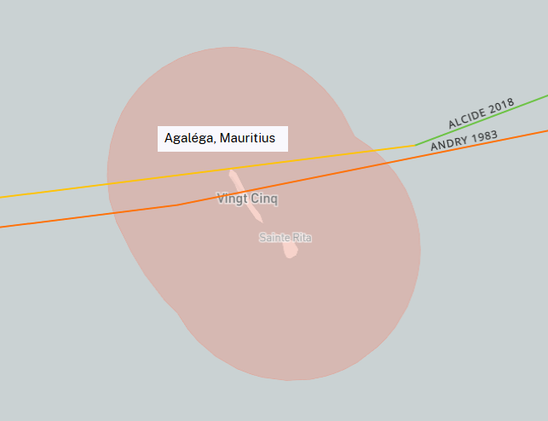
According to NOAA's historical hurricane track database, only two hurricanes have ever passed over #Agalega -- Cat 2 Andry 1983 and Cat 1 Alcide 2018.
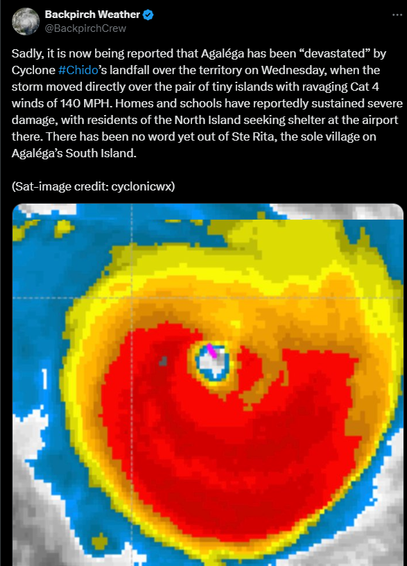

Sadly, it is now being reported that Agaléga has been “devastated” by Cyclone #Chido’s landfall over the territory on Wednesday, when the storm moved directly over the pair of tiny islands with ravaging Cat 4 winds of 140 MPH. Homes and schools have reportedly sustained severe
🔁 Etienne Kapikian (@EKMeteo)
🌀L'oeil du Cyclone Tropical Intense #CHIDO (95 kt) passe directement sur l'archipel d'#Agaléga ce 11 décembre vers 18UTC. Pression de 958 hPa mesurée sur une bouée à proximité. C'est un des plus violents impacts cycloniques sur ce territoire (comparable à ANDRY, 8 décembre 1983)
🐦🔗 https://twitter.com/EKMeteo/status/1866919376571838590
🕐 11/12 19:53

🌀L'oeil du Cyclone Tropical Intense #CHIDO (95 kt) passe directement sur l'archipel d'#Agaléga ce 11 décembre vers 18UTC. Pression de 958 hPa mesurée sur une bouée à proximité. C'est un des plus violents impacts cycloniques sur ce territoire (comparable à ANDRY, 8 décembre 1983)
Las novedades de #AGalega ya están disponibles en #Playmax 👀
Este nuevo servicio ha sido lanzado por la televisión de Galicia y podrás encontrar series como 'DES' o películas como 'La sombra de la ley'.
Lo que es más importante... es GRATIS.

Xabarín oficialmente odia os videos verticais. Modernidades as xustas, moi ben feito.

 Marcos Taracido
 CelloMom On Cars
 WeatherMatrix (Jesse Ferrell)
 Météo Pédagogie
 Roi
Roi cutreflix.com
 Hipólito (Libre de Altri)
 eukesey