 Muki Haklay
Have you ever wanted 15 minutes to talk with an editor about your future paper?
If you’re going to #CAPS2025 in Portland, come to the Editor Rapid Reviews! Get advice on how to turn your ideas into a paper.
#citizenscience #participatoryscience
Sign up for a slot lnkd.in/grkQn726
#AGUPubs
LinkedIn
 Muki Haklay
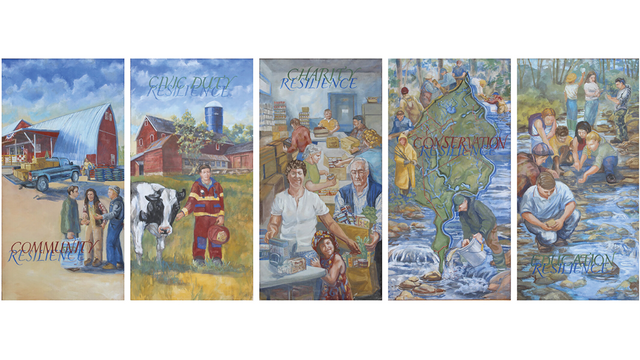
An editor highlight from me on EOS.org https://eos.org/editor-highlights/integrating-science-art-and-engagement-to-strengthen-communities sharing an article from the Community Science journal on using art and science for communicating climate resistance. #CitizenScience #CommunityScience #ClimateChange #Resilience @AGU_Eos #AGUpubs

 Scott Doney
recent article:
“More Than Marine Heatwaves: A New Regime of Heat, Acidity, and Low Oxygen Compound Extreme Events in the Gulf of Alaska”
selected for featuring as an AGU Editor’s Highlight with short write-up in EOS
#AGUpubs #ocean #climate #ClimateChange #acidification
https://eos.org/editor-highlights/compound-extreme-events-threaten-marine-ecosystems
“More Than Marine Heatwaves: A New Regime of Heat, Acidity, and Low Oxygen Compound Extreme Events in the Gulf of Alaska”
selected for featuring as an AGU Editor’s Highlight with short write-up in EOS
#AGUpubs #ocean #climate #ClimateChange #acidification
https://eos.org/editor-highlights/compound-extreme-events-threaten-marine-ecosystems


 Chris Field
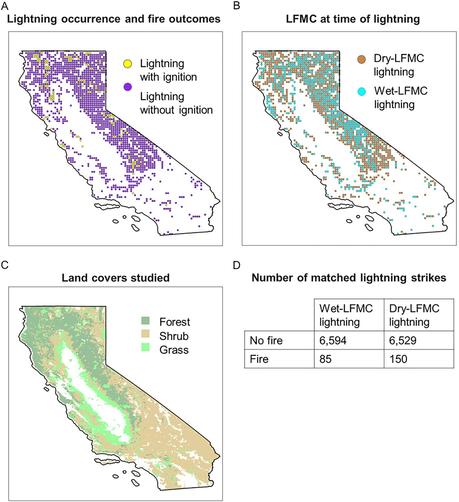
New in #AGUpubs: Dry Live Fuels Increase the Likelihood of Lightning-Caused Fires.
Study isolates the effect of live fuel moisture content (LFMC) from other fire drivers and shows that California fire likelihood is higher when LFMC is below a critical flammability threshold, informing wildfire prediction and management.
Read the study: https://bit.ly/3qO68BN
New in #AGUPubs Geophysical Review Letters: Study quantifies and isolates the effect of snow and ice depressing California's Central Valley floor, showing for the first time how to disentangle, decouple, and isolate two effects of elevation changes due to #groundwater levels and snowpack loading.
Read: https://bit.ly/3N2nBOi
Read: https://bit.ly/3N2nBOi

 Dr Micha Campbell
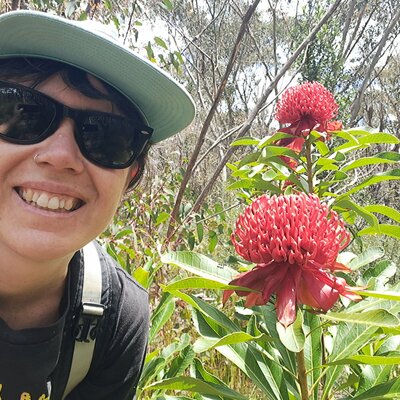
We were very kindly invited to write a communication piece for #AGUPubs Eos magazine, to go along with our recent review paper. If you'd like a quick overview on using #speleothems for #palaeofire research, look no further!
https://eos.org/editors-vox/using-cave-formations-to-investigate-ancient-wildfires
 Polar Remote Sensing, Bremen
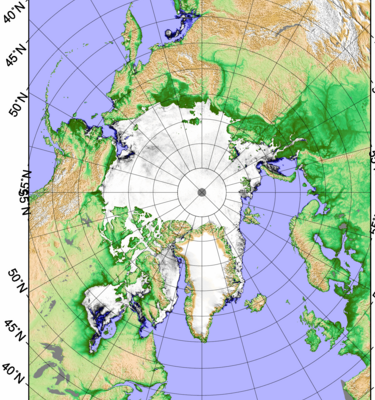
Our new paper about #Arctic #seaice melt pond fraction derived from #Sentinel-2 #satellite data is now published in #AGUpubs Geophysical Research Letters. We used the product to analyze the evolution of melt ponds during the #MOSAiCexpedition. https://doi.org/10.1029/2022GL102102

 Manuela Brunner
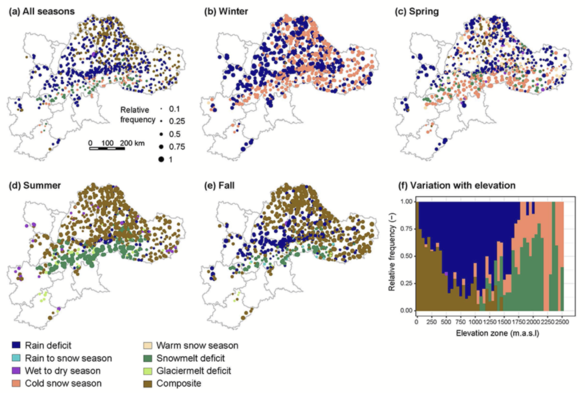
Thrilled to see our new #GRL study on changes in #drought generation processes and severity in the Alps as an editor's highlight in @AGU_Eos, @theAGU and #AGUpubs:
https://eos.org/editor-highlights/streamflow-drought-intensification-in-the-european-alps
@[email protected]
https://eos.org/editor-highlights/streamflow-drought-intensification-in-the-european-alps
@[email protected]

 Erin Hanan
Article by Jianning Ren out in #AGUpubs: We found that beetle effects on fire were a function of 2 counteracting forces: increases in fuel loading & decreases in aridity, with the dominant force depending on local fire regime: https://agupubs.onlinelibrary.wiley.com/doi/10.1029/2022MS003073
 o'anluain
Potentially deadly steam-powered volcanic eruptions like that which buried Pompeii may launch hot ash much further than previously thought, according to a new study in AGU’s Geophysical Research Letters. #AGUpubs
https://news.agu.org/press-release/death-valleys-ubehebe-crater-reveals-volcanic-hazard-areas-are-underestimated/
https://news.agu.org/press-release/death-valleys-ubehebe-crater-reveals-volcanic-hazard-areas-are-underestimated/

Death Valley’s Ubehebe Crater reveals volcanic hazard areas are underestimated
AGU press contact: Liza Lester, +1 (202) 777-7494, [email protected] (UTC-5 hours) Contact information for the researchers: Greg A. Valentine, Department of Geology, University at Buffalo, [email protected] (UTC-5 hours) WASHINGTON — When magma bubbles up toward Earth’s surface and meets groundwater, steam pressure builds, sometimes bursting into eruptions that spew currents of hot ash, potentially burning and asphyxiating people and burying nearby cities. Take, for example, similar ash currents that formed during the eruptions at Mount Vesuvius, which were responsible for many of the fatalities in the city of Pompeii around 79 C.E. These so-called phreatomagmatic eruptions do not just occur at large, mountainous volcanoes like Mount Vesuvius. They can also occur in distributed volcanic fields, where the volcanic activity is spread out over a wider, more unassuming area, and the eruptions leave behind craters called maars. While only a handful of maar-forming phreatomagmatic eruptions have occurred throughout recorded history, geologists can estimate the hazardous areas around future maar-forming eruptions by examining how far volcanic deposits extend from maar craters. Deposits produced by currents of hot ash, called pyroclastic surges, extend 1 to 6 kilometers (0.6 to 3.7 miles) from most maar craters, suggesting that the pyroclastic surges only travel that far from an eruption site. However, that distance estimate, called the surge runout distance, may be an underestimate, according to a new study published in AGU’s Geophysical Research Letters. The study, led by University at Buffalo professor Greg Valentine, increases the range of pyroclastic surge runout to 10–15 kilometers (6–9 miles). The evidence for the increased runout comes from the Ubehebe Crater in California’s Death Valley, which was caused by a phreatomagmatic eruption around 2100 years ago. There, the researchers found pyroclastic surge deposits up to 9 kilometers (5.6 miles) from the crater that likely once extended even farther before being wiped away by wind and rain. Ubehebe’s surge runout may be more representative of phreatomagmatic eruptions than the runout distances from other maar craters that have been studied. According to Valentine, there is nothing outstanding about Ubehebe’s size compared to similar craters, but Death Valley’s extremely arid environment with few plants and little erosion could have better preserved the volcanic ash deposits around Ubehebe. In other words, the researchers think erosion is the culprit for the shorter observed runout distances around other volcanic craters. “Previous studies of surge runout distance had used the best data that had been available, which is based on deposits of volcanoes where similar eruptions occurred,” Valentine said. “Most of those used a few kilometers, but here, we think just because of the good preservation in Death Valley, we see evidence for a wider area of impact.” “When you are trying to figure out the extent of volcanic eruptions’ impacts and you’re looking at it through the lens of the geologic record, you are beholden to what is preserved,” said Erik Klemetti, a volcanologist at Denison University not involved in the study. “The key point from this study is that a lot of detailed work needs to be done in places where you will not lose the volcanic deposits to really get a better sense of the average and maximum distances that some of these hazards might impact.” The researchers also used a computer model to explain the longer surge runout distance. Although phreatomagmatic surges from maar eruptions are dangerously hot to humans, they are cooler than most other volcanic surges because the magma's heat is lost when vaporizing the groundwater. According to the researcher's model, these colder, and thus denser, pyroclastic surges do not rise and mix with the overlying air as much as hotter surges, which causes them to travel farther along the ground. Re-evaluating volcanic hazard risks Extended pyroclastic surge runout distances could have big implications for volcano hazard assessments, especially for cities built on volcanic fields where future phreatomagmatic eruptions are possible. According to Valentine, “If you are in a large city, having a hazard that extends ten kilometers from a crater is very different from one that extends only two kilometers from the crater. The volcano could affect a much larger populated area and much more infrastructure.” “The study certainly has big implications for places like Auckland that are built on a volcanic field,” said Jan Lindsay, a University of Auckland professor and co-leader of DEVORA, a multi-agency, collaborative research program that provides assessments of volcanic hazards and associated risks to the roughly 1.72 million people in Auckland, one of New Zealand’s largest cities. “We also have plenty of water, which is needed to create those phreatomagmatic eruptions,” Lindsay said. “There is every expectation that we should have that kind of eruption should our volcanic field erupt again.” Jessica Ball, a volcanologist at the U.S. Geological Survey’s California Volcano Observatory, agrees. “The study has a big impact on how we draw hazard zones for this type of volcano,” she said. Ball helps create volcano hazard assessments at California’s Clear Lake and the surrounding area, where 17,910 people live on an active volcanic field. “We can take our knowledge of where past eruptions occurred, the stress in the Earth’s crust, where subsurface heat is located and how the eruptions behave, like the surge runout distances, to identify zones where hazards might happen,” she said. According to both Ball and Lindsay, accurate runout distances are needed to assess whether and where to evacuate metropolitan areas when preparing for an imminent volcanic eruption. Current hazard assessment methods may need to update their pyroclastic surge runout distances to provide more accurate assessments to policymakers, but more work is still needed to fully understand how the proposed longer pyroclastic surge runout will impact cities like Auckland. “For Auckland, our current volcano contingency plan factors in a 5-kilometer (3-mile) radius evacuation zone around any new vent, to account for pyroclastic surge hazards. In light of this new study, we need to first carefully consider whether the potentially longer surge distances are also possible at a future Auckland eruption, and, if so, what the risks to life and safety are beyond 5 kilometers (3 miles),” Lindsay said. ### Contributed by Derek Smith ### AGU (www.agu.org) is a global community supporting more than half a million advocates and professionals in Earth and space sciences. Through broad and inclusive partnerships, we advance discovery and solution science that accelerate knowledge and create solutions that are ethical, unbiased and respectful of communities and their values. Our programs include serving as a scholarly publisher, convening virtual and in-person events and providing career support. We live our values in everything we do, such as our net zero energy renovated building in Washington, D.C. and our Ethics and Equity Center, which fosters a diverse and inclusive geoscience community to ensure responsible conduct. Notes for Journalists: This study is published with open access. Neither the paper nor this press release is under embargo. Download a pdf of this article here. Greg Valentine is involved in related volcanic hazard research that will be presented at this year’s Fall Meeting. The researchers simulated volcanic eruptions with explosives and used the resulting seismo-acoustic signals to estimate the final depth of the crater as it was forming. Paper title: “Lateral Extent of Pyroclastic Surge Deposits at Ubehebe Crater (Death Valley, California) and Implications for Hazards in Monogenetic Volcanic Fields” Authors: Greg A. Valentine, (corresponding author), University at Buffalo, Buffalo, NY, USA Judy Fierstein, U.S. Geological Survey, Volcano Science Center, Menlo Park, CA, USA James D. L. White, Department of Geology, University of Otago, Dunedin, New Zealand