What a week... #OpenFold is out and supposedly faster and more memory efficient then #AF2. This reaches the #AF3 token limit on a local GPU 👍 (only with proteins though...) #StructuralBiology @strucbio https://www.nature.com/articles/s41592-024-02272-z?utm_source=twitter&utm_medium=social&utm_campaign=nmeth
OpenFold: retraining AlphaFold2 yields new insights into its learning mechanisms and capacity for generalization - Nature Methods

OpenFold is a trainable open-source implementation of AlphaFold2. It is fast and memory efficient, and the code and training data are available under a permissive license.

Nature

A spoonful of sugar #11 🍬

As the rest of the community, we are excited about #AF3 and have been testing its performance in the reconstruction of glycans and glycosylation. We have found the following limitations users should be aware of:

- The structure of the Asn-linkages is incorrect

- All N-glycans have an a2 arm, while the Man should be in a3

What we suggest 😜 is to build the protein with AF3 and to reglycosylate it with ReGlyco at https://glycoshape.org  

#glycotime

GlycoShape

GlycoShape is an OA database of glycans 3D structural data and information that can be downloaded or used with Re-Glyco to rebuild glycoproteins from the RCSB PDB or EMBL-EBI AlphaFold repositories

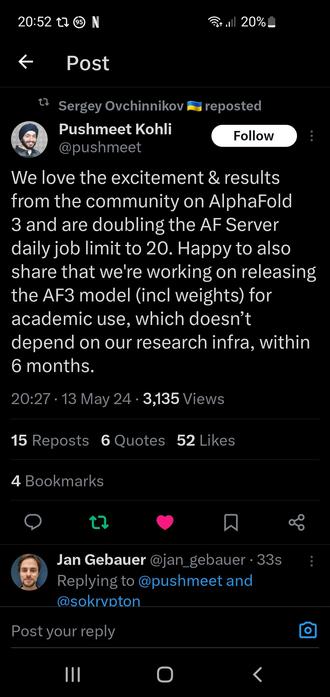
@xtaldave @strucbio there is a very interesting announcement over at Twitter. Let's hope for the best đŸ€ž #AF3 #OpenScience