#4p1000 #4per1000 #CR41W
Wenn es doch nur einen Plan gäbe, die Böden zu regenerieren und mehr Humus aufzubauen...
Ach, den gibts? 👀
Ach so, es wurde in den letzten 10 Jahren doch schon "eine Strategie erarbeitet, in der Ziele bis 2050 ❗ festgelegt sind"?
Gut, denn es eilt ja auch nicht. 🤡
Internationale "4 per 1000" In... BLE - Internationale "4 per 1000" Initiative
Die internationale "4 per 1000" Initiative wurde am 1. Dezember 2015 im Zuge der Klimarahmenkonvention (UNFCCC - COP21) in Frankreich ins Leben gerufen. Ziel der Initiative ist es, weltweit gesunde und kohlenstoffreiche Böden zu etablieren. Die BLE unterstützt im Auftrag des Bundesministeriums für Ernährung und Landwirtschaft (BMEL) das Exekutivsekretariat der Initiative.

Join the “4 per 1000” Northern European Regional Meeting
3 days, colleagues from all over Northern Europe, 12 keynote speeches, 2 field trips, tens of posters, and countless opportunities to connect.
@cem_oezdemir
und es sollte um #humusaufbau , Wiederbewässerung der #moore , Erhalt und Erweiterung natürlicher #laubwälder , Wiederbegrünung verödeter Landstriche gehen. All das hilft dem #wasserhaushalt der Natur.
Gutes Grundlagenwissen:
#4von1000 #4per1000
Internationales Abkommen, das während des #pariserklimaabkommen|s auch von der damaligen Bundesregierung unterzeichnet wurde
https://4p1000.org/?lang=en
#kisstheground
https://kissthegroundmovie.com/
The collective review of the CarboSMS network is out (open access) ! 🌾🌳
Current #controversies on mechanisms controlling #soil C storage: implications for interactions with practitioners and policy-makers. A review
#4per1000 #agriculture #forestry
https://link.springer.com/article/10.1007/s13593-023-00876-x


Current controversies on mechanisms controlling soil carbon storage: implications for interactions with practitioners and policy-makers. A review - Agronomy for Sustainable Development
There is currently an intense debate about the potential for additional organic carbon storage in soil, the strategies by which it may be accomplished and what the actual benefits might be for agriculture and the climate. Controversy forms an essential part of the scientific process, but on the topic of soil carbon storage, it may confuse the agricultural community and the general public and may delay actions to fight climate change. In an attempt to shed light on this topic, the originality of this article lies in its intention to provide a balanced description of contradictory scientific opinions on soil carbon storage and to examine how the scientific community can support decision-making despite the controversy. In the first part, we review and attempt to reconcile conflicting views on the mechanisms controlling organic carbon dynamics in soil. We discuss the divergent opinions about chemical recalcitrance, the microbial or plant origin of persistent soil organic matter, the contribution of particulate organic matter to additional organic carbon storage in soil, and the spatial and energetic inaccessibility of soil organic matter to decomposers. In the second part, we examine the advantages and limitations of big data management and modeling, which are essential tools to link the latest scientific theories with the actions taken by stakeholders. Finally, we show how the analysis and discussion of controversies can guide scientists in supporting stakeholders for the design of (i) appropriate trade-offs for biomass use in agriculture and forestry and (ii) climate-smart management practices, keeping in mind their still unresolved effects on soil carbon storage.
 Blyde
Blyde Dr. Traci Birge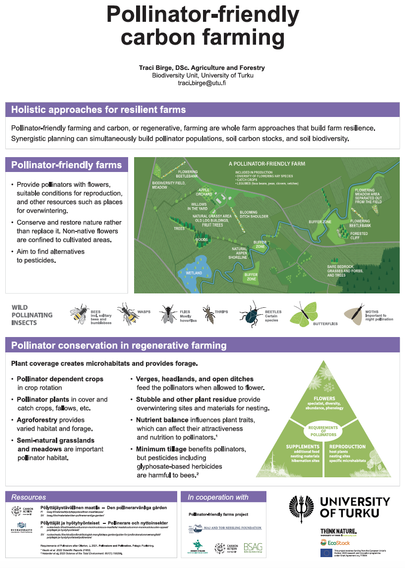
 Mondenfee
 Marie-France Dignac