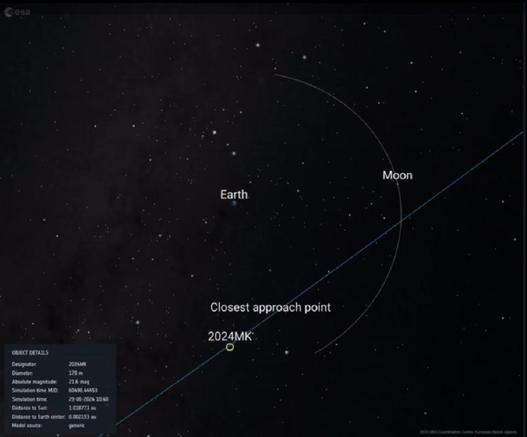
NASA management also promotes #TeamRadar at #SBAG , highlighting the #2011UL21 and #2024MK observations two weeks ago: https://echo.jpl.nasa.gov/asteroids/june2024.goldstone.planning.html
Thank you again, management.
NASA management also promotes #TeamRadar at #SBAG , highlighting the #2011UL21 and #2024MK observations two weeks ago: https://echo.jpl.nasa.gov/asteroids/june2024.goldstone.planning.html
Thank you again, management.
More details about the #TeamRadar observations of asteroids #2024MK and #2011UL21 from #Goldstone and #Canberra as they flew past Earth this past week:
2011 UL21 turns out to have a small satellite orbiting it at something over 3 kilometers away.
And 2024 MK is really tumbling.
ESA: "Two large asteroids safely pass Earth just 42 hours apart" - https://www.esa.int/Space_Safety/Planetary_Defence/Two_large_asteroids_safely_pass_Earth_just_42_hours_apart
But these are #2024MK and #2011UL21, which will be 0.75 lunar distances and 17 lunar distances away respectively this week.
In other words:
A pretty normal week, astronomically speaking.
Except for those of us who study piles of rock in space; for whom it is a little busy.
Two large asteroids will safely pass Earth this week, a rare occurrence perfectly timed to commemorate this year's Asteroid Day. Neither poses any risk to our planet, but one of them was only discovered a week ago, highlighting the need to continue improving our ability to detect potentially hazardous object in our cosmic neighbourhood.