A Comprehensive Look at the Marx Brothers' Career in the 1930s and 1940s

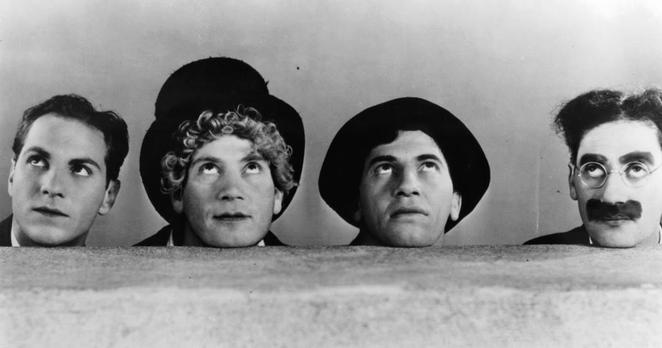
📰 Original title: Funny Portraits of the Marx Brothers in the 1930s and 1940s

🤖 IA: It's not clickbait ✅
👥 Users: It's not clickbait ✅

View full AI summary: https://en.killbait.com/a-comprehensive-look-at-the-marx-brothers-career-in-the-1930s-and-1940s.html?utm_source=mastodon_world&utm_medium=social&utm_campaign=killbait.mastodon_world
#cinema #marxbrothers #classiccomedy #1930s1940s

A Comprehensive Look at the Marx Brothers' Career in the 1930s and 1940s

The Marx Brothers were a legendary American comedy team known for their work in vaudeville, Broadway, and 14 feature films. The group originally included Chico, Harpo, Groucho, Gummo, and Zeppo Marx, though Gummo and Zeppo eventually left, leaving the iconic trio of Chico, Harpo, and Groucho. Critics and fans alike consider them among the most influential comedians of the 20th century, a status reinforced by the American Film Institute, which recognized five of their films among the top 100 comedy movies, including two in the top fifteen. In the early 1930s, the brothers’ films, such as 'Animal Crackers' (1930) and 'Monkey Business' (1931), were highly surreal and chaotic, regarded as their purest comedic work. 'Duck Soup' (1933) is widely celebrated as their masterpiece, though it initially underperformed due to its irreverent political satire. After Zeppo retired, the trio signed with MGM under producer Irving Thalberg, who reshaped their on-screen personas into more heroic characters, leading to commercial hits like 'A Night at the Opera' (1935) and 'A Day at the Races' (1937). Following Thalberg’s death, the quality of their films declined, and the brothers briefly retired in 1941. They returned for occasional comebacks, including 'A Night in Casablanca' (1946) and their final film together, 'Love Happy' (1949), which featured a cameo by a young Marilyn Monroe. Despite these transitions, the Marx Brothers remain celebrated for their groundbreaking comedic contributions and enduring influence on film humor.

KillBait

A Comprehensive Look at the Marx Brothers' Career in the 1930s and 1940s

📰 Original title: Funny Portraits of the Marx Brothers in the 1930s and 1940s

🤖 IA: It's not clickbait ✅
👥 Users: It's not clickbait ✅

View full AI summary: https://en.killbait.com/a-comprehensive-look-at-the-marx-brothers-career-in-the-1930s-and-1940s.html?utm_source=mastodon_social&utm_medium=social&utm_campaign=killbait.mastodon_social

#cinema #marxbrothers #classiccomedy #1930s1940s

A Comprehensive Look at the Marx Brothers' Career in the 1930s and 1940s

The Marx Brothers were a legendary American comedy team known for their work in vaudeville, Broadway, and 14 feature films. The group originally included Chico, Harpo, Groucho, Gummo, and Zeppo Marx, though Gummo and Zeppo eventually left, leaving the iconic trio of Chico, Harpo, and Groucho. Critics and fans alike consider them among the most influential comedians of the 20th century, a status reinforced by the American Film Institute, which recognized five of their films among the top 100 comedy movies, including two in the top fifteen. In the early 1930s, the brothers’ films, such as 'Animal Crackers' (1930) and 'Monkey Business' (1931), were highly surreal and chaotic, regarded as their purest comedic work. 'Duck Soup' (1933) is widely celebrated as their masterpiece, though it initially underperformed due to its irreverent political satire. After Zeppo retired, the trio signed with MGM under producer Irving Thalberg, who reshaped their on-screen personas into more heroic characters, leading to commercial hits like 'A Night at the Opera' (1935) and 'A Day at the Races' (1937). Following Thalberg’s death, the quality of their films declined, and the brothers briefly retired in 1941. They returned for occasional comebacks, including 'A Night in Casablanca' (1946) and their final film together, 'Love Happy' (1949), which featured a cameo by a young Marilyn Monroe. Despite these transitions, the Marx Brothers remain celebrated for their groundbreaking comedic contributions and enduring influence on film humor.

KillBait