Over the weekend, in the continued search to try to look for very localised names, I was looking at Heneghan's in the 1926 census living outside of Connaught - to see if any were born outside of Connaught. Only one family (widow & daughters fit that description).
But I also found that the head of household of Fastnet Lighthouse was a Patrick Heneghan from Blacksod.
#1926Census #1926IrelandCensus
(1/2)
Another useless thing about the 1926 census: because it doesn't list religion in the initial search result for a name or street, etc, it's impossible to verify my immediate impression that certain streets that were filled with Protestant civil servants in 1911 are now filled with Catholic civil servants in 1926. As a social research tool, it's crap. #census #1926census

In light of the release of the #1926Census - Project Infant volunteers are currently working on adding enhanced transcripts of the 1901, 1911 and 1926 censuses for various institutions in Ireland.

You can view the ones we have so far (with more on the way) here: https://projectinfant.ie/census

Census – Project Infant

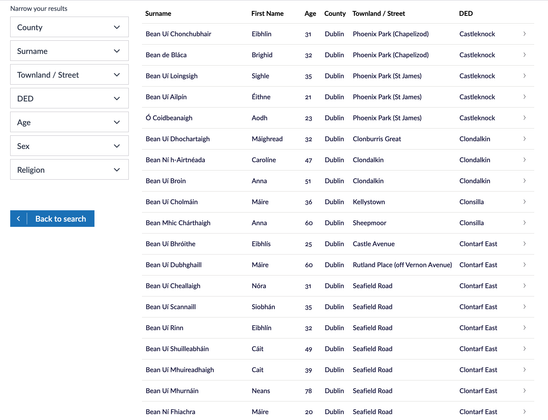
One of the problems with using AI - I was puzzled that I couldn't find any Ceannt women.
Anyone - absolutely anyone - who filled out the form in Irish and listed her name as "Bean uí duine-éigin" - well, her surname is listed as "Bean" 😂
Its equivalent in English would be listing her surname as "Mrs"
#AI #1926Census #census #Ireland
I wonder what the most geographically concentrated surname in the #1926Census was (excluding super rare names essentially representing one family)?
Let's put a minimum of 200 people in the country with the same surname (which excludes Tohers).
One of my other 3 grandparents surnames: over 98% in one county, the next most popular county only had 2 with the surname!
In that county they were spread between 16 DEDs, but over 20% were in the one DED, and almost 60% were spread between just 4 DEDs.
Huh. Looking at my mother's household entry in the #1926census. She had a sibling who died in childhood that I never knew about.
Poked at the #1926census a little. Turns out that it lands in a somewhat unfruitful spot for my ancestry: this person died in 1924, that person emigrated to the US in 1925, etc. Most of the interesting gaps in my haphazard research are still in the gaps caused by the infamous Four Courts event. Although for some of them, it's questionable whether any real record of them _ever_ existed, beyond a scribble or two in a church register.
The Irish 1926 Census records are finally live!
Marking the first census of the Irish Free State, these records offer an incredible look at Ireland a century ago. Remarkably, over 1,000 people listed in the original 1926 files are still with us today. #1926Census #Ireland #Genealogy #History https://www.corkbeo.ie/news/history/more-1000-recorded-1926-census-33796255
More than 1,000 recorded in 1926 Census are still alive today as database released to public

The database was released at midnight, allowing members of the public to delve into the past

Cork Beo
@baoigheallain Exactly. They must not have talked to people who actually use the censuses a lot, who'd have told them that the person's trade and place of birth, and the house number of the current house are essential things to have on the front search page, for functional use
#1926census #CensusOfIreland #census #Ireland

Really enjoying finding family (and extended connections) in the #1926Census records.

I seem to be finding them faster/easier than other family members so I have some tips.

Use first letter of first name as a search term (too many name variants over time mean that fixing the first name too early can make you miss it). If using initial of 1st name, also include sex in the search to narrow it down. As does knowing approx age. (1/2)