
23 Followers
64 Following
11 Posts

@k_tsetsos and I wrote a new Perspective paper: https://osf.io/preprints/psyarxiv/2bjae

How do decision biases arise in the brain? Contrary to existing accounts, which lack explanatory depth and are often reduced to "just-so stories", we explore how choice biases emerge as a by-product of biologically plausible and normatively justifiable decision computations, such as relative value coding, selective information sampling, and non-linear accumulation dynamics.

OSF

@k_tsetsos @eLife

It also shows that direct replication endeavours, relying on precisely replicated designs and stimuli, may counter-intuitively perpetuate unnoticed errors and inadequacies, leading to seemingly robust yet inaccurate scientific conclusions.

#DecisionMaking #DecoyEffect #DecisionNeuroscience
New paper with @k_tsetsos is published in @eLife

Paper: https://elifesciences.org/articles/83316

We showed that a unidimensional distractor effect in a previous study (Chau et al., 2014 Nature Neuro.) affords alternative interpretations.

Twitter thread: https://twitter.com/yinan_cao/status/1624113909597601792

Our work is a demonstration of a self-correcting process exclusively by virtue of the power of #openscience.

Clarifying the role of an unavailable distractor in human multiattribute choice

A previously reported positive influence of a distractor alternative on decision accuracy was driven by an unintended covariation between key variables, beyond which the distractor has a modest negative influence on accuracy, possibly mirroring asymmetric multiattribute context effects.

eLife
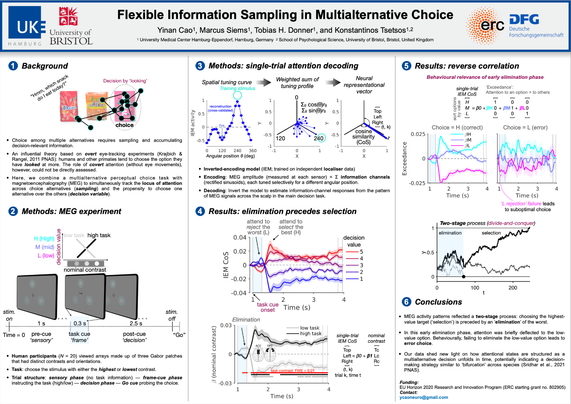
In case you missed my #SfN22 poster? Using MEG & multialternative choice task, we show that flexible information sampling follows a "bifurcation" strategy that reduces a complex 3-alternative choice into more tractable 2-alternative choices. New work with Konstantinos Tsetsos and Tobias Donner