Wout Bittremieux

186 Followers
172 Following
108 Posts

I develop AI solutions to derive novel biological knowledge from large-scale mass spectrometry proteomics and metabolomics data.

Research interests: mass spectrometry, AI, open science.

Assistant research professor at the University of Antwerp, ๐Ÿ‡ง๐Ÿ‡ช.

he/him

Websitehttps://bittremieux.be
GitHubhttps://github.com/bittremieux/
Google Scholarhttps://scholar.google.com/citations?user=fBl8-IwAAAAJ

Our paper on the nearest neighbor suspect spectral library for untargeted metabolomics made it to the Nature Communications top 25 health sciences articles of 2023, out of more than 8500 published articles in @naturecomms. #NCOMTop25

Read it here: https://www.nature.com/articles/s41467-023-44035-y
Check out the full collection: https://www.nature.com/collections/dbigcchjdg

Open access repository-scale propagated nearest neighbor suspect spectral library for untargeted metabolomics - Nature Communications

Interpreting untargeted mass spectrometry (MS) data is challenging due to incomplete reference libraries. Here, the authors created the nearest neighbor suspect spectral library from largescale public MS data, significantly enhancing the ability to hypothesize structures for unknown mass spectra.

Nature

Important bug fix available for Casanovo which caused crashes when running without a GPU due to unstable beam search decoding.

Get the latest v4.1.0 now by upgrading from PyPI:

pip install --upgrade casanovo

After the first year as assistant professor at @uantwerpen, I gave my inaugural lecture at the Faculty of Science Research Day yesterday.

To make it a bit more entertaining than a standard scientific presentation, I showcased how our computational #MassSpectrometry and #AI tools could help combat the next fictional #zombie๐ŸงŸ pandemic.

Slides: https://doi.org/10.5281/zenodo.10638649

Molecules of Mystery: A Journey of Computational Mass Spectrometry and Artificial Intelligence

Inaugural lecture at the Faculty of Science Research Day 2024.

Zenodo

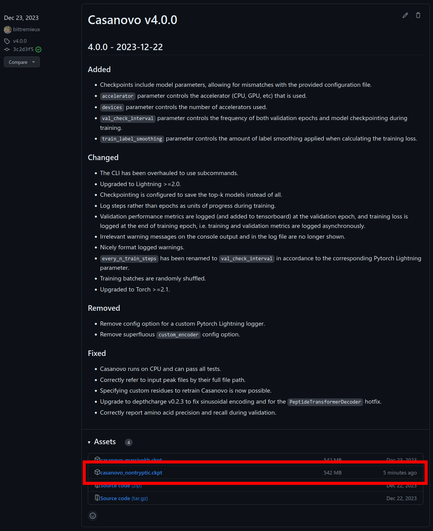
Weights for the non-enzymatic version of Casanovo v4.x are now available. Use this to analyze data that was generated using a different protease than trypsin, for immunopeptidomics, ...

You can find the model weights on GitHub under the "Assets" of release v4.0.0: https://github.com/Noble-Lab/casanovo/releases/tag/v4.0.0

Note that by default Casanovo will automatically download the tryptic model weights. To use the non-enzymatic model, download the weights file manually and specify it using the `--model` command-line argument.

Release Casanovo v4.0.0 ยท Noble-Lab/casanovo

4.0.0 - 2023-12-22 Added Checkpoints include model parameters, allowing for mismatches with the provided configuration file. accelerator parameter controls the accelerator (CPU, GPU, etc) that is ...

GitHub

Is this the way open science is performed nowadays?

Ten days before official publication of MASST+ in @naturebiotech but presumably after acceptance, all relevant source code was removed from its GitHub repository. It is now a shell repo that only includes a README and data files used for testing. Also no deposition of the code to @zenodo_org, so what's to prevent this history from disappearing as well?

Rather shocking.

Paper: https://www.nature.com/articles/s41587-023-01985-4
Repository: https://github.com/mohimanilab/MASSTplus

Fast mass spectrometry search and clustering of untargeted metabolomics data - Nature Biotechnology

MASST+ speeds up querying of metabolomics mass spectrometry data by two orders of magnitude.

Nature

๐ŸŽ‰ Major new Casanovo release! ๐ŸŽ‰

Casanovo v4.0.0 contains many performance upgrades, bug fixes, and more improvements.
End users will want to check out our more convenient command-line interface and power users will enjoy the added flexibility for training their own custom models.

Get it from PyPI using: `pip install -U casanovo`.

๐Ÿ“ˆ The suspect spectral library boosts the spectrum annotation rate by 1.7 to 3.0 fold across various sample types, significantly expanding the amount of biological knowledge that can be obtained from untargeted metabolomics experiments.

It is available as a free and open community resource, so we hope that other researchers can similarly use it to derive more value from their data.

๐Ÿ•ต๏ธ We demonstrate the benefit of the suspect library through the discovery of novel acylcarnitines, apratoxin natural products, products from drug metabolism, and more.

Additionally, the suspect spectral library enabled us to get new insights into an Alzheimer's disease phenotype.

๐Ÿ“š The suspect spectral library was compiled by global molecular networking of 521 million MS/MS spectra. Ultimately, we extracted 87,916 novel reference spectra that correspond to molecules that are structurally related to previously known reference compounds.

The suspect library is freely available on @gnps_ucsd! Use it in your GNPS jobs or find it here: https://gnps.ucsd.edu/ProteoSAFe/gnpslibrary.jsp?library=GNPS-SUSPECTLIST

โšก I'm super excited that our work on creating the #GNPS nearest neighbor suspect spectral library for #untargeted #metabolomics has now officially been published in @naturecomms.

This was a massive effort, as evidenced by the many awesome co-authors I was able to collaborate with. ๐Ÿ™Œ Many thanks to everyone, but especially to @pdorrestein1, as this paper is one of the main outcomes from my postdoc at @ucsandiego.

Manuscript: https://doi.org/10.1038/s41467-023-44035-y