Check out Sorbis — new nodes added: Ring, FM, Grain, and more. Many of them ported from Max/MSP externals I built a long time ago.
🔗 https://codeberg.org/wandersound/sorbis
#rustlang #audiodev #livecoding #electronicmusic #dsp #opensource

Digital Sound Artist | Digital Music Scholar & Researcher.
wandersound.ca
Check out Sorbis — new nodes added: Ring, FM, Grain, and more. Many of them ported from Max/MSP externals I built a long time ago.
🔗 https://codeberg.org/wandersound/sorbis
#rustlang #audiodev #livecoding #electronicmusic #dsp #opensource
Working on crossfade syntax for section transitions in Sorbis (my open-source computer music scripting language). Which reads better to you?
Option A — keyword:
o: play A xfade 10ms B xfade 5% C xfade 10% A
Option B — symbolic:
o: play A >10%< B >5ms< C >10%< A
(> = fade out, < = fade in, value = overlap amount)
What feels more intuitive?
A script looks like this:
bpm 120
~p: pitch 60, 64, 67, 72
~r: rhythm 1, 0.5, 0.5, 1
~melody: combine ~p ~r
~env: adsr 0.01, 0.1, 0.7, 0.3 ~melody.gate
o: sin ~melody.freq >> mul ~env >> mul 0.4
Chains prefixed with ~ are modulation signals. >> pipes one node into the next. combine zips a pitch sequence and a rhythm sequence into frequency and gate signals. The output chain is always o.
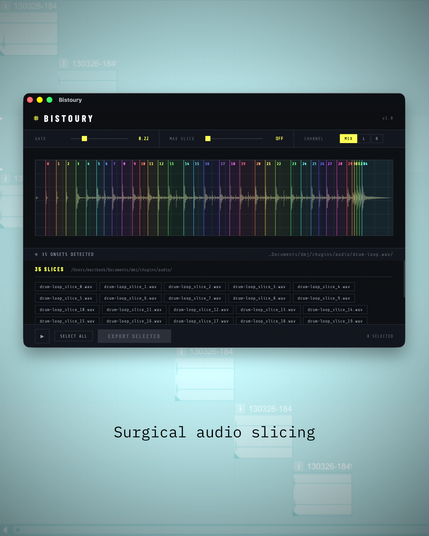
Bistoury is out.
This one started as a ChucK script I kept reaching for during sound design sessions — drop a file, get the cuts, move on. At some point I figured if I was using it this much, maybe others would too.
It finds where sounds actually begin — not where they get loud, but the true foot of the attack. Backtracks before the transient so your cuts land clean. Works on drums, yes, but also pads, bowed strings, anything with an onset buried under a slow build.
wandersound.ca/bistoury