The View from Out There

42 Followers
6 Following
69 Posts
This is a micro-blog account dedicated to sharing less-seen pictures of astronomical objects and space exploration. Some we'll break down to explain what's interesting about what they show, while others give an unusual perspective of something quite familiar to you. #Astronomy #Astrophotography #Space
Banner Image"Space Cartoon Background" by Ifu used under a CC BY-SA 3.0 license

A dust storm in Hellas Planitia on Mars, photographed by Mars Express on February 13, 2016.

The Hellas basin is Mars' deepest region, with Badwater Crater in the Peneus Palus (part of Hellas off the bottom left of this image) 8200 meters below the areoid—Mars' "sea level". When the poles' dry ice sublimates in summer, the atmospheric pressure on its floor is 1.5% of Earth's, approaching three times the norm.

#Mars #Space

Source: https://www.flickr.com/photos/132160802@N06/35573529390/

Credit: ESA/DLR/FU Berlin/J. Cowart

Hellas Basin - Mars Express

Flickr

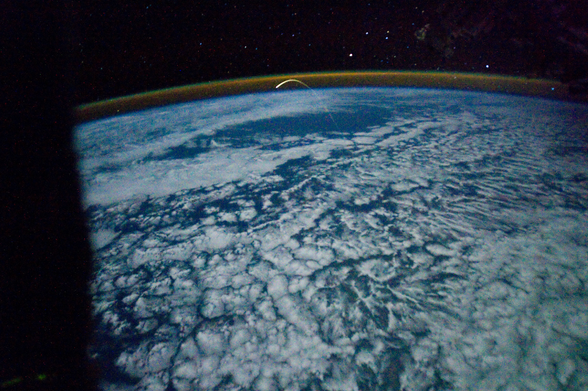
On July 21st, 2011 the orbiter Atlantis returned to Earth after visiting the ISS and delivering two cargo modules, the Rafaello MPLM and an LMC.

This picture was taken from the station by astronaut Mike Fossum as Atlantis left a trail of glowing plasma high up in the Earth's atmosphere. It was the final flight of the Space Shuttle program.

Source: https://www.flickr.com/photos/nasamarshall/5964456530

#space #spaceflight #iss #SpaceShuttle

Atlantis Goes Home: The Series (NASA, International Space Station, 07/21/11)

Flickr

Source 1: https://science.nasa.gov/missions/hubble/ngc-541-fuels-an-irregular-galaxy-in-new-hubble-image

Source 2: Jet-induced star formation in 3C 285 and Minkowski [sic] Object; https://arxiv.org/pdf/1410.8367

Source 3: Minkowski’s Object: A Starburst Triggered by a Radio Jet, Revisited; https://arxiv.org/pdf/astro-ph/0604557

2/2

NGC 541 Fuels an Irregular Galaxy in New Hubble Image - NASA Science

This striking pair is an elliptical galaxy NGC 541 and an unusual star-forming, irregular dwarf galaxy known as Minkowski’s Object (the bluish object to the lower left of NGC 541). Elliptical galaxies are nearly spherical to egg-shaped groups of stars that form when galaxies merge. NGC 541 shoots out radio jets that are invisible to […]

NGC 541 is a lenticular galaxy about 230 million light years away, with wide error bars. To its northeast, bottom left in this picture, is Minkowski's Object.

The blue-ish Object is a region of recent star formation, ~7.5 million years old. One theory is that it's an irregular galaxy but the more-commonly held one is that it's a former cloud of gas that strayed into an invisible-to-the eye jet from NGC 541. The second and third pictures show the smoking gun in radio frequencies. 1/2

#Space

The flight took off from Rapid City, North Dakota with US Army Air Corps officers Stephens and Orvil A. Anderson on board. They set a record for height that wasn't broken until after WWII (Joseph Kittinger's Manhigh I mission was only the second to beat it, in 1957). The end of the flight was more exciting than intended, as its balloon ruptured and the two men had to parachute to safety. (3/3)

It's just 10 pixels in this digitized version but there's a L-to-R straight rule drawn on the horizon that makes it clear if you zoom in.

The photo was taken by Albert W. Stephens, who also took the aforementioned 1930 one, and printed in the 5/1936 issue of National Geographic. To do it, he rode the capsule Explorer II to 22,066m—I trust you can see why I see this sort of thing as a proto-Space Age.

Credit: Alan Wilson on Flickr https://www.flickr.com/photos/ajw1970/51111110315

(2/3)

Gondola from 1935 research balloon ‘Explorer II’

Flickr

March 1947 brought us the first photo showing the Earth from space (~160km high), taken by a V-2 launched from White Sands, NM by the US's Small Steps Program.

The space race of the '50s and '60s was prefigured by the USA and USSR dueling with high-altitude balloons in the '20s and 30s. In 1930 the equivalent of the 1947 picture was taken, the first known image to show the curvature of the Earth. The one here is from five years later but shows the same thing. (1/3)

#space #stratosphere #1930s

About 420 million light years away is the galaxy group Matessian 7. Two of its members are collectively known as Arp 282 (individually it's NGC 169 dominating the image and IC 1559 barreling into it from the bottom).

They're interacting strongly and you can see streams of dark dust between them, dotted with highly luminous stars or star clusters initiated by tidal forces.

Credit: Judy Schmidt, from HST and Legacy Survey data

Source: https://www.flickr.com/photos/geckzilla/51591641345/

#space #astrophotography

Arp 282

Flickr

There was a 2003 reprint of Stuart's 1956 newsletter report in the Association of Lunar & Planetary Observers' own publication (vol. 45, issue 2); unfortunately, while I can find links to the PDF, it seems to be offline. But if you're interested in the historical record for lunar impacts (including Stuart's Event) and other transient phenomena on the Moon, NASA funded a 1967 report on them. You can read it here:

https://ntrs.nasa.gov/api/citations/19680018720/downloads/19680018720.pdf

In 1956, amateur astronomer Leon Stuart published this photo and a short announcement. He said that he'd seen an impact on Nov. 15, 1953, and that it lasted about 8 seconds—a bit of a problem as we now know lunar impacts are visible for less time than that.

With no other observation of it, it was dismissed as a point meteor, but in 2002 NASA claimed that Clementine images showed a new crater in the right spot. Unfortunately follow-up found pre-1953 photos that seem to show the same crater. 2/3