Measuring a world rate of profit
My article 'Measuring the World Rate of Profit: A Marxian Approach' is now published in Review of Radical Political Economics. Using 32 countries and multiple profit rate measures, it finds a long-run downward trend driven by technological change, with a partial recovery in the 1980s-90s.
https://thinkhammerly.wordpress.com/2026/03/26/measuring-world-rate-of-profit-marxian-approach/?utm_source=mastodon&utm_medium=jetpack_social
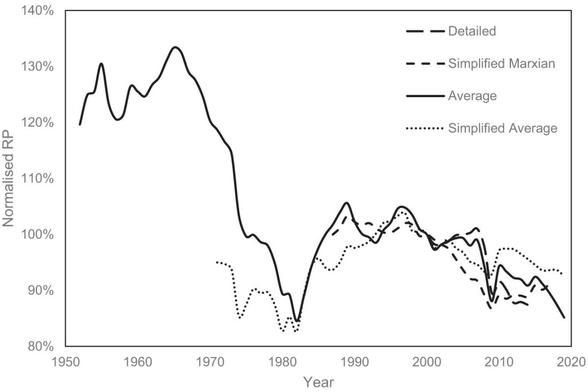
Measuring the World Rate of Profit: A Marxian Approach
New research applying Marxian measures of profit rate across 32 countries finds a downward trend in the world rate of profit between 1952 and 2019, driven by technological change.
Why do economies stagnate? My review of Douglass North’s classic explores the cognitive and institutional forces shaping economic change—and why breaking the cycle is a political, not just technical, challenge. Includes a critical look at the scarcity premise. Read more:
https://thinkhammerly.wordpress.com/2026/03/10/economic-change-4/?utm_source=mastodon&utm_medium=jetpack_social
Review: Understanding the Process of Economic Change
Economic growth is the exception, not the rule. In Understanding the Process of Economic Change, Nobel laureate Douglass North argues that economies are not merely sets of equations, but complex sy…

Stitching the Silence: Searching for Clarity Behind the Iranian Blackout
Searching for clarity behind the digital curtain of the Iranian blackout, this post looks at the 2025–2026 crisis so far. By collating scarce verified reports and official rhetoric, it assesses the…
Why is $252 billion in AI investment producing less than 5% revenue gains for most firms? My latest piece argues this isn't a timing problem — it's capitalism doing what Marx said it would.
https://thinkhammerly.wordpress.com/2026/02/25/ai_accumulation_marxian_profitability/?utm_source=mastodon&utm_medium=jetpack_social

The Contradictions of AI Accumulation: A Marxian Profitability Analysis
Global AI investment reached $252 billion in 2024, yet revenue gains remain marginal for most firms. This piece argues that isn’t a temporary lag — it’s a structural tendency. Drawing o…
Searching for clarity behind the digital curtain of the Iranian blackout, this post looks at the 2025–2026 crisis so far. By collating scarce verified reports and official rhetoric, it assesses the state's narrative and the structural risks of a looming power vacuum.
https://thinkhammerly.wordpress.com/2026/01/31/stitching-the-silence/?utm_source=mastodon&utm_medium=jetpack_social
Stitching the Silence: Searching for Clarity Behind the Iranian Blackout
Searching for clarity behind the digital curtain of the Iranian blackout, this post looks at the 2025–2026 crisis so far. By collating scarce verified reports and official rhetoric, it assesses the…

Sometimes ‘Year’ Isn’t a Year: How Web of Science Date Fields Mislead Bibliometric Analysis
Web of Science mixes Early Access and Publication Year in its search results, creating misleading trends for bibliometric analysis. Here’s how the distortion works — and how to avoid it.
Publication Year Isn’t Always What It Seems
Web of Science mixes Early Access and Publication Year in its search results, creating misleading trends for bibliometric analysis. Here’s how the distortion works — and how to avoid it.
Publication Year Isn’t Always What It Seems
Web of Science mixes Early Access and Publication Year in its search results, creating misleading trends for bibliometric analysis. Here’s how the distortion works — and how to avoid it.
https://thinkhammerly.wordpress.com/2025/12/12/publication-year-isnt-always-what-it-seems/?utm_source=mastodon&utm_medium=jetpack_social
Publication Year Isn’t Always What It Seems
Web of Science mixes Early Access and Publication Year in its search results, creating misleading trends for bibliometric analysis. Here’s how the distortion works — and how to avoid it.
Counting Authors — Why Bibliometric Defaults Can Mislead
The post warns against using bibliometric software blindly and advocates for validating results using alternative approaches.
https://thinkhammerly.wordpress.com/2025/11/30/counting-authors-why-bibliometric-defaults-can-mislead/?utm_source=mastodon&utm_medium=jetpack_social

Counting Authors — Why Bibliometric Defaults Can Mislead
The post warns against using bibliometric software blindly and advocates for validating results using alternative approaches.