
151 Followers
455 Following
362 Posts
tuning global tech pulse toward int'l civic data-informed products, starting in Peace Corps in Tanzania & Liberia.
It turns out you can run Claude artifacts in ObservableHQ so I made a version of the Claude-artifact-runner in it. It helped me make a visualization based on iOS’s sleep picker & that Taipei/Honolulu xkcd. Welcome: https://observablehq.com/@thadk/claude-artifact-runner
Claude Artifact Runner

import React 19 from @gnestor/react; import `@pkg/tailwind` and `tailwind-css`; implement Shad/CN templates manually as needed from its website, and provide `cn()`. See @gnestor/react-examples for help with Observable and React 19 inspired by https://github.com/claudio-silva/claude-artifact-runner Your useObservableState (if needed to look into one of the useState's) Your Claude Provided Artifact Code: Instructions Rename the variable above to match your component. Copy and paste the artifact code into rend

Observable
Sharp lil story of a 1781-born hardscrabble English engineer who saw beyond prevailing limits.
One among many who began to "project" themselves upward in the midst of enclosure (~1830s) and industrialization in England.
From Acemoglu&Simon Power & Progress (2023)
Fair warning: Haven't read farther but this made me wanna buy the book.

Next another fruits cluster. And the infamous mustard-like 🥬brassica veggie group which was late to Americas via Columbian Exchange https://en.wikipedia.org/wiki/Columbian_exchange

Pomegranate and clove clearly have shared plant structures. I can't say what guava & allspice have in common but I'll take it.

Cabbage here too. I'm impressed by how distant the mustard-likes are from the other major salad #agriculture veggies we know and love. 🥗Salads are true mixtures. (Just realized Swiss Chard was back with Amaranth)

Columbian exchange - Wikipedia

In the next batch of Dicots:
First 🍇 grapes branch off on their own. I want to look at US grapes vs. Europe ones someday.

Then next big branch spans many delicious things across continents. Did you realize the pod-like 🍫Colombia-region Cacao, the mighty African Baobab tree's fruit, Egyptian-area Okra, and 🌺 Hibiscus all fall in one branch together?
Finally trees like 🍋lemons (all citrus, really), lychee, pistachios, and cashew fruit are not so distant.

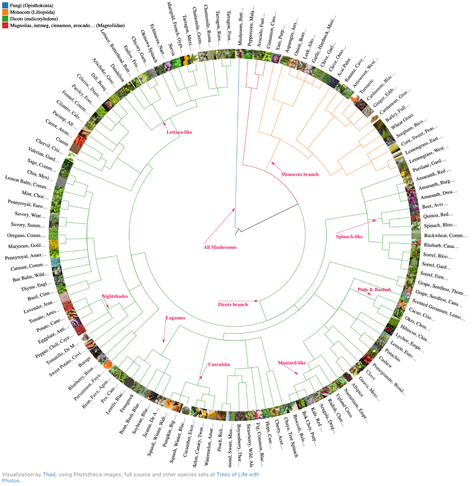
Branching to Dicots, the first significant branch contains spinach, which you can see is related to beets, and Peru-region Andean quinoa.

It also includes tasty weed purslane, which I just learned was used in 1818 in poultices to help feet, from OED. Amaranth here too.
Lots of sour rhubarb-y things here are fascinatingly placed near Buckwheat, which is used for flour.

Next we have garden monocots, and note we're drastically simplifying for what we picked: Austronesian Purple yams stand alone leftmost.
🧅🧄 Asparagus and Alliums like onions a bit related.
Acai palms stand off, distant to 🍌banana (not far from ginger & cardamon). 🍌 only carried across from Papua NG via Africa in early 1000s we know from language.
🌽 🌾At the same Acai parent branch we split to the grains and grasses: staple foods are here like barley, corn & wheat, along with aromatic lemongrass
I am not a biologist but taking them in clockwise order they appear. I won't touch all the important distinctions, just the branches I recognize:
Fungi and Magnoliidae break off first visually.
🍄I read recently Fungi are kinda like animals that opted to put their digestive apparatus on their skin. Onto the plants...
🥑Avocados, Bay leaf and Cinnamon are some of the weirdos belonging to Magnoliidae in red. Think Magnolia trees.
Then we have the monocots in orange.
I made this "tree" of life for ~130 typical garden and kitchen plants & munchies. Photos are too tiny but I haven't thought of a great way to fix it. Just pinch and zoom. Welcome feedback. (thanks to @mbostock, Phytotheca and ETE3 for the starting points) https://observablehq.com/@thadk/garden
Garden Phylogeny

See the NCBI breakdown of common garden foods with photographs by Phytotheca.

Observable
@patcon short of a legend, here’s some of the data being shown in red and green for each individual, darkened when there are more “points of unity” in that segment. Pressing on 11 Venn also works but some of the segments are quite small.
Um, GPTChat is really helpful and you should try it while it's free.
A random jaunt: