Sergi Valverde

336 Followers
171 Following
65 Posts
CSIC tenured scientist. Head of the Evolution of Networks Lab at the Institute of Evolutionary Biology (Barcelona). Extended Biology. Amar y Leer.
Webhttp://svalver.github.io
ORCIDhttps://orcid.org/0000-0002-2150-9610

Innovation isn’t random — it follows geometric laws.

Our new Behind the Paper post in Springer-Nature Communities explores how innovation forms a fractal geometry — self-organizing like a living system. https://communities.springernature.com/posts/the-fractal-geometry-of-innovation

The Fractal Geometry of Innovation

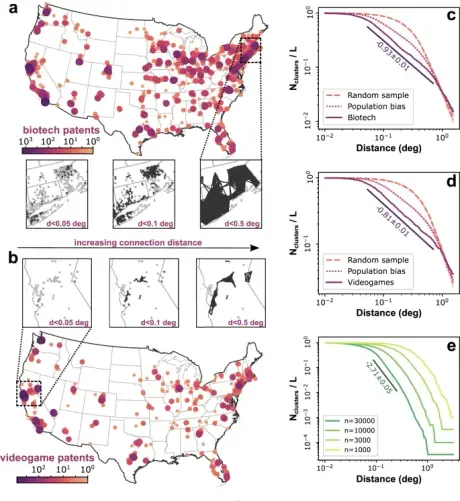
Why are some cities more innovative than others? Mapping more than a century of U.S. patents, our npj Complexity study reveals fractal and scaling patterns in innovation—showing how the distribution of inventors may follow a regular, global geometric pattern emerging from simple rules.

Springer Nature

Fractal clusters and urban scaling shape spatial inequality in U.S. patenting
Salva Duran-Nebreda, Blai Vidiella, R. Alexander Bentley & @svalver
https://www.nature.com/articles/s44260-025-00054-y

Innovation is distributed unevenly across space, yet the mechanisms behind persistent patenting inequality are poorly understood.

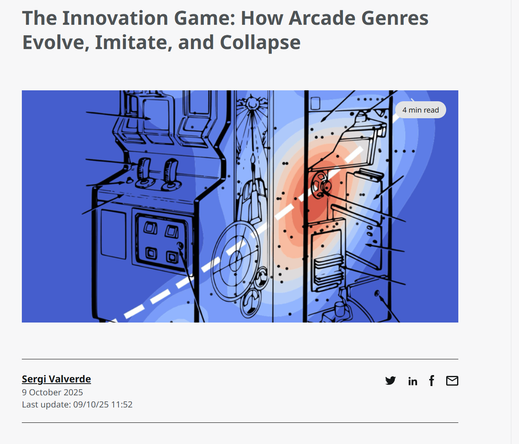
Blog post in the Cambridge University Press blog by @svalver about the macroevolution of arcade games recently published in the "Evolutionary Human Sciences"
https://www.cambridge.org/core/blog/2025/10/09/the-innovation-game-how-arcade-genres-evolve-imitate-and-collapse/
Thanks Ivan Sudakow for organizing workshop on the interactions of statistical physics, tectonics and macroevolution. I've learned many things! James Clerk Maxwell birthplace is also a very symbolic and cozy place.
Exciting paper from Sergi Valverde ( @svalver ) showing similarity in the scientific progress and the technological evolution!
https://academic.oup.com/mbe/advance-article/doi/10.1093/molbev/msaf148/8159018?searchresult=1

Evolution is coupled with branching across many granularities of life
https://royalsocietypublishing.org/doi/10.1098/rspb.2025.0182

Evidence of saltative branching for proteins (aminoacyl transfer RNA (tRNA) synthetases), animal morphologies (cephalopods) and human languages (Indo-European). These three cases provide unique insights

h/t @svalver

When did human language emerge?

It is a deep question, from deep in our history: When did human language as we know it emerge?

This analysis suggests our language capacity existed at least 135,000 years ago, with language used widely perhaps 35,000 years after that

Linguistic capacity was present in the Homo sapiens population 135 thousand years ago
https://www.frontiersin.org/journals/psychology/articles/10.3389/fpsyg.2025.1503900/full

Frontiers | Linguistic capacity was present in the Homo sapiens population 135 thousand years ago

Frontiers

Archaeology and the Construction of Artifact Lineages:
From Culture History to Phylogenetics
Michael O’Brien, Sergi Valverde @svalver et al
https://link.springer.com/article/10.1007/s13752-025-00491-x

Agrees with Niles Eldredge but documenting of (pre)history is only 1st step facing paleobiologists and archaeologists.

Archaeology and the Construction of Artifact Lineages: From Culture History to Phylogenetics - Biological Theory

American archaeology has long been focused on reconstructing past cultures through the description and chronological ordering of items found in the archaeological record. This goal was most evident starting in the early 20th century through what became known as culture history, which in retrospect produced results based on common sense and ethnographic analogues rather than on formal theory. By the mid-1930s, some culture historians realized the lack of testability in their conclusions and began exploring Darwinian evolutionary theory as an alternative. However, their efforts were often ignored or ridiculed, and it wasn’t until the early 1980s that evolutionary theory and associated methods began to play significant roles in archaeology. This acceptance grew from the development of a genetics-based theory of cultural transmission and the introduction of phylogenetic methods into anthropology and archaeology. These methods offered the necessary means for distinguishing between simple historical continuity—one thing following another chronologically—and heritable continuity—how one thing is related to another in terms of descent. Two concepts that play key roles in the reconstruction of cultural phylogenies are tradition and lineage, the former representing patterns of phylogenetic relationship and the latter patterns of genealogical descent.

SpringerLink

Is cultural evolution similar to biological evolution?

Darwin himself became interested in the similarities between natural and human-driven evolutionary change

Punctuated equilibrium in the large-scale evolution of programming languages
Sergi Valverde @svalver and Ricard V. Sole
https://royalsocietypublishing.org/doi/10.1098/rsif.2015.0249

The many ways toward punctuated evolution
Salva Duran-Nebreda, @AndrejPaleobio @svalver et al
https://onlinelibrary.wiley.com/doi/10.1111/pala.12731

Punctuated evolution is a complex pattern resulting from the interaction of both external and internal eco-evolutionary feedback.