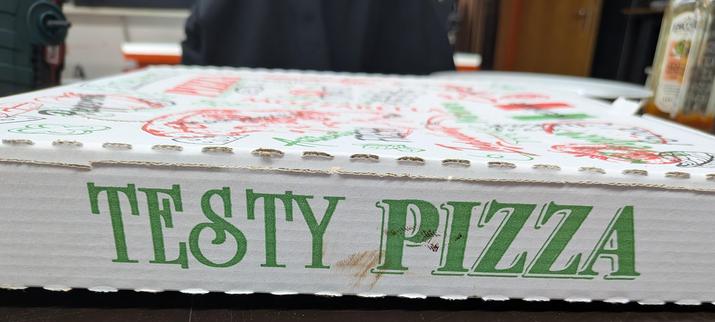
Not one of the adjectives I would use to describe pizza.
| Github | https://github.com/stdlogicvector/ |
Reading a book titled 'Schlieren Methods' and learning about the quantitative applications.
Sadly I cannot find the the mentioned publication my Maksutov. I'd like to know how big that mercury mirror was.
In the same book a method for a large-screen projection system is described. An electron beam charges an oil film whereby its changed reflection produces bright and dark regions in a schlieren setup... What a wonderfully convoluted way to produce an image!


Now with USB3 and 5000fps!
As the sensor doesn't output usable data in the first line of the image I used the space to include metadata. The first 32 pixels contain a framecounter, the next 32 a microsecond timestamp. The remaining 16bit are user programmable, but I might replace that with the exposure time in microseconds.
Above 5kfps I get recording errors despite the datarate being only ~0.35Gbps. But I don't know the cause of the problem yet.
Switched to a different objective and got this amazing shot of a pigeon starting!
(1000 fps -> 25fps)
A lighter being lit, recorded at 2000 fps, played back at 25 fps.
Mastodon won't accept the video directly, so I had to convert to GIF, which introduced the dithering.
I'll try to find a better way to convert...
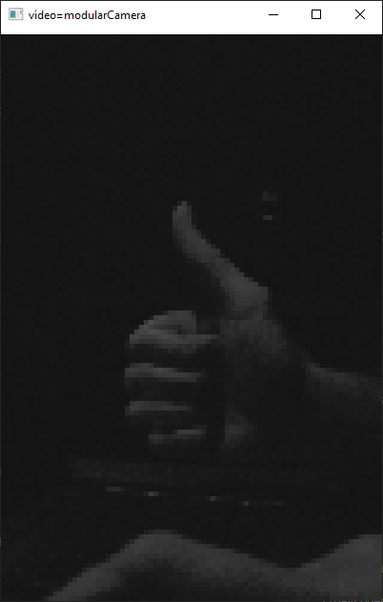
I finally got the data transfer from the AISC110C high-speed camera sensor working!
It's a 5€ chip that outputs 80x120 video at up to 40k fps.
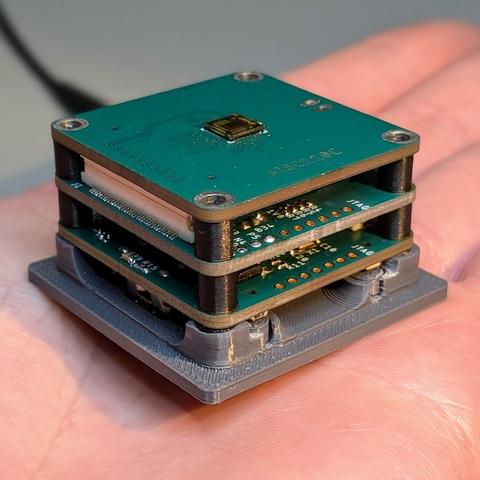
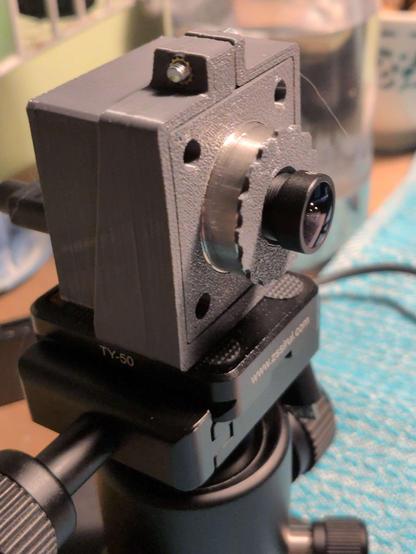
Data is read with a Xilinx Spartan7 and transmitted via USB3 with a Cypress FX3, each on its own little PCB.
The front PCB is exchangeable, making this a neat modular platform. I already have an analog video frontend with the ADV7182 and am working on a Cameralink interface.
Videos are coming tomorrow, I need more light for the high framerates.