Startup Lab

@startuplab
211 Followers
50 Following
76 Posts
I write about business, rationality, productivity, creativity, tech. I'll post everything I learn on the path towards my dream - building a successful startup.
Bloghttps://startuplab.io
Newsletterhttps://startuplab.io/newsletter
Mediumhttps://medium.com/@startuplab
Twitterhttps://twitter.com/StartupLabIO
"You don't want to be in a career where people who have been doing it for two years can be as effective as people who have been doing it for twenty—your rate of learning should always be high. As your career progresses, each unit of work you do should generate more and more results. There are many ways to get this leverage, such as capital, technology, brand, network effects, and managing people."

People are bad at understanding compound growth, there was nothing like that in our ancestral environment, but there's a lot of instances of it in technology and business.

Exponential curves are the key to wealth generation. With technology, more and more businesses will take advantage of network effects and extremes scalability, so we'll see this more and more often.

Think about your life/career from that perspective as well. Move towards a career that has a compounding effect.

I've always wanted to subscribe to the top Product Hunt products via RSS but couldn't. So I've made an rss feed myself:

https://phrss.startuplab.io/

(They have an official feed, but it's a firehose of everything that's submitted and it spams my feed with 100s products every week. My feed contains only the featured ones).

You improve your models of how things work and come up with epiphanies/ideas by taking action and practicing.

Don't wait until you have the perfect startup idea, or have figured out all the answers on how to write well, or have learned all the theory.

Taking action and making things without perfectly seeing the whole picture is uncomfortable, but this is the best way to tweak and improve your model.

Draw your map as your journey towards your goal, not before you get out of the house.

Boredom is valuable, it is a state that drives creativity. When your brain feels bored, but doesn't have the outlet of games, TV, or social media, it will seek other ways to relieve it, which often results in making cool things or thinking up some ideas.

The craving to refresh reddit or RSS has value, it is the same sensation that drives you to do cool stuff. By not refreshing the page, you can "save up" the boredom/dopamine, fuel it into the motivation to do useful things.

Notes on Startup Growth
(Most insightful things I have learned from the recent Startup School lectures)

https://medium.com/@startuplab/notes-on-startup-growth-4af0bf9e9706

Notes on Startup Growth – Startup Lab – Medium

(Most insightful things I have learned from the recent Startup School lectures)

Why retention is important:

If you have 7% revenue churn in a month (you lose 7% of paying users), it doesn't seem like a lot (you still keep 93% of your revenue), but that adds up to 58% in a year. So if you're a $1m/year startup, each year you have to figure out how to make up for $580k in lost revenue, and grow on top of that.

The more you grow, the harder and more expensive it will be for marketing to gain the amount of users you have lost.

Don't keep pouring water into a leaky bucket.

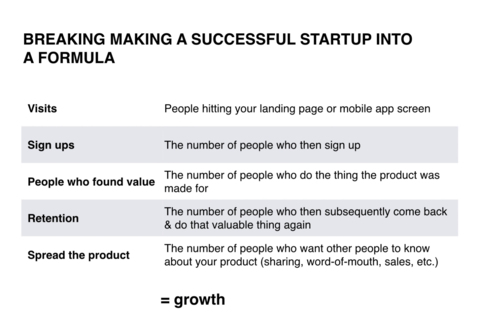
Startup growth formula:

Visits * Sign ups * People who found value * Retention * People who shared product = Growth.

Use these metrics to diagnose why startup is not growing and fix it.

To prioritize - forecast outcomes. How much effort will it take, how much value it will produce? Work on one thing that has the best ratio.

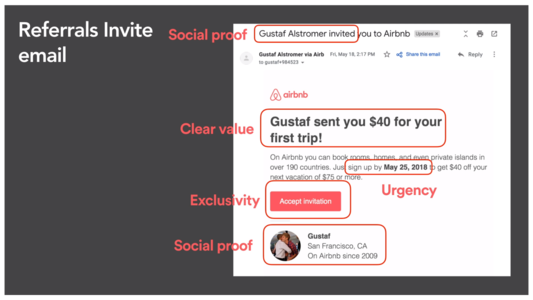
An example of Airbnb optimizing an invite email:

- Use inviter's name in the subject for social proof.

- Use big headline conveying clear value (get $40 on your first trip).

- Create urgency by setting a deadline, the date by which you can accept the invite.

- CTA button says "Accept invitation" instead of just "Sign up" creating more "sense of exclusivity".

- Inviter's name, social image, information on how long he's been a user - creates even more social proof.