It's been months in the making, but it's finally ready. In an interactive article, we provide an entirely new view of the Ukraine war.
Using satellite-based systems, we calculated the intensity of fighting and degree of physical destruction in every corner of the country. As part of it, I developed a machine learning algorithm that uses data on abnormal heat events to detect over 14,000 instances of plausible fighting since the war began.
Register to read for free https://www.economist.com/interactive/2023/02/23/data-from-satellites-reveal-the-vast-extent-of-fighting-in-ukraine

Data from satellites reveal the vast extent of fighting in Ukraine
Scars of the war can be found far beyond the front lines
But at least for right v left lawmakers, the use of internal Twitter data in a study later peer-reviewed makes a pretty clear case. An algorithm bias yes, but boosting parties on the right, not the left.
https://www.economist.com/graphic-detail/2021/11/13/according-to-twitter-twitters-algorithm-favours-conservatives
According to Twitter, Twitter’s algorithm favours conservatives
Its data shows a bias aiding unreliable media, regardless of ideology, and right-wing political parties
And as difficult as studying Twitter is, other platforms are often harder - with no good way to get data at scale (and the need for elaborate methods as a result). Just getting the Instagram posts plotted below took days of work, for instance:
That too, is hard to study. The above graph is based on me manually labeling over two thousand tweets, training a machine learning algorithm on this data, and then using that algorithm to label 3.7m more tweets, which I then analyzed.
https://www.economist.com/graphic-detail/2022/05/14/russia-is-swaying-twitter-users-outside-the-west-to-its-side
Russia is swaying Twitter users outside the West to its side
An army of suspicious accounts began churning out pro-Russian content in March
So is the scale of attempted political manipulation on the site, such as that in all probability seen early this year.
All that said, this is not something that is very easy to study. People outside Twitter do not have access to algorithmic and non-algorithmic feeds at scale. And who uses the platform, who decides to tweet, and who are banned, are different questions.
But it also found that links to websites classified as hyper-partisan/untrustworthy were roughly doubled in the algorithmic feed (in almost all cases these were right-wing).
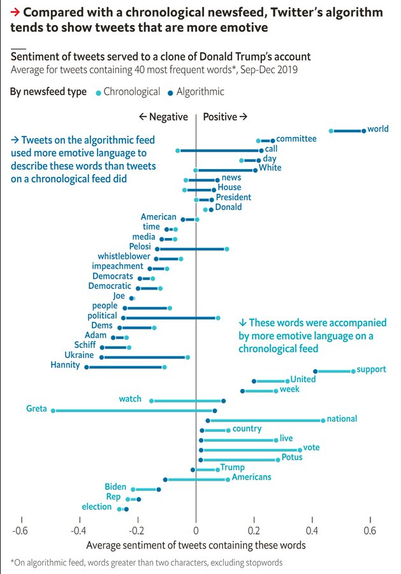
In retrospect, perhaps the most interesting part of that investigation was how the recommendation system changed the emotive content: more fear, anticipation, and anger
To do so, I built a clone of Trump's twitter account and kept it running for months, recording the observed timeline and comparing it to one without a recommendation system (i.e. just the tweets from followed users)
Here, I looked at how the algorithmic timeline could affect the content seen by a particular user -- the most powerful one on the platform at the time.