 Hanami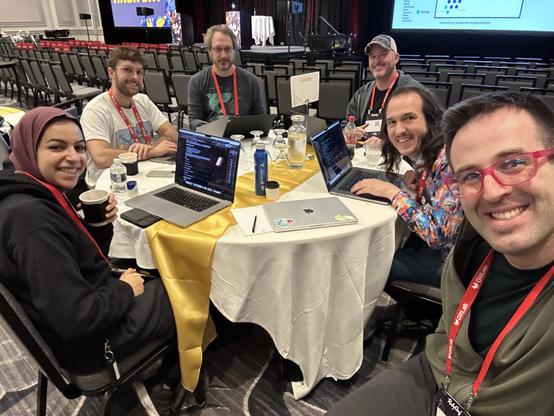
I’m at RubyConf!
Lifelong learner. I’m building a Ruby, called Natalie, for fun. I sometimes record hacking sessions on YT.
| Videos | https://youtube.com/TimMorgan |
| Website | https://timmorgan.dev |
| GitHub | https://github.com/seven1m |

Lifelong learner. I’m building a Ruby, called Natalie, for fun. I sometimes record hacking sessions on YT.
| Videos | https://youtube.com/TimMorgan |
| Website | https://timmorgan.dev |
| GitHub | https://github.com/seven1m |
First merged PR from the #RubyConf24 hack day, thank you @seven1m!

I'm at RubyConf! Thanks for letting me sit at the hack day table and talk about Hanami a bit. If this is the wrong direction, feel free to pick it apart or summarily close if not exactly what y...
This is in contrast to Thread.report_on_exception and Thread#report_on_exception, which seem to behave like a "default" and a "local" as I would expect. Changing Thread.report_on_exception affects any threads created after that, and you can override the setting with Thread#report_on_exception.
Weirdly inconsistent!
There is scarce documentation about this, but my observation is that Thread.abort_on_exception is not a "default" setting for new threads, but rather a sort of "global" setting. If either the global or the local setting is true, then the thread causes the main thread to abort when there is an unhandled exception.
...at least, that's how it appears to work. 😅
