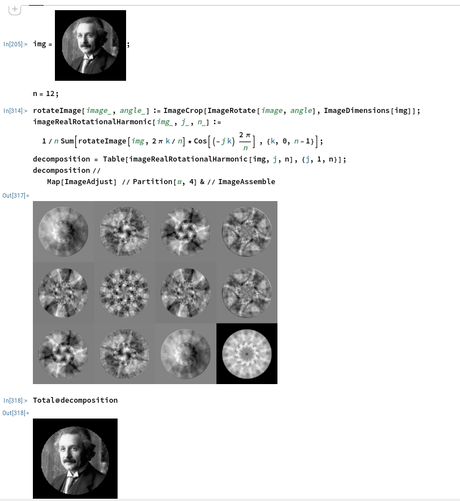
Up to some crazy stuff with image symmetry as a tutorial on Fourier transforms
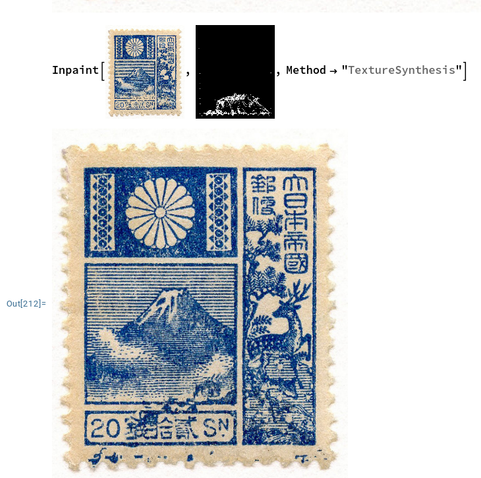
And of course it provides clean access to modern image manipulation tools. This texture synthesis alg is actually a bit too old. I've written my own, but it works here. After this I import the image into GIMP and use a cloning tool on the section that still look wrong.
The entire notebook interface is in fact designed for this purpose. Originally, it was for doing stuff like algebraic manipulation by Mathematicians, but when you think about it, this is a similar process to more artistic work itself. Other programming languages aren't conceived with this sense of collaboration between the language and programmer,
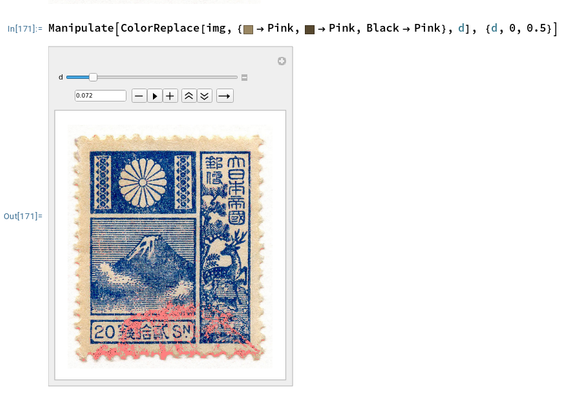
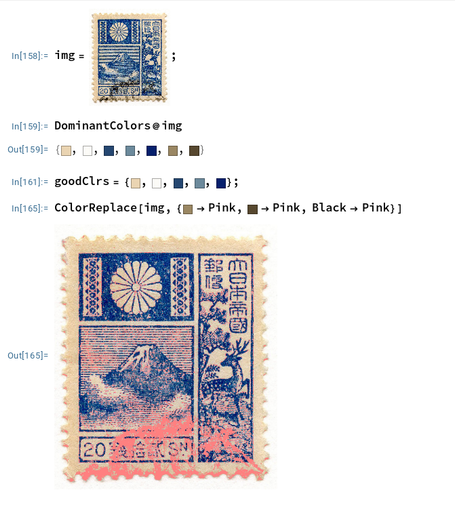
Mathematica is built from the ground up for kind of messy work between formal programming and informal hand exploration. In this case, I've created a UI on the fly to adjust a parameter of an image process algorithm to detect the black stain.
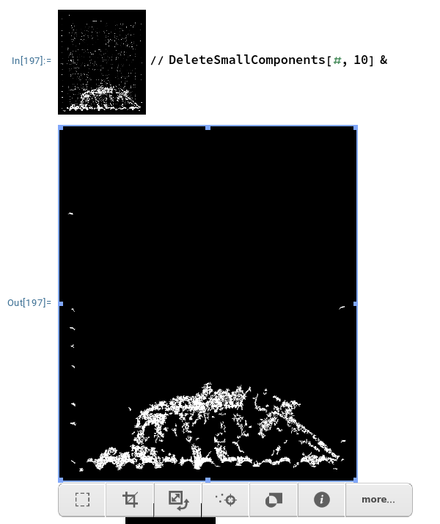
I'm using Mathematica for most of this work. And what the code below illustrates for me is how important the UI is. Colors and Images are first class objects that we can manipulate both programmatically and in a manual style. It's possible to mix and develop both kinds of workflows together. In this case I'm getting the major colors to get a rough mask of the black stain.
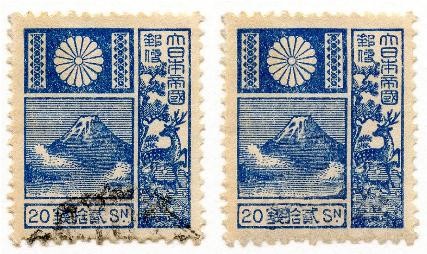
A short write up on how I performed a cleanup of this beautiful stamp. Because it encompasses a lot of about what I think about when it comes to images and art and practice.
We don't appreciate enough how recent and difficult our modern system of positional numbers is, but sometimes non-positional number systems have cool benefits. Like this example in Japanese where they can write (the years 27 thru 28) by writing "2 x 7 8". I secretly dream of being to insane write stuff like "2k(9)(x3)" for "2009-2013"
100% sure this looks pathetic, but I'm sorta proud. After many many years without touching diff eqs I read an article today that mentioned solving a linear ode with an integrating factor and I was able to stumble thru deriving the basic integrating factor for linear ODEs without cheating and looking at Wikipedia. Fear me.
https://en.m.wikipedia.org/wiki/Integrating_factorIntegrating factor - Wikipedia
Saw a tweet today saying : "Given a regular n-gon inscribed in a unit circle, the product of the chords from one vertex of the polygon to all the others is equal to n." Which is pretty beautiful... so naturally I tried to work it out in Mathematica.. As a formal product its:
Product[Abs[1 - E^((2 Pi I theta)/n)], {theta, 1, n - 1}]
And Mathematica didn't solve it! (1)
At cafe working. Decide to take a break. See a Japanese cooking video that seems interesting and click it. Oh no my headphones are plugged in. Oh no it's one of those Japanese cooking videos that starts with the chef screaming "GOOD MORNING" and his name and stuff at you.
The entire cafe just seems me floundering and struggling as a man screaming in Japanese blasts from my speakers.