Sarah Warnau

@sarahwarnau
2 Followers
5 Following
8 Posts
I am a PhD candidate at #WageningenUniversity and at Wetsus centre for sustainable water technology. In my research I brings together meteorology and water technology to investigate the potential for freshwater production through Technology-Enhanced Atmospheric Moistening.
pronounsshe/her

New publication! πŸ“šβœ¨

As part of the @nextgems_eu project, Junhong Lee and I investigated how morning soil moisture differences relate to afternoon precipitation in two high resolution climate models

Why does this matter? πŸ€” Because getting these feedbacks right is crucial for reliable projections of extreme precipitation, drought, and heatwaves.

Read the article here: https://doi.org/10.1186/s40562-026-00461-6

Spatial and temporal preferences for afternoon precipitation over morning soil moisture in global storm-resolving simulations - Geoscience Letters

This study firstly examines both spatial and temporal preferences for afternoon precipitation over morning soil moisture using global storm-resolving simulations from two state-of-the-art km-scale Earth system models: the ICOsahedral Non-hydrostatic (ICON) and integrated forecasting system (IFS). These results are compared with coarse-resolution simulations from the Max Planck Institute Earth System Model (MPI-ESM). Our analysis reveals distinct preference patterns across the models. In ICON with resolved convection, afternoon precipitation is likely to develop over drier soil than the surrounding areas with high heterogeneity, possibly suggesting that mesoscale circulation plays a crucial role. Temporal preferences for afternoon precipitation vary across regions. In contrast, IFS with partially parameterized convection, intended to increase convective system size, shows a preference for temporally drier-than-normal soils, but no spatial preference, implying a strong influence of large-scale coupling. MPI-ESM with fully parameterized convection demonstrates an opposite pattern, favoring wetter soil than the surrounding areas, consistent with previous studies.
SpringerLink

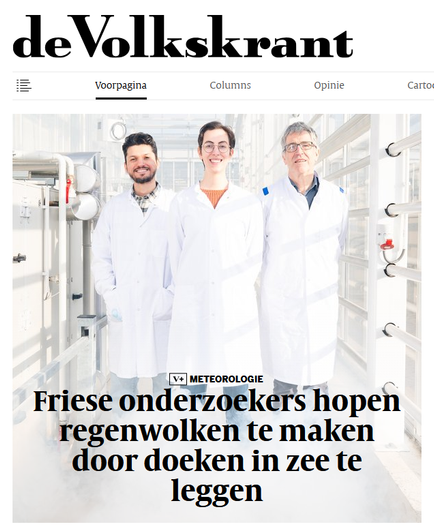
Excited to share that my research at Wetsus and Wageningen University & Research got featured in de Volkskrant! You can find the article online through the link below or in print tomorrow (Saturday February 7th)!

Photo by Jan Mulders for de Volkskrant

https://www.volkskrant.nl/wetenschap/friese-onderzoekers-hopen-regenwolken-te-maken-door-doeken-in-zee-te-leggen~b0f2d06d/

🌳 New publication in EGU Biogeosciences!

We modeled the atmospheric boundary layer development throughout the Mediterranean basin to find out where convective rainfall is sensitive to the land cover: forest or bare soil. The results give valuable insights regarding the hydrological impact of potential forestation projects.

If you want to find out more, you can read the full article here https://lnkd.in/erPRHHAG

LinkedIn

This link will take you to a page that’s not on LinkedIn

🌍 New publication alert!

I am proud to share the overview paper of the nextGEMS | next Generation Earth Modelling Systems project where we show the progress made in this international collaboration pushing the limits of what is possible with global climate models.

Participating in the nextGEMS hackathons has taught me to work with high-res climate data and let to new research directions and collaborations!

πŸ‘‰ Read the paper here https://doi.org/10.5194/gmd-18-7735-2025

nextGEMS: entering the era of kilometer-scale Earth system modeling

Abstract. The Next Generation of Earth Modeling Systems (nextGEMS) project aimed to produce multidecadal climate simulations, for the first time, with resolved kilometer-scale (km-scale) processes in the ocean, land, and atmosphere. In only 3 years, nextGEMS achieved this milestone with the two km-scale Earth system models, ICOsahedral Non-hydrostatic model (ICON) and Integrated Forecasting System coupled to the Finite-volumE Sea ice-Ocean Model (IFS-FESOM). nextGEMS was based on three cornerstones: (1) developing km-scale Earth system models with small errors in the energy and water balance, (2) performing km-scale climate simulations with a throughput greater than 1 simulated year per day, and (3) facilitating new workflows for an efficient analysis of the large simulations with common data structures and output variables. These cornerstones shaped the timeline of nextGEMS, divided into four cycles. Each cycle marked the release of a new configuration of ICON and IFS-FESOM, which were evaluated at hackathons. The hackathon participants included experts from climate science, software engineering, and high-performance computing as well as users from the energy and agricultural sectors. The continuous efforts over the four cycles allowed us to produce 30-year simulations with ICON and IFS-FESOM, spanning the period 2020–2049 under the SSP3-7.0 scenario. The throughput was about 500 simulated days per day on the Levante supercomputer of the German Climate Computing Center (DKRZ). The simulations employed a horizontal grid of about 5 km resolution in the ocean and 10 km resolution in the atmosphere and land. Aside from this technical achievement, the simulations allowed us to gain new insights into the realism of ICON and IFS-FESOM. Beyond its time frame, nextGEMS builds the foundation of the Climate Change Adaptation Digital Twin developed in the Destination Earth initiative and paves the way for future European research on climate change.

πŸŽ‰ My first PhD paper has been published in Environmental Science & Technology!

In this article, we explore a completely new way to produce freshwater on a large scale for people and nature restoration: Technology-Enhanced Atmospheric Moistening (TEAM), deliberately moistening the atmosphere to generate more rain.

Read the publication here: https://lnkd.in/e-XwmcM9
I'd love to hear your thoughts!

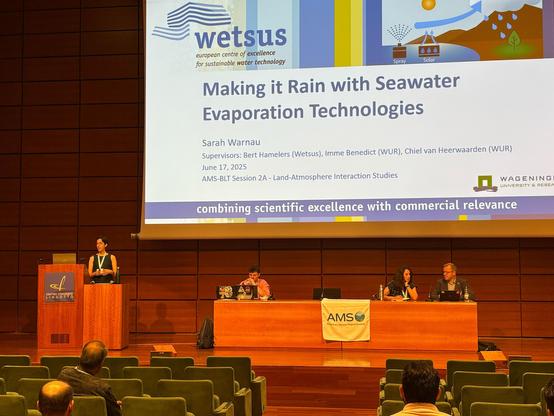
Last week I presented at the AMS Boundary Layer and Turbulence Symposium in Turin! I showed recent results of modelling the large scale evaporation of seawater and how that impacts the atmospheric moisture content downstream. My goal is to see if it is possible to make it rain more in coastal dryland regions using seawater evaporation technologies.
It was a great week full of interesting talks and conversations with the international atmospheric boundary layer community!
#25BLT #Wetsus #WUR
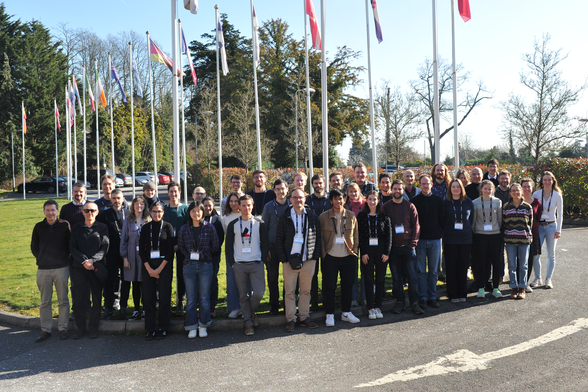
Thanks a lot to all the teachers and participants of the @ECMWF course on subgrid parameterization of physical processes. It was a very interesting and fun week!

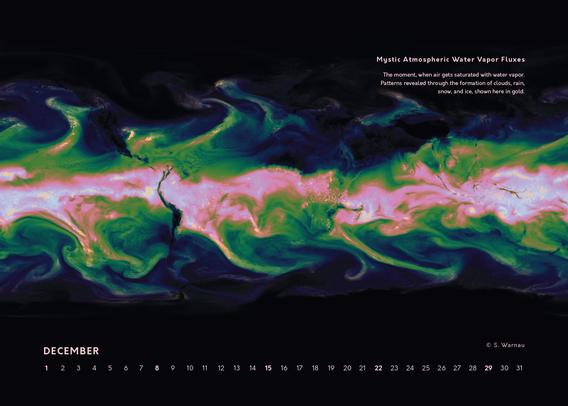
πŸ“† As we step into the final month of the year, #nextGEMS is excited to present the last masterpiece from its 2024 #ScienceArt calendar! 🎨

🌨️ This stunning contribution, titled "Mystic Atmospheric Water Vapour Fluxes," was crafted by project partner Sarah Warnau, from Wageningen University. The artwork beautifully visualizes the formation of clouds, rain, snow, and ice, brought to life through glittering dispersed patterns.✨

#ClimateScience #EarthSystemModelling #SciComm #Clouds