
Romain Brette
@romainbrette
- 563 Followers
- 38 Following
- 35 Posts
I'm a theoretical neuroscientist in Paris.
 Le Néandertal se sent las, las
 The Transmitter
Paul Middlebrooks talks with @romainbrette about his new book, “The Brain, In Theory,” which offers alternatives to many of the computer science frameworks currently driving theoretical neuroscience.
"The Brain, In Theory" is out today!
A short excerpt in The Transmitter:
https://www.thetransmitter.org/theoretical-neuroscience/the-brain-in-theory-an-excerpt/

‘The Brain, In Theory,’ an excerpt
In his new book, Brette pushes back against theories that describe the brain as a “biological computer.” In this excerpt from Chapter 4, he challenges equating brain evolution with programming, and the universality of neural network models.
New preprint: “A dynamical perspective on biological reproduction”
https://hal.science/hal-05491732
I replace von Neumann's self-reproducing machine with a dynamical model of reproduction, in which invariant reproduction occurs as a result of convergence to a fixed point - ie, an emerging property. The genome then becomes a transmissible developmental constraint, not a representation of the organism. With many examples from Paramecium biology ;)
A dynamical perspective on biological reproduction
Classically, biological reproduction is explained as the building of a new organism from replicated genomic instructions. The corresponding theoretical model is von Neumann's self-reproducing machine, which relies on an invariant universal constructor that can build any machine from instructions. However, the reproductive incompatibility of species and the diversity of developing processes speak against the existence of a universal constructor. Without a universal constructor, the genome as representation of the organism is circularly defined: what the genome represents is specified by the developmental processes represented by the genome.<p>I propose to take invariant reproduction not as a premise, but as an emergent dynamical property.</p><p>Reproduction is seen as the iteration of a transform that maps one generation to the next, a transform shaped by the genome. Invariant reproduction then occurs when a reproductive sequence converges to a fixed point. A reproductive sequence may also diverge, converge to a cycle (multigenerational life cycle), or to one of several fixed points (non-genomic inheritance). When it does converge, it is necessarily to a stable point, implying that development is robust to perturbations. Finally, speciation can be understood as a process by which reproductive transforms become mutually incompatible, that is, the basins of attractions of the fixed points do not overlap any more. In this view, the genome is an inheritable constraint on development, not a representation of the organism. I suggest that this dynamical framework is a more coherent model of biological reproduction than von Neumann's computational framework.</p>
 Cian O’Donnell
gave a short lecture this morning on principles of computational modelling, always try to stress the point made by @romainbrette that adding details to a model does not automatically make it more realistic.
The wooden airplane model has more 'details' but only the paper model can fly

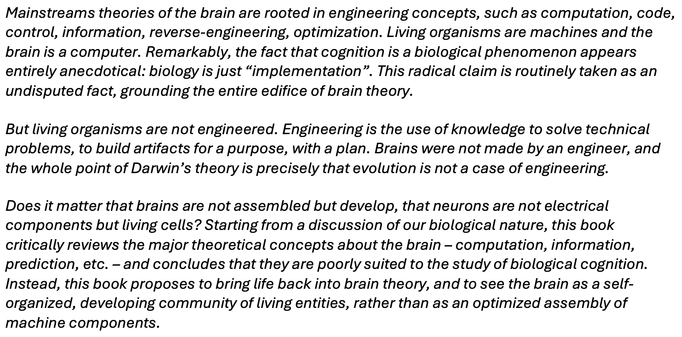
I wrote a book: "The brain, in theory" (to be published by Princeton University Press).
First chapter and TOC:
http://romainbrette.fr/WordPress3/wp-content/uploads/2024/12/The-brain-in-theory-TOC-and-first-chapter.pdf
Just published: "Theory of axo-axonic inhibition".
https://journals.plos.org/ploscompbiol/article?id=10.1371/journal.pcbi.1013047
I show that chandelier cells, which target the AIS of principal cells of cortex and hippocampus, inhibit by raising the spike threshold in an ohmic fashion (proportional to the synaptic current). This is the case also if the synaptic current is depolarizing (as long as the reversal potential is below spike threshold).

Theory of axo-axonic inhibition
Author summary Chandelier cells form GABAergic synapses on the initial segment of pyramidal cells of the cortex and hippocampus. Despite their striking morphology and alterations in neurological diseases such as epilepsy, their functional role remains unclear. This study develops a quantitative theory to precisely assess the electrical impact of a synaptic input at the proximal axon. It shows that axo-axonic inhibition acts by shifting the action potential threshold proportionally to the synaptic conductance. This work underlines the role of chandelier cells in controlling action potential initiation and provides a quantitative tool to interpret experimental observations.
I reviewed Farid Zahnoun's book, The embodiment of meaning:
https://rdcu.be/dJaTO
Great book demonstrating the incoherence of functionalism, the mainstream doctrine that claims that mind is essentially the causal organization of functional states.
 Comité pour la science ouverte
Prix science ouverte - logiciel libre Catégorie Documentation
Brian : simulateur de réseaux de neurones biologiques à impulsions, conçu pour permettre le développement rapide de nouveaux modèles.
@sup_recherche #prixscienceouverte
#scienceouverte #opensource #logiciellibre


 Marcel Stimberg
The Brian simulator (still not on Mastodon 😲) just won a prize by the French government (open source research software, category documentation) 🍾
https://social.numerique.gouv.fr/@ouvrirlascience/111493886838813874

Comité pour la science ouverte (@[email protected])
Attaché : 1 image Prix science ouverte - logiciel libre Catégorie Documentation Brian : simulateur de réseaux de neurones biologiques à impulsions, conçu pour permettre le développement rapide de nouveaux modèles. @sup_recherche #prixscienceouverte #scienceouverte #opensource #logiciellibre https://github.com/brian-team/brian2