New research by McCartan and colleagues explores the nuances of climate change impacts on host-parasite dynamics
https://journals.plos.org/climate/article?id=10.1371/journal.pclm.0000632


Non-profit, Open Access and multidisciplinary journal for climate research.
Editors-in-Chief: Niklas Boers & Sirkku Juhola
Executive Editor: Jamie Males
| Homepage | http://plosclimate.org/ |
| https://www.linkedin.com/company/plosclimate/ | |
| Bluesky | https://bsky.app/profile/plosclimate.org |
New research by McCartan and colleagues explores the nuances of climate change impacts on host-parasite dynamics
https://journals.plos.org/climate/article?id=10.1371/journal.pclm.0000632
New Essay by Yule et al.:
"The opportunities and challenges of developing and implementing local climate adaptation targets"
https://journals.plos.org/climate/article?id=10.1371/journal.pclm.0000634

There's still time to sign up for today's webinar on Key Priorities for Open Climate Research in Europe!
10am UTC/11am CET
Register here: https://plos.zoom.us/webinar/register/WN_jz-FPDxRSiCAZBjswIA7Yg
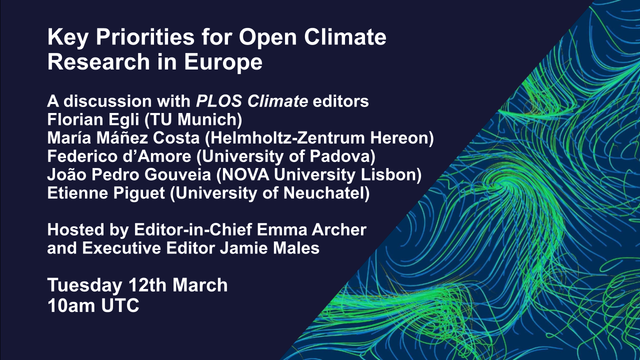

In this online event, members of PLOS Climate's editorial board will share perspectives on the key priorities for climate research in Europe, including opportunities provided by Open Science approaches. We will also highlight opportunities to publish your research in our Open Access, non-profit journal. Hosts: Jamie Males, Executive Editor, PLOS Climate Emma Archer, Editor-in-Chief, PLOS Climate Speakers: Florian Egli, Academic Editor, PLOS Climate- TU München, Germany María Máñez Costa, Academic Editor, PLOS Climate- Helmholtz-Zentrum Hereon, Germany Federico D’Amore, Academic Editor, PLOS Climate- Università di Padova, Italy João Pedro Gouveia, Academic Editor, PLOS Climate- Universidade Nova de Lisboa, Portugal Etienne Piguet, Academic Editor, PLOS Climate- Université de Neuchâtel, Switzerland Denia Kolokotsa, Section Editor, PLOS Climate- Technical University of Crete, Greece
Join us tomorrow for a discussion of the Key Priorities for Open Climate Research in Europe!
Register here: https://plos.zoom.us/webinar/register/WN_jz-FPDxRSiCAZBjswIA7Yg
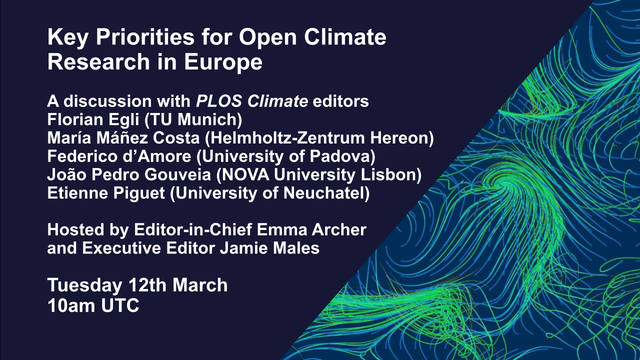
In this online event, members of PLOS Climate's editorial board will share perspectives on the key priorities for climate research in Europe, including opportunities provided by Open Science approaches. We will also highlight opportunities to publish your research in our Open Access, non-profit journal. Hosts: Jamie Males, Executive Editor, PLOS Climate Emma Archer, Editor-in-Chief, PLOS Climate Speakers: Florian Egli, Academic Editor, PLOS Climate- TU München, Germany María Máñez Costa, Academic Editor, PLOS Climate- Helmholtz-Zentrum Hereon, Germany Federico D’Amore, Academic Editor, PLOS Climate- Università di Padova, Italy João Pedro Gouveia, Academic Editor, PLOS Climate- Universidade Nova de Lisboa, Portugal Etienne Piguet, Academic Editor, PLOS Climate- Université de Neuchâtel, Switzerland Denia Kolokotsa, Section Editor, PLOS Climate- Technical University of Crete, Greece
Join us next Tuesday 12th March at 10am UTC for a free webinar on Key Priorities for Open Climate Research in Europe! 🔑
Speakers include PLOS Climate editors Florian Egli, João Pedro Gouveia, Etienne Piguet, María Máñez Costa & Federico d'Amore
Register here:
https://plos.zoom.us/webinar/register/WN_jz-FPDxRSiCAZBjswIA7Yg
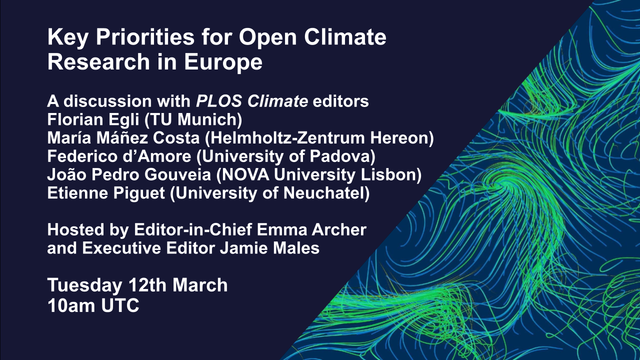
In this online event, members of PLOS Climate's editorial board will share perspectives on the key priorities for climate research in Europe, including opportunities provided by Open Science approaches. We will also highlight opportunities to publish your research in our Open Access, non-profit journal. Hosts: Jamie Males, Executive Editor, PLOS Climate Emma Archer, Editor-in-Chief, PLOS Climate Speakers: Florian Egli, Academic Editor, PLOS Climate- TU München, Germany María Máñez Costa, Academic Editor, PLOS Climate- Helmholtz-Zentrum Hereon, Germany Federico D’Amore, Academic Editor, PLOS Climate- Università di Padova, Italy João Pedro Gouveia, Academic Editor, PLOS Climate- Universidade Nova de Lisboa, Portugal Etienne Piguet, Academic Editor, PLOS Climate- Université de Neuchâtel, Switzerland Denia Kolokotsa, Section Editor, PLOS Climate- Technical University of Crete, Greece
In a new Review article, Läderach et al. highlight opportunities to leverage #ClimateFinance for synergistic, cross-sectoral risk reduction
https://journals.plos.org/climate/article?id=10.1371/journal.pclm.0000355

A convergence of several risk drivers creates the compound crises we see across the globe today. At the same time, the global humanitarian community and national institutions in affected countries are increasingly resource constrained. In this context, existing financing mechanisms should be evaluated for their potential to create synergies between social protection, peace, and inclusion objectives on the one hand and climate resilience outcomes on the other. The existing international architecture of climate change mitigation and adaptation policy and financing holds, in principle, the potential to address not only its main purpose of climate action, but also to contribute to development outcomes and address multiple risk drivers. Examples of this exist, but for these mutual benefits to emerge, and for climate finance to contribute more significantly to crises prevention, the agendas must become more aligned. Aligning several factors may enable coherence: i) Timeframes, from short-term response to multi-year programming; ii) Planning and targeting, moving towards conflict-sensitive area-based approaches and universal access to services; iii) Institutional arrangements and partnerships, coordinated national planning and jointly implemented local action.
📢 New Opinion article:
Sudeepa Khanal, Gabriele Bolte & Melanie Boeckmann highlight the need for cross-sectoral integration to advance health equity in climate action.
🔗 https://journals.plos.org/climate/article?id=10.1371/journal.pclm.0000349

In a new Opinion article for our APECS Collection, Melina Kourantidou lays out how economic tools can support Indigenous climate resilience in the Arctic
https://journals.plos.org/climate/article?id=10.1371/journal.pclm.0000342
Economic tools remain under-used in addressing multiple challenges faced by indigenous communities in the rapidly changing Arctic. While there are multiple explanations for this under-use, perceptions that economic principles diverge from indigenous value systems and are rooted in Western paradigms limit the uptake of these tools to bolster resilience in the face of climate change. Nevertheless, Indigenous communities are expected to integrate their traditional systems with the historically imposed colonial systems of resource extraction to sustain their economies and community wellbeing that are challenged by environmental shifts and socioecological transitions. These changes manifest in resource use, availability and management and affect the ways Indigenous knowledge has traditionally guided resource exploitation decisions and practices. Using select examples, this paper argues that economic approaches to the management of marine resources have the potential to improve the well-being and resilience of indigenous Arctic communities. While more work is needed to tailor economic tools to the specific needs of indigenous people, the integration of resource economics and traditional approaches to resource management holds promise for strengthening Indigenous resilience in the face of the profound challenges posed by climate change.
Check out our updated homepage, featuring new research, reviews and opinion on topics including anthropogenic forcing of hydroclimate, broad inference in ecology and evolution, crop yield projections under CMIP6, and much more!