407 Followers
4 Following
28 Posts
We develop and distribute open-source tools for neuroscience.
Websitehttps://open-ephys.org
What a great first day at #FENS2024! Come see the open source tools we make in action: our extracellular ephys acquisition board, the UCLA Miniscopes, our new ONIX multimodal system (for neuropixels probes!), the HARP behavior board, and more!

We taught about this at the fantastic workshop organized by @ggatto of the CRC1451 in Cologne, with Sam Sober and Amanda Jacob.

Reach out if you want to give this technique a try!

Looking for a high-resolution readout of motor neuron activity to study fine details of behavior?

Check out what you can do with CAMBER #myomatrix arrays and our Acquisition Board in this blog post.

https://open-ephys.org/blog/2024/3/22/emg-recordings-with-our-acquisition-board

Looking at single motor units during behavior with our Acquisition Board — Open Ephys

We just wrapped another fantastic workshop, this time about using high-resolution EMG recordings to untangle single motor unit contributions to behavior! The workshop was focused around the new high-density muscle electrode arrays called myomatrix , and it turns out these are really easy to use wit

Open Ephys
3/3 And, yes, our swag came with a datasheet 🤓. Already looking forward to next year's art project...
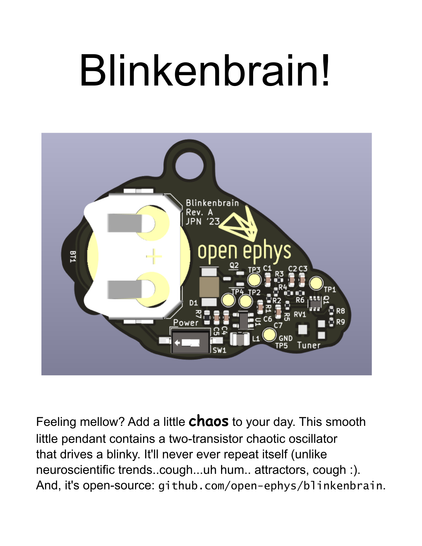
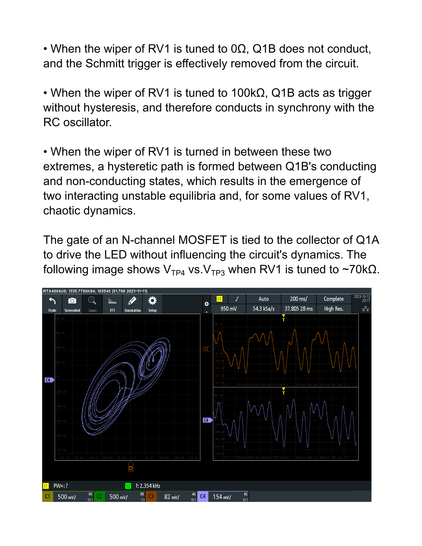
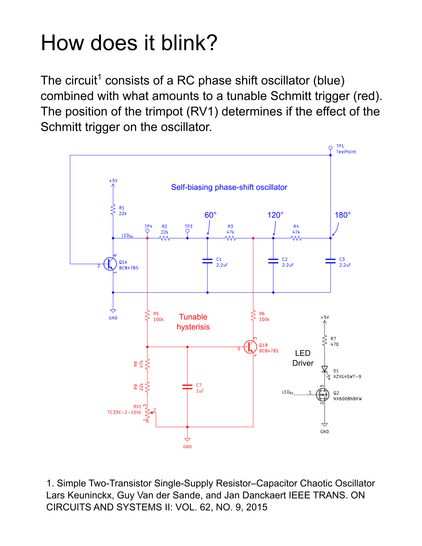
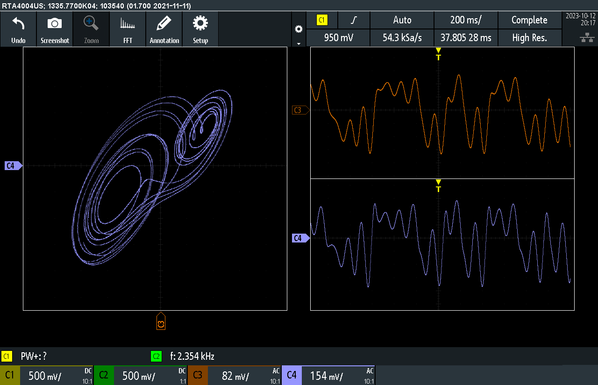
2/3 It has an analog, 2 transistor, chaotic attractor that drives an LED.
1/3 In case you missed the Open Ephys SfN booth this year, here are the designs for our Blinkenbrain chaotic key chain swag: https://github.com/open-ephys/blinkenbrain
It's a smooth-brained, analog, chaotic (in the formal sense) blinky!
GitHub - open-ephys/blinkenbrain: Mouse brain pendant with chaotic tendencies

Mouse brain pendant with chaotic tendencies. Contribute to open-ephys/blinkenbrain development by creating an account on GitHub.

GitHub
@andyalexander End of october. We will post when the store goes live.
This is all built on an open hardware standard and API (https://open-ephys.github.io/ONI/) that is flexible enough to work, even simultaneously, with passive electrodes, Neuropixels, or Miniscopes, and whatever other sensors, actuators, or software you might want use. (3/3)
Home — ONI

This system by
@openephys, Jon Newman, Jack Zhang, Aarón Cuevas-López, Jakob Voigts et al. uses an extremely thin tether that streams a ton of data but keeps behavior intact. Through a lot of engineering it also provides sub-ms closed-loop latencies, 3D-tracking and more. (2/3)
It's an unspoken fact that freely moving lab mice are not really freely moving. We came up with a method to change this. See the preprint: https://biorxiv.org/content/10.1101/2023.08.30.554672v1 (1/3)