Norbert Lindenberg

77 Followers
87 Following
101 Posts
Working on fonts, keyboards, tools, and standards for Brahmic scripts.
Workhttps://lontar.eu

Unicode 17 includes a change that may improve line breaking, backspacing, and other behavior for Khmer, Myanmar, and twelve other Brahmic scripts: Extended grapheme cluster breaks, which may be used in such processes to identify “characters”, no longer occur within sequences of a conjoiner and a consonant in these scripts. Such sequences represent conjunct forms that users see as indivisible entities.

See

https://www.unicode.org/reports/tr44/tr44-36.html#Derivation_InCB

https://www.unicode.org/L2/L2024/24058r-conjuncts.pdf

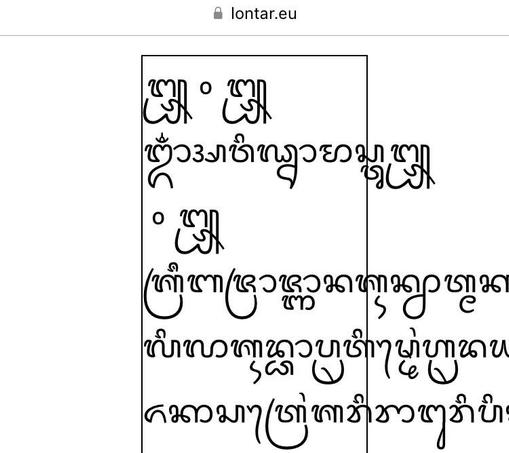
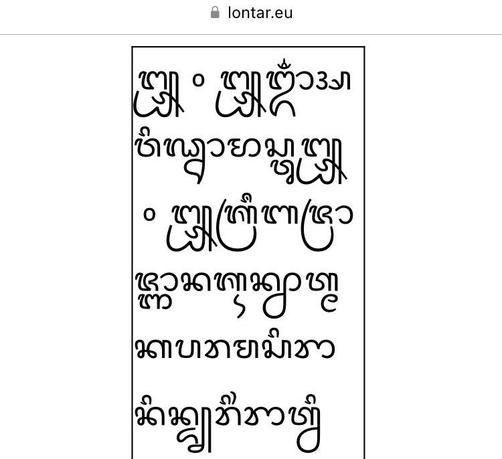
After Safari and Chromium-based browsers, now Firefox finally also provides correct line breaking at orthographic syllable boundaries for several Brahmic scripts such as Balinese and Javanese. This style of line breaking was originally proposed in
https://www.unicode.org/L2/L2022/22080r2-line-break-ortho-bnd.pdf
and standardized in Unicode 15.1
https://www.unicode.org/reports/tr14/tr14-51.html

The screen shots show line breaking for Balinese in the past and the present. The text is supposed to stay inside the box.

New article:

Order and disorder in Unicode

The Unicode Standard lacks well-defined encoding orders for the orthographic syllables of Brahmic scripts. This creates problems such as missing search results, incorrectly rendered text, and security holes. This article discusses the causes of these problems and various localized attempts at solving them. It proposes a new form of normalization as a more generic solution.

https://lontar.eu/en/notes/order-and-disorder-in-unicode/

New article: Introduction to Brahmic scripts

…covering their usage for major languages, their characteristics as an abugida, the formation of orthographic syllables, and layout issues.

https://lontar.eu/en/notes/introduction-to-brahmic-scripts/

Introduction to Brahmic scripts

Updated article: Encoding orders of Brahmic scripts

Documents the encoding orders that the OpenType Universal Shaping Engine assumes for the Brahmic scripts it supports. Understanding encoding orders is necessary when rendering or otherwise interpreting text in these scripts, as well es when entering text using input methods or otherwise generating text.

Updated for Unicode 16.0 and latest USE documentation and data.

https://lontar.eu/en/notes/encoding-orders-of-brahmic-scripts/

Encoding orders of Brahmic scripts

So nice to see that Safari now provides correct line breaking for Balinese, Javanese, and other scripts, as proposed in
https://www.unicode.org/L2/L2022/22080r2-line-break-ortho-bnd.pdf

Screen shots show line breaking for Balinese in iOS 17.3 and today’s iOS 17.4. The text is supposed to stay inside the box.

New article: Encoding orders of Brahmic scripts

Documents the encoding orders that the OpenType Universal Shaping Engine assumes for the Brahmic scripts it supports. Understanding encoding orders is necessary when rendering or otherwise interpreting text in these scripts, as well es when entering text using input methods or otherwise generating text.

https://lontar.eu/en/notes/encoding-orders-of-brahmic-scripts/

Encoding orders of Brahmic scripts

iOS 17 finally includes a font for the Batak script that renders text as required by the Unicode Standard: In the word “ᯖᯪᯇ᯲” , the vowel “◌ᯪ” must be shown after the final consonant “ᯇ” even though it’s pronounced and encoded before it. The font is the current release of Google’s Noto Sans Batak, which has adopted the implementation technique I developed in “Constructing fonts for the Batak script”.

https://lontar.eu/en/notes/constructing-fonts-for-batak/

Constructing fonts for the Batak script

Aditya Bayu Perdana illuminates use of Balinese musical symbols and non-use of Sasak characters in new Unicode Technical Note:

https://www.unicode.org/notes/tn51/

UTN #51 Musical Symbols and Sasak Characters in the Balinese Script

Jikji, the oldest surviving document that was printed with movable metal type, 1377 in Cheongju, Korea, is currently on display as part of the exhibition “Imprimer ! L’Europe de Gutenberg” at the Bibliothèque national de France in Paris.

https://www.bnf.fr/en/agendaEN/printing-gutenbergs-europe

Printing! Gutenberg’s Europe

BnF – Institutional website

BnF – Institutional website