Nino Kadic

@ninokadic
2.7K Followers
3.4K Following
1.9K Posts
Postdoc at the Institute of Philosophy, Zagreb | PhD, King’s College London | Primarily working on mind and metaphysics 💭
LocationZagreb, Croatia
Websitehttps://www.ninokadic.com/

The question of whether AI is already conscious, and whether it deserves moral status, largely depends on which approach we consider. Someday, we may face tough questions about how we define consciousness and assign moral status. #philosophy #AI

https://substack.com/@ninokadic/note/c-188218114?r=1uhg5t

Nino Kadic (@ninokadic)

The question of whether AI is already conscious, and whether it deserves moral status, largely depends on which approach we consider. Someday, we may face tough questions about how we define consciousness and assign moral status.

Substack

In my first Substack post, I write about why panpsychism - the view that consciousness is everywhere - should be taken seriously. While seemingly radical, it rests on a set of individually compelling premises about the nature of reality. Subscribe for more! ✨

Link: https://open.substack.com/pub/mindmonads/p/why-take-panpsychism-seriously?r=1uhg5t

#panpsychism #philosophy #consciousness

Why take panpsychism seriously

The radical idea that consciousness is everywhere

Mind Monads
I keep talking about panpsychism, but I have papers in the making on the vagueness argument, Russellian physicalism, and on the philosophy of Raymond Tallis. Will be posting them here, I believe most will be open access.

We're all fundamental. Here's my weird take on #panpsychism. Open-access article! 🙂

https://link.springer.com/article/10.1007/s11229-023-04464-0

Monadic panpsychism - Synthese

One of the main obstacles for panpsychism, the view that consciousness is fundamental and ubiquitous, is the difficulty of explaining how simple subjects could combine to form complex subjects. Known as the subject combination problem, it poses a possibly insurmountable challenge to the view. In this paper, I will assume that this challenge cannot be overcome and instead present a version of panpsychism that completely avoids talk of combination. Inspired by Gottfried Wilhelm Leibniz’s metaphysics of monads, I will focus on a relational explanation of how simple subjects could constitute complex experiences, without them having to combine in virtue of their subjectivity. I call this view monadic panpsychism. Additionally, my proposal will not rely on emergence and so it will circumvent problems commonly faced by emergentist accounts. As I will argue, monadic panpsychism is preferable to combinatory and emergentist panpsychism because it faces a significantly less worrisome set of objections. Apart from being unaffected by the seemingly insuperable issue of subject combination, I will demonstrate that monadic panpsychism also has tools to address other kinds of the combination problem. That alone justifies the need for a new formulation of panpsychism, one which faces unique difficulties but also offers unique solutions.

SpringerLink
@davidruffner Yeah, the combination problem is a major issue for some forms of panpsychism. I tried instead to avoid it by presenting my own version of the view - monadic panpsychism - without combination or radical emergence, but with its own set of problems (that I think are less serious).

@ninokadic I am into this idea that all physical things have an inner and outer aspect. For simpler objects like electrons or protons, the outer aspect would be describable with physics. But the inner aspect is some kind of extremely simple consciousness along with a limited ability to make choices (consistent with quantum mechanics). Combinations of things can in turn have their own inner and outer aspect. So more complex combinations might be able to physically do more things and might have a correspondingly more complex consciousness. I still think the components that are part of this system still have their own consciousness. I'm not sure how the combination consciousness forms or disappears and the combination is built or broken apart. I think this is something you study.

I have come to these ideas through reading various sources including Pierre Teilhard de Chardin's book the Phenomenon of Man and also John Conway's Free Will Theorem.

What ontology of consciousness do you find most convincing and why? 🧠
Studying Philosophy Does Make People Better Thinkers | Journal of the American Philosophical Association | Cambridge Core

Studying Philosophy Does Make People Better Thinkers - Volume 11 Issue 4

Cambridge Core
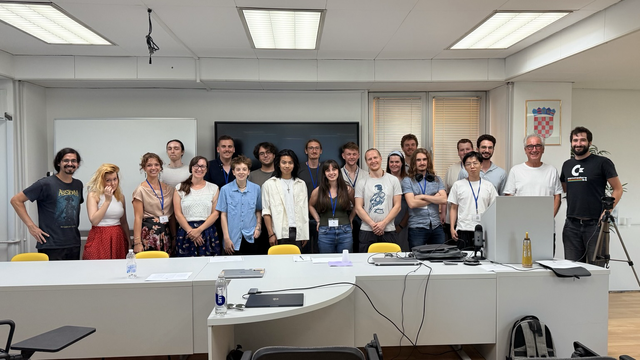
So grateful to everyone who helped me organise the Summer School on #Panpsychism at the Institute of #Philosophy in Zagreb, as well as to everyone who attended! ☺️
Any good conferences on AI ethics coming up? #philosophy @philosophy