Ecology of the eastern horseshoe bat and its sensitivity to the impacts of fire | Western Sydney University
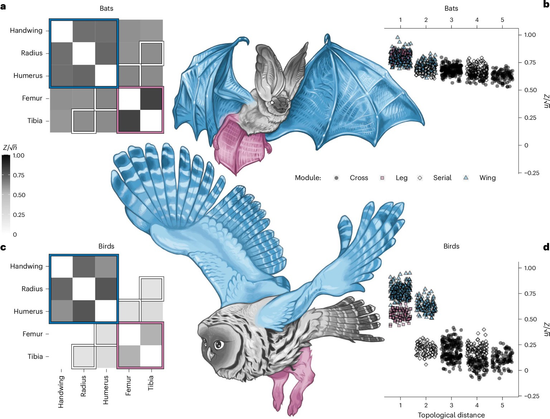
Beautiful figure showing bird 🐦 wings & legs evolve independently, while bat 🦇 wing & leg proportions are integrated. This may have inhibited bat adaptive responses such as lower rate of phenotypic evolution & homogeneous evolutionary dynamics in contrast to birds |
https://www.nature.com/articles/s41559-024-02572-9
Evolutionary integration of forelimb and hindlimb proportions within the bat wing membrane inhibits ecological adaptation - Nature Ecology & Evolution
Contrary to expectations from studies of birds, ecological radiation in crown bats is associated with strong trait integration both within and between forelimb and hindlimb.
5/ check out the accompanying Research Briefing that summarises the study in a lay-person manner:
https://www.nature.com/articles/s41558-024-02169-x
Increased environmental drying risk for anurans globally under projected climate change - Nature Climate Change
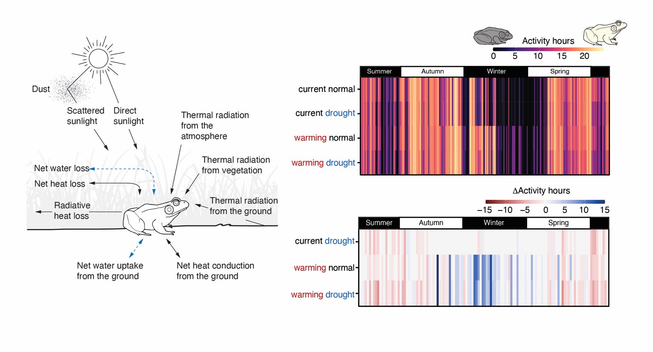
Climate change is exacerbating the severity of drought for life on land, especially for drying-sensitive species such as anurans (frogs and toads). Evaporative water loss rates for anurans are expected to double in areas with increased aridity. Increased drought severity combined with climate warming will likely reduce activity time for anurans owing to physiological limits.
4/ lastly, we simulated how drought would impact frog activity based on physiological limits. The combination of warming & drought will have the largest impact in the warmest quarter of the year.
3/ ecological types (arboreal, ground-dwelling, stream-dwelling) do not predict drying risk, but water-conserving strategies such as water-proof skin & ability to make cocoons are important predictors.
2/ frogs globally are also at risk to a combination of increasing drought intensity, frequency, & duration by 2100.
1/ we show areas where frogs occupy will increase in dryness by up to 33% by 2100.
Increasing land drying & drought will threaten water-sensitive species such as frogs 🐸. We examine their potential exposure risk under different warming scenarios |
https://doi.org/10.1038/s41558-024-02167-z | @NatureClimate
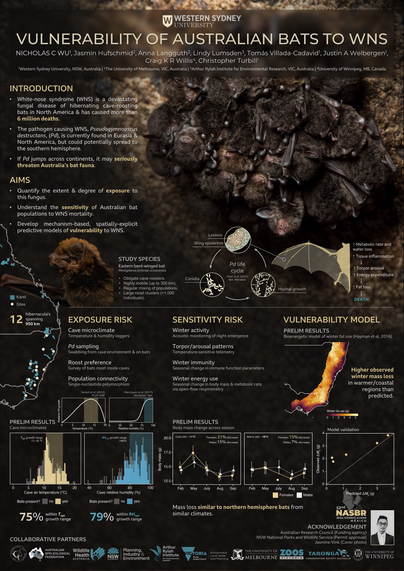
If you missed out on my talk today at NASBR, here is a poster that summarises the current progress of our work 🦇.
#bats #WNS4/ risk of exposure is widespread but lack of species-specific information on the wintering biology and immunity of cave bats in the southern hemisphere prevents accurate prediction of consequences of Pd infection 🚨