Neil Thurman

159 Followers
211 Following
14 Posts
Professor at LMU Munich's Department of Media and Communication; Honorary Senior Research Fellow in the Department of Journalism at City, University of London; and Volkswagen Foundation Freigeist Fellow.
Websitehttps://neilthurman.com/
Google Scholarhttps://scholar.google.com/citations?user=niz-ERMAAAAJ&hl=en
Twitterhttps://twitter.com/neilthurman
LinkedInhttps://www.linkedin.com/in/neilthurman/

We compare audience perceptions of news videos made with various levels of AI-involvement (high, medium & none). On average consumers liked automated news videos as much as manually made ones, but only when the automation process involved human post-editing:

https://journals.sagepub.com/doi/10.1177/14648849241243189

A reminder of the importance of message variance in communication research. We fielded a survey experiment with 14 sets of 3 videos. Each set had a manually-made, a partly-automated & a highly-automated video. The set of Trump videos had statistically significant contrasts between the automation levels for 10 evaluation items. However, the sets of videos on Musk & 5G stories had none! Stark take-home message: relying on 1 or 2 sets of messages is highly problematic:

https://journals.sagepub.com/doi/10.1177/14648849241243189

Register free for @MeCCSA’s 3rd online seminar on 'Innovations in Local News' on 20 March. We'll be presenting two new studies. The first is on readers' reactions to local automated journalism and the second is on "How local newspaper publishers can use paywall strategies to nudge readers to enter & exit the subscription funnel":

https://www.tickettailor.com/events/localandcommunitymedianetworkmeccsa/1181898

Only committee stage & 3rd reading to go for Canada's “Act to restrict young persons’ online access to sexually explicit material”. It only targets commercial porn sites, not porn on social & search. However, our research shows that <18s regularly encounter porn on social & search too. E.g., in the UK, 63% of 16- and 17-year-olds had encountered pornography on social media and 51% on search, on av. around 2 months ago.

https://www.theglobeandmail.com/canada/article-senate-bill-would-require-age-verification-for-canadians-accessing/

Our UK survey:

https://onlinelibrary.wiley.com/doi/10.1002/poi3.250

Senate bill would require age verification for Canadians accessing porn sites

Senate bill requiring age verification for Canadians accessing porn sites proceeds to committee without Liberal support

The Globe and Mail

Good analysis of the limitations of Netflix's recent audience data release by Steven McIntosh:

"Netflix ranks its viewing data by the total number of hours viewed … It's a reasonable metric, but one that favours certain shows, and comes with several caveats … [with these figures] it's almost impossible to reliably estimate the actual audience in the way we do with terrestrial TV programmes … Without further breakdowns … they only tell part of the story":

https://www.bbc.com/news/entertainment-arts-67725679

Netflix: What the viewing figures actually tell us about viewing habits

The Night Agent and The Mother were among the streamer's biggest hits in the first half of 2023.

BBC News

Excellent piece by Joseph Hook in today's Press Gazette focusing on Florian Stalph, Sina Thäsler-Kordonouri's and my study about what readers want from data-driven reporting:

https://pressgazette.co.uk/media-audience-and-business-data/research-asks-if-readers-care-about-numbers/

The VolkswagenStiftung-funded study appears a special issue Journalism, edited by Jingrong Tong, Howard Tumber and Barbie Zelizer.

What do readers want from numbers? Using data well without getting in the way of a good story

Research finds online audiences want data used in news stories to be presented simply, concisely and not to obstruct the narrative. 

Press Gazette

What do readers actually pay attention to when consuming data-driven 📊 news, including automated stories?

🚨 Our in-depth investigation reveals 28 perception criteria that have application in future research on how audiences perceive different types of data-driven journalism.

For journalists producing data-driven reporting, our findings indicate what audiences want: that it is constructive, concise, provides analysis, has a human angle, and includes visual elements:

https://journals.sagepub.com/doi/10.1177/14648849231179606

In our new study we compare audience perceptions of news videos made with 3 levels of AI-involvement: high, partial & none.

The partially automated videos received human post-editing.

Our results show automated news videos need human post-editing to be as well-liked as human-made videos.

On average, consumers liked automated news videos as much as manually made ones, but only when the automation process involved human post-editing.

Full study is #openaccess on SSRN:

https://papers.ssrn.com/sol3/papers.cfm?abstract_id=4304961

What are the reasons viewers choose a specific program on a VOD platform? In our new study we found that the duration of availability of a program & its placement in the platform’s online interfaces strongly influences its VOD viewership. A program’s genre was not as significant an influence.

Our study's findings challenge the assumption that viewers exercise significantly higher levels of control when consuming content on VOD platforms as opposed to on linear TV:

https://journals.sagepub.com/doi/10.1177/13548565231174590

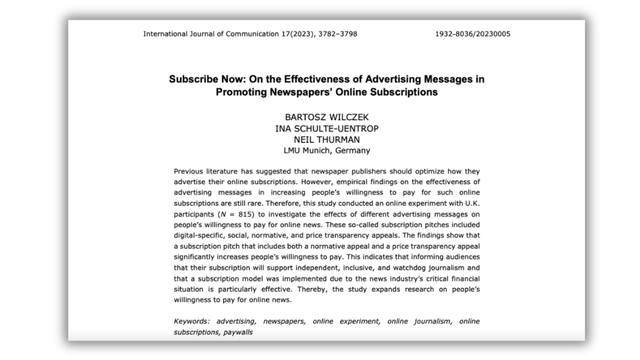
How can online newspapers increase readers' willingness to pay?

We tested 4 different advertising messages—alone and in combination.

We found that an online subscription pitch was most effective when it contained 2 messages:

1 emphasizing a subscription supports independent, inclusive, & watchdog journalism.

Another, giving the difficult financial situation of the news industry as a reason for introducing online subscriptions.

Full study:

https://ijoc.org/index.php/ijoc/article/view/19984

@bartoszwilczek

Subscribe Now: On the Effectiveness of Advertising Messages in Promoting Newspapers’ Online Subscriptions | Wilczek | International Journal of Communication

Subscribe Now: On the Effectiveness of Advertising Messages in Promoting Newspapers’ Online Subscriptions