
Nico Cellinese

17 Followers
15 Following
4 Posts
Plant evolutionary biologist, Curator/Professor at the Florida Museum of Natural History, University of Florida. Tree of Life nerd at http://phyloref.org. I only speak on behalf of myself.
https://www.floridamuseum.ufl.edu/cellinese-lab/

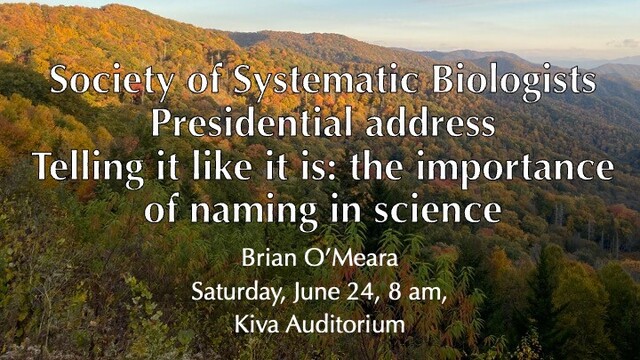
My @SystBiol presidential address is 8 am local on Saturday for #Evol2023

It's on the importance of naming (still tweaking):

#SnailDarter and #Dams
#Misconduct
#EponymousAwards
#Eugenics and our community's role in it

Boldly and accurately naming things is a key step in addressing issues, and has impact on research but also how our field works.

Please attend!
First paper out from our studies on the evolution of the remaining Florida populations of Guzmania monostachia (Bromeliaceae/Tillandsioidae). More to come soon.
https://www.mdpi.com/1424-2818/15/4/525#
The Fate of Guzmania monostachia in Florida Rests with Humans

Land use changes by humans have eliminated more than half of the wetlands in Florida over the last 200 years, and additional losses are anticipated as a consequence of climate change and ongoing development activities that will accommodate a rapidly growing human population. Both spell danger for the biodiversity and ecosystem services in Florida, and data are needed to inform conservation priorities and actions concerning threatened or endangered wetland species. We modeled the projected distribution of an endangered epiphyte native to the forested wetlands in South Florida, Guzmania monostachia (Bromeliaceae), in response to changing climate and sea level conditions. We constructed ecological niche models (ENMs) under the present framework by using georeferenced occurrence points and projected them into the past and future under different scenarios. Our future climate-based ENMs predicted small losses in suitable habitat for G. monostachia in South Florida, with expansions into higher latitudes due to the warmer climate. In contrast, the models predicted a considerable, although non-detrimental, loss of suitable habitat due to rising sea levels. The combined results suggest that human activity is and will remain the largest threat to G. monostachia in Florida, and conservation efforts should focus on preserving existing habitats that will remain above sea level and explore possibilities for assisted migration.

MDPI
Excellent opportunity for training in systematics and NGS methods in Germany. Fun included!
https://www.taxon-omics.com/summer-school-23-muc
Summer School Taxon-Omics 2023 — DFG SPP 1991

DFG SPP 1991