9 Followers
2 Following
6 Posts
Golden Dome intends to use AI onboard satellites to identify and track targets for low-latency weapons deploy. This is why "data-centers in space" have suddenly become a hot topic despite having no other plausible commercial value.

SpaceX lacks the hardware or a plan with scientific viability for a genuine Mars program. The scientific community has long recognized the facade. A feasibility study published in the journal Nature definitively concluded that a crewed Mars mission using Starship is unworkable. The vehicle’s massive dry weight creates a severe Delta-v deficit, making a return flight physically impossible. Furthermore, the architecture lacks closed-loop life support and relies on massive, non-existent nuclear power and water-mining infrastructure. Instead of building for Mars, Starship is a heavy-lift vehicle with low characteristic energy (C3). This is only a reasonable design for driving mass to low-Earth-orbit constellations—a trajectory that perfectly mirrors decades-old Pentagon objectives, that recently has manifested as Golden Dome.

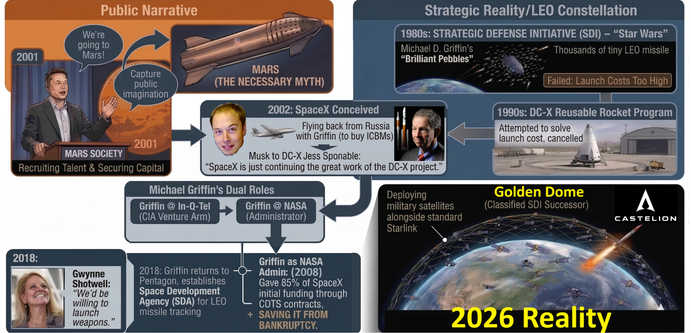
In the 1980s, Michael D. Griffin architected "Brilliant Pebbles," a global missile-interceptor network made up of thousands of weaponized satellites in Low Earth Orbit. It died alongside Reagan's Strategic Defense Initiative in 1990s after the DC-X reusable rocket program failed to lower launch costs. The architectural dream survived through "New Space" advocacy. Griffin co-founded the Mars Society and recruited Elon Musk after he was brought to his attention by Peter Thiel. In 2001 Griffin and the young Musk traveled together to Russia to examine ICBMs. SpaceX was conceived on the flight home to solve the exact launch bottleneck that killed Brilliant Pebbles. Musk later admitted the company was simply "continuing the great work of the DC-X project," and it was ultimately Griffin—later acting as NASA Administrator—who awarded billions of dollars in contracts that saved a zero-experience SpaceX from bankruptcy.

SpaceX masking began to slip when Gwynne Shotwell publicly confirmed the company's willingness to launch offensive weapons in 2018. That same year, Griffin returned to the Pentagon to establish the Space Development Agency, mandated to build a proliferated LEO constellation for hypersonic missile tracking. In 2019, U.S. General Terrence O'Shaughnessy pitched the Senate on "SHIELD"-a layered orbital missile defense system. Shortly after, O'Shaughnessy retired from the military and joined SpaceX to lead their discreet new division: Starshield.

Three decades later, Brilliant Pebbles is finally materializing as Golden Dome. As Reuters reported, Musk's Starshield is the frontrunner to build this classified SDI successor, pitching the Pentagon on a Golden Dome architecture involving thousands of weapon satellites. Starshield is already deploying these military satellites alongside standard Starlink satellites.

Mars was the necessary myth to recruit talent, capture public imagination, and secure capital. But as the Nature study proves, Starship was never physically capable of planetary colonization. The capabilities SpaceX actually delivered...cheap mass-to-orbit and rapid satellite replenishment...are the exact prerequisites of Golden Dome.

https://en.wikipedia.org/wiki/Golden_Dome_(missile_defense_system)
The Heritage Foundation's Project 2025 thinks the U.S. can "win at nuclear war" using Elon Musk's Starlink according to their recent paper.

A deeper look shows Musk was involved since at least 2001. https://archive.today/D2zIG#:~:text=Shotwell

One of the founders of SpaceX, Michael D. Griffin has been driving this forward for decades after originally serving as SDI's Deputy for Technology and designing the first space-based interceptors. Griffin helped SpaceX grow from it's founding in multiple key ways. Funding SpaceX for it's first seven years when he became NASA administrator. https://en.m.wikipedia.org/wiki/Michael_D._Griffin

While Russia is now threatening to place nukes in orbit, China has the economic capability to compete directly, by promoting domestic launch cost reduction and deploying multiple Starlink competitor constellations such as G60.

At SpaceX, Terence O'Shaughnessy (who goes by "Shags") runs the Special Programs that include Starshield. As a four-star general, his background is in homeland missile defense for Northern Command. He is an ideal person to guide and align the commercial side of Starlink with the more strategic national security objectives of LEO constellations.

Further reading,

https://thehill.com/opinion/technology/4444690-trumps-revival-of-a-us-missile-defense-plan-is-a-job-for-the-space-force/

[Interceptors are cheap]. "A rocket pod of 100 interceptors at a cost of approximately $60,000 per micro-missile" (note General Hyten quoted here now works for Kuiper)
https://rb.gy/evn78e

Michael D. Griffin - Wikipedia

Starlink satellites, launched by SpaceX, are primarily known for their commercial and military communication purposes. However, SpaceX's recent $1.8 billion contract to develop a constellation of spy satellites and its agreements with the Space Development Agency (SDA) suggest that the company's ambitions with Starlink and Starshield extend further.

The concept of large satellite constellations in low Earth orbit (LEO) has its roots in the Strategic Defense Initiative (SDI). This Cold War-era program aimed to eliminate the threat of nuclear weapons by intercepting intercontinental ballistic missiles (ICBMs). Satellites positioned closer to Earth in LEO can swiftly target and track objects on the ground, providing both low-latency communication and high-resolution sensing capabilities. They also hold the potential for offensive actions, such as deploying interceptors to shoot down rockets or ICBMs during their vulnerable boost phase.

The idea of Brilliant Pebbles, an SDI initiative, was to deploy small, space-based interceptors to neutralize ICBMs. Although the Anti-Ballistic Missile Treaty (ABMT) eventually precluded their full development, the concept morphed into early commercial LEO constellations in the 1990s, such as Teledesic. Supporters of SDI actively supported these efforts. The idea was to let commercial markets drive the foundational tech development for these constellations with the expectation that it could serve an eventual dual-use military purpose once the political will was reconstituted. A future military payoff incentivized companies to build these LEO constellations even if commercial Internet alone didn't make full sense from a business profitability perspective. Unfortunately they all went bankrupt after launch costs failed to lower sufficiently and the political barriers for SDI refused to resolve.

But now after the ABMT and all other blocking treaties have been abandoned, SpaceX appears to be following a similar path with its Starshield program. Gwynne Shotwell, SpaceX's President/COO, has publicly confirmed that offensive capabilities could be supported by the company if requested by the U.S. government. This aligns with the growing interest among Republicans and the Heritage Foundation in weaponizing space, contrasting with the Biden administration's more cautious approach.

Elon Musk's political shift towards the Republican party may be influenced by these strategic developments. The left has largely felt that Brilliant Pebbles is a classic fallacy that attracts those who believe there is a technological solution to everything. It is thought unlikely to be reliable and will inevitably lead to an arms race where either side shortens the time to launch nukes (by pre-launching / staging them in orbit or otherwise).