Martin Johnsson

@mrtnj
906 Followers
2K Following
295 Posts
PhD in genetics. Associate professor (docent) at the Swedish University of Agricultural Sciences (SLU), Uppsala. The Jar Jar Binks of animal genomics. Writes in English, svenska & gruntings. he/him
cv, publications, etchttps://martinjohnsson.se
bloghttps://martinjohnsson.se/blog
Time for #eseb2025! If you want to talk about population genetics in effectively small populations, the value of simulation, and how domestic animals are weird, find me at the Tuesday poster session, or anywhere, really.
People rant about how large language models break university education. I don't know. My students seem to be using ChatGTP much the same way they use a search engine. They still work through the problem sets, try to understand the answers, and ask questions. They go to lab to do practical stuff. They sit a traditional exam, albeit on a university computer with no Internet access. We do our best to write an exam that probes the learning objectives. It seems just like normal education stuff to me.

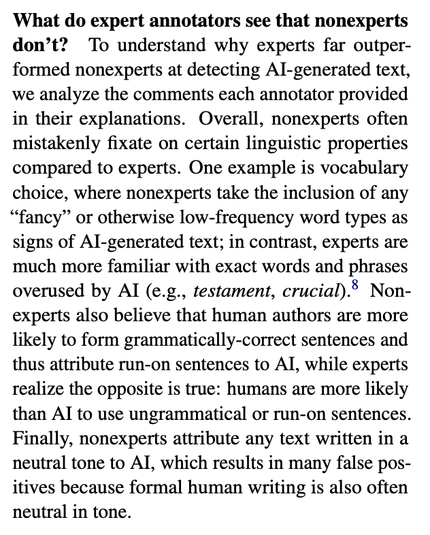
This whole article about who can and can't detect AI writing is fascinating!

The average person essentially does no better than chance, but a panel of 5 people who use AI for writing every day got only 1 in 300 wrong.

The screenshot describes how they look at the writing differently.

https://arxiv.org/pdf/2501.15654

Who even knows what "infer" means. Let's write "guesstimate".
Category:Autistic writers - Wikipedia

"This AI output is highly inaccurate."
"Nah, you're just prompting it wrong."
"How do I go about prompting it the right way?"
"You really need to know the subject you're asking about. Then you can help it avoid making mistakes."
"If I know the subject deeply myself, why am I asking an AI about it?"
"It helps to train the AI."

Also, don't forget the beautiful television clip of Feynman, the great communicator, being stumped by "fucking magnets, how do they work?". Fisher, the great statistician, tied himself in Gordian knots of motivated reasonig trying to deny the evidence that smoking is harmful.

The great heroes often weren't even that good.

https://youtu.be/MO0r930Sn_8?si=5jiJ9iSMY3Uq8yYe

Richard Feynman Magnets

YouTube

the meta-issue here being: no heroes.

If we look at the majority of "great" scientists, they turn out to be (aside from white men) bad people.

- Feynman a misogynist (at the mildest definition of his actions)
- Fermi made plans to radioactively poison German civilians
- Fisher a racist and eugenicist (oh and he also didn't think smoking was bad for you)
- ... the list goes on

Glorifying and mythologizing scientists leads to intellectual blind spots where folks don't think critically about the other things those individuals did.

It also doesn't **add** anything to science by doing so. The "cute" stories in Feynman's books about him peeing upside-down, bongo drumming etc, aren't even really interesting, next time you hear one have a think about how you'd feel if it was told about someone you did yr undergrad with (insufferable roommate vibes).


if you write about R. A. Fisher in a positive light in your abstract, I'm not coming to your talk.

This paper is nice and clear and was helpful in thinking about the undergraduate teaching materials I'm currently writing.

It's helpful to take the useful and conceptually clear stuff from old genetics and save some of the arcane terminology and notation for the historically interested.

https://doi.org/10.1093/genetics/iyae078

(Can't remember who recommended the paper on here. Thank you for doing so, forgotten benefactor!)