new video! 🎉
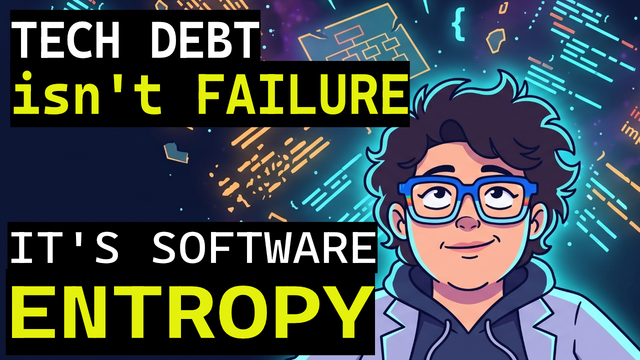
Episode 2 of The Physics of Software is up -- this one's about entropy, and why your codebase decays even when nobody does anything wrong.
Spoiler: it's the Second Law of Thermodynamics. not as a metaphor. as an actual thing.

Human-centered systems engineer.
Localization is architecture, not translation.
All opinions are my own, etc etc. She/her.
| Website | https://moriel.tech |
new video! 🎉
Episode 2 of The Physics of Software is up -- this one's about entropy, and why your codebase decays even when nobody does anything wrong.
Spoiler: it's the Second Law of Thermodynamics. not as a metaphor. as an actual thing.
physics brain + software brain = one very specific obsession
complexity in software behaves like energy in physics. it doesn't disappear. it moves.
so when someone says "we simplified it" what they mean is "we moved the complexity somewhere you're not looking at"
I made a video about this. it has physics. it has code. it has a skit filmed in my office with moustaches and wigs.
come nerd out with me 🤓

Everyone's posting AI skills to make agents less sycophantic and more rigorous.
I took it to its natural conclusion: I made a satirical skill pack that turns your AI into a 10x techbro with zero chill.
No, I do not apologize. Deck for VCs dropping soon.

DDDnD is a satirical card game about the real tradeoffs of software architecture — where shipping the quick fix is tempting, debt amnesty is seductive, and the CTO goes quiet for a reason. Here's what it is, why I built it, and why the humor hits harder than it should.
I made a satirical card game about software architecture where technical debt has delayed effects and the VP of Product always wants features.
It's called DDDnD -- a satirical card game about software architecture where every decision is a real tradeoff and the debt always accumulates.

I ran an experiment where I let AI build an app step-by-step, and required it to explain every assumption it made.
What stood out wasn't the AI. It was how familiar the decisions felt.
Small choices coalescing into architecture.
Initial assumptions that were never revisited.
"Iteration" is a series of accumulated assumptions. Acknowledging them make them decisions that can be reasoned.
The video goes through the experiment and a couple of high level insights:
https://www.youtube.com/watch?v=ehRD-ijK3aY

Some of the biggest computer science problems hide inside the smallest UI elements. Take… a character counter.
It looks harmless. It sounds trivial. It's everywhere.
Except -- character counting is one of those computer science topics that holds a LOT more complexity than we think -- and has a lot of actual impact on *real users* when we overlook them.
This topic is close to my heart, so... join me in breaking this down, and let's try to do this better!

We still model users as if they’re "local."
One language. One currency. One regulatory context.
That abstraction made sense once. It doesn’t anymore.
The "default user" is often a data-model fiction -- and we quietly exclude real humans because of it.
Localization isn’t translation. It's modeling for human variability.

My interview in the Maintainable Software podcast is out! I talked about modernizing software, what it means to have large codebases maintainable, how to approach modernization without "running after fads", how we approach modernization in the Foundation and why having product vision is crucial for architecture.
Oh, and a random book recommendation!
Join Robby and Moriel Schottlender as they dive into the challenges of modernizing the MediaWiki platform, the backbone of Wikipedia. Learn about the evolution of a 23-year-old codebase, balancing flexibility with maintainability, and fostering a thriving open-source community.

 Domain-Driven Design Europe