We’ve demonstrated precise, orthogonal remote-control (ON+OFF!) of cell-free expression using blue/UV photocaged DNA templates and antisense oligonucleotides!
Preprint led by my students Giacomo Mazzotti + Denis Hartmann 🤩
@uclchemistry #chemistry #chemiverse #synbio #bioengineering #cellfree
https://bit.ly/3RxGbja
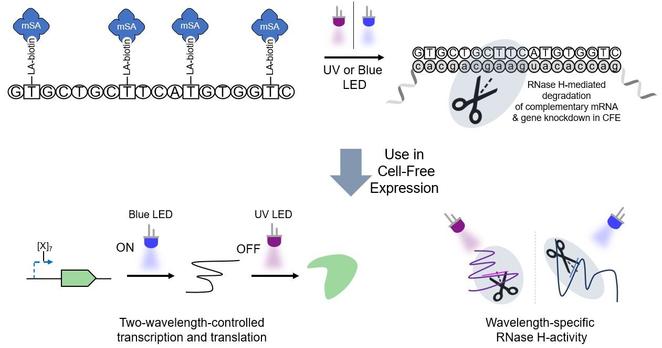

Precise, orthogonal remote-control of cell-free systems using photocaged nucleic acids
Cell-free expression of a gene to protein has become a vital tool in nanotechnology and synthetic biology. Remote-control of cell-free systems with multiple, orthogonal wavelengths of light would enable precise, non-invasive modulation, opening many new applications in biology and medicine. While there has been success in developing ON switches, the development of OFF switches has been lacking. Here, we have developed orthogonally light-controlled cell-free expression OFF switches by attaching nitrobenzyl and coumarin photocages to antisense oligonucleotides. These light-controlled OFF switches can be made from commercially available oligonucleotides and show a tight control of cell-free expression. Using this technology, we have demonstrated orthogonal degradation of two different mRNAs, depending on the wavelength used. By combining with our previously generated blue light-activated DNA template ON switch, we were able to start transcription with one wavelength of light and then halt the translation of the corresponding mRNA to protein with a different wavelength, at multiple timepoints. This precise, orthogonal ON and OFF remote-control of cell-free expression will be an important tool for the future of cell-free biology, especially for use with biological logic gates and synthetic cells.
We report live as Brenda from Bristol recieves her latest review request
We've developed light-activated antisense oligonucleotides by conjugating photocages onto phosphorothioates 😍🧬🔦!
We used these as cell-free expression OFF switches 🧪🛑⚡️!
Preprint from my student Denis Hartmann
https://bit.ly/3P2uTSG
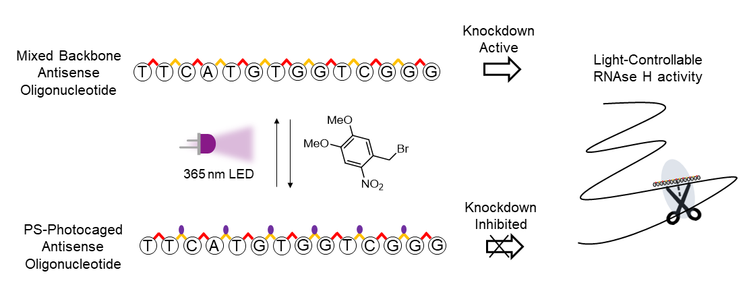

Light-controlled cell-free protein synthesis using phosphorothioate-caged antisense oligonucleotides
Cell-free expression of a gene to protein has become a vital tool applied in DNA nanodevices and synthetic cells. Antisense oligonucleotides are often used to induce gene knockdown; however, they have been underexplored for cell-free applications. Developing methods to non-invasively control gene knockdown with antisense oligonucleotides will be crucial for their precise regulation of cell-free biology and biotechnology. Here, we report a mild method for selectively attaching photoremovable protecting groups, photocages, onto phosphorothioate linkages of antisense oligonucleotides. Using this photocaging method, upon illumination, the original phosphorothioate antisense oligonucleotide is reformed. Photocaged antisense oligonucleotides, containing mixed phosphorothioate and phosphate backbones, showed a drastic reduction in duplex formation and RNAse H activity, which was recovered upon illumination. For the first time, we demonstrated that photocaged antisense oligonucleotides can be used to control cell-free protein synthesis. This technology will have future applications in light-activated biological logic gates and controlling the activity of synthetic cells.
I think someone has dramatically under calculated the size of this building
Wonderful to get the whole group together for a winter outing ❤️ This time ice skating at Somerset House!
The look when someone else uses your pipettes
#gbboI've finally downloaded a mastodon app and now I can do gifs!!!
Why thank you very much for your feedback 😂
Considering how to tell your PI that you've broken the HPLC on your first day in the lab