MERICS

@merics
53 Followers
36 Following
185 Posts
The Mercator Institute for #China Studies (MERICS) is a European research and analysis institute established in 2013.
Websitehttps://merics.org/en
In our latest MERICS China Essentials we looked at the mixed signals coming from Beijing on economic policy for foreign investors, a relaxation of rules regarding data exports and Wang Yi’s visit to Australia and New Zealand. Read the whole issue here: https://merics.org/en/merics-briefs/mixed-economic-messages-eased-data-export-rules-wang-yi-down-under
Mixed economic messages + eased data export rules + Wang Yi in Down Under

Top Story Beijing preaches economic opening and practices security-focused closing The Chinese government is once more campaigning to attract foreign investment while remaining committed to its security-centric economic agenda that targets overseas suppliers. Premier Li Qiang this week used the annual China Development Forum to woo global investors by highlighting reforms in economic policy, urban development, industrial development and transitioning business to sustainability. His speech followed hard on the heels of the State Council issuing a 24-point plan – its second in only seven months – to help foreign companies, and the Cybersecurity Administration of China easing rules for cross-border data transfers (see the entry on data exports below). But these business-friendly measures were marginal and the intended positive message was undercut by a Financial Times report that Beijing is replacing Intel and AMD chips and Microsoft’s Windows in government computers. This was a strong reminder of its desire to substitute foreign technology with domestic alternatives as it focuses on national security and economic self-reliance. Even Xi Jinping’s meeting on Wednesday with US CEOs, meant to reassure them about China’s economic prospects, must have been of limited comfort to investors least of all the attending CEO of Qualcomm, who has to contend with US export controls on chips and now also China’s purge of some US chips. Beijing is sending mixed signals that it is both open to reform to stimulate foreign investment and focused on national security over economic liberalization. This is one reason why the government’s first 24-point plan of August 2023 did not change the downward trajectory of foreign direct investment flows – and why the new measures (that include oft-promised reforms about fair competition) are unlikely to be any more successful. Foreign investors still need to be convinced that China is worth their longer-term commitment. That will require solving both the challenges identified by European companies in China as well as deep structural reform to the economic model to get more resources to consumers.  MERICS Analysis: “China’s red carpet isn’t achieving the results it used to, largely because foreign investors can see where it will take them – to an economy in downturn and a political elite unwilling or unable to meaningfully correct the course,” said Jacob Gunter, Lead Analyst at MERICS. “Xi and his colleagues place national security above the major reforms required to revive the struggling economy. Their marginal tweaks will do little to boost the economy or investor confidence.” Media coverage and sources: South China Morning Post: China ready to remove barriers for foreign companies, Premier Li Qiang tells international forum Financial Times: China blocks use of Intel and AMD chips in government computers Nikkei Asia: China plans to ease visa rules to attract foreign talent and money Global Times: China issues 24-point action plan to attract foreign investment, facilitate data flows and business travel Reuters: China's Xi Jinping to meet with American executives on Wednesday, sources say , METRIX 89:0 This is the number of Hong Kong Legislative Council members that respectively voted for and against the city’s new Safeguarding National Security Ordinance on March 19. The unanimity of Hong Kong’s lawmakers is noteworthy given that the new legislation is even tougher than China’s Hong Kong National Security Law of 2020. It loosely defines infractions from treason and insurrection to “incitement to disaffection,” states that these crimes can be committed outside Hong Kong as much as within, places a particular focus on containing “external forces,” restricts defendants’ procedural rights and more generally aligns Hong Kong with Chinese Communist Party ideology.  (Source: https://www.legco.gov.hk/yr2024/chinese/counmtg/voting/v20240319.pdf) If you want to know more on the new security law, click here to read the comment by MERICS expert Katja Drinhausen. , Topics China relaxes data export rules The facts: Compelled to listen to business concerns amid the lowest foreign investment in decades, China’s regulators have significantly relaxed rules on transferring data abroad. The Cyberspace Administration of China (CAC) eased restrictions on exporting both non-sensitive and personal information as of March 22, after lobbying by European industry and EU officials. Companies were frustrated with vague definitions and a very low bar for triggering security reviews, which had put them in compliance limbo and disrupted their business. What to watch: Companies can now export the personal data of up to 1 million people without a mandatory assessment, while exports necessary for normal business operations (e.g., human resources or e-commerce) are exempt. Moreover, information collected in international trade, transportation, academic cooperation, manufacturing and marketing can leave the country without any prior authorization if it doesn’t contain personal or “important” data. And unless regulators have explicitly designated data as “important,” firms can export it without applying for a security review. Authorities are working to clarify the scope of “important” and “core” data, a longstanding headache for industry.  While Beijing may claim that the new rules show it is putting economic interests ahead of security, President Xi Jinping’s security-first policies could still thwart implementation, which is up to sectoral regulators. European companies may need to keep up the pressure depending on how the new rules play out in practice.   MERICS analysis: “This move is significant and welcome news for the foreign business community,” says Rebecca Arcesati, Lead Analyst, MERICS. “As the US government is scrutinizing Chinese firms’ collection of sensitive data, from the personal information of TikTok users to data collected by port cranes and smart cars, Beijing may also use it to argue it is instead putting economic interests ahead of security. But in Xi Jinping’s China, security comes first, so smooth implementation of the new rules is not a given.” Media coverage and sources: Cyberspace Administration of China: Provisions on Facilitating and Regulating Cross-Border Data Flows  CNB: What is the important content of the Provisions on Promoting and Regulating Cross-Border Data Flows?  21st Century Business Herald: The identification of important data got a national standard! Expert: This is of great significance to the security management of cross-border data flows  Read more: Hinrich Foundation: China’s data management: Putting the party state in charge  , Thaw with limits: Wang Yi’s reopening with Australia and New Zealand The facts: Aiming to further mend ties with Australia and New Zealand, Wang Yi, China’s Minister of Foreign Affairs and the Chinese Communist Party’s top diplomat, made the first high-level visit to the countries in 8 years. From March 17-21, he met not only with his counterparts, but also with Prime Ministers Luxon and Albanese. While there appears to be traction in rebuilding economic relations, geopolitical differences and security concerns remain. What to watch: Wang’s visit is part of a reset that began when Australia’s current government took office in mid-2022. China has removed effective bans on barley and coal introduced after the previous administration’s anti-dumping investigations and more assertive China policy. The shift reestablished Australia as China’s main coal supplier at the end of last year. Discussions laid the groundwork for a visit by Premier Li Qiang later this year and touched on lifting China’s barriers to imports of wine and lobster. Indeed, China said this week it would remove the three-year-old tariffs on wine.  There were no similar signs of progress on security and geopolitical divergences – especially in the South China Sea – beyond “mitigating differences,” as Australian Foreign Minister Penny Wong put it. Wang again called on Australia to pursue an “independent foreign policy” – meaning distancing itself from the US, Australia’s key security partner. Beijing may be hoping that the current diplomatic outreach will help it to capitalize on uncertainties ahead of US elections – and potentially their fallout. MERICS analysis: “The measure of success in the current phase of engagement with China, also in Europe, is maintaining constructive relations and damage control rather than resolving fundamental differences,” says Grzegorz Stec, Head of MERICS’ Brussels Office. “While efforts to restore economic stability in China or take advantage of uncertainties related to the US election may present an opening for now, there is no fundamental reassessment of the relationships.”  Media coverage and sources: AP: China’s foreign minister meets New Zealand counterpart, beginning trip that also includes Australia FT: China urges Australian caution on ‘third-party’ disruption of relationship DW: Philippines summons Chinese envoy over latest reef clash SCMP: WTO faults Australian inquiry into trade dispute with China , Death of 13-year-old boy sparks debate about China’s rural-urban divide The facts: The alleged murder of a 13-year-old by three similarly aged boys in rural Hebei has sparked a debate about the plight of millions of children left behind by their parents who work in China’s cities. The intense online exchanges were noteworthy given the tightly controlled media landscape and because they touched on the problems of China’s hukou system. It still makes it hard for citizens to access public services anywhere but in the home region where they are registered. The victim and the three suspects were all reported to be under 14 and growing up away from their migrant-worker parents, engendering many online comments about juvenile delinquency and legal questions.  What to watch: “Rural revitalization” and “rural-urban integration” have long been touted by authorities. While the hukou system has seen changes, substantial reform is still lacking. Many cities in principle now allow children of migrant workers to enter schools, but socio-economic and administrative barriers are still high. Xi Jinping used his recent visit to Hunan to call on local officials “to further energize the central region.” But Beijing’s ambitions to provide migrant workers with job opportunities closer to home and children have not been matched by concrete measures. China’s rural-urban divide is yet another problem that demands state resources in a time of a struggling economy.  MERICS Analysis: “The recent online debate about ’left-behind children’ has provided a rare glimpse of soul-searching by Chinese citizens,” says Christina Sadeler, Senior Analyst at MERICS. “But the government’s current policies are not sufficient to tackle rural-urban inequalities and the social problems that come with them.”  Media coverage and sources: The Guardian: Killing of teenager in China sparks debate about ‘left behind’ children China Daily: Killing of Hebei student ruled premeditated murder Global Times: Murder of 13-y-o by teenagers triggers reflection on juvenile crime CDT: “Left-behind Youth” murder spurs reflection on “Teaching Hatred” , MERICS CHINA DIGEST In Beijing, Dutch Prime Minister Mark Rutte raises cyberespionage with President Xi Jinping (Reuters) Rutte said that during talks with Xi on March 27, he had discussed a cyberespionage incident that the Netherlands had blamed on the Chinese government. Chinese state-backed cyber spies gained access to a Dutch military network last year, the intelligence agency MIVD said last month, calling it part of a trend of Chinese political espionage against the Netherlands and its allies. (24/03/27) US and UK unveil sanctions against Chinese state-backed hackers over alleged ‘malicious’ attacks (The Guardian) Hackers backed by China’s government spy agency have been accused by the US and UK of conducting a yearslong cyber-attack campaign, targeting politicians, journalists and businesses. UK officials said those sanctioned are also responsible for a hack that may have enabled access to information on tens of millions of UK voters held by the Electoral Commission, as well as for cyber-espionage targeting lawmakers who have been outspoken about threats from China. (24/03/27) Chinese train maker withdraws from Bulgaria tender after EU probe (Euractiv) Chinese rail giant CRRC has withdrawn from a tendered project in Bulgaria after the EU in February launched a probe into suspected subsidies, the European Commission said on March 26. The tender was for the purchase of 20 electric trains and their maintenance over 15 years, for a total value of around €610 million. (24/03/28) China says relations with Philippines at 'crossroads' amid maritime incidents (Reuters) Chinese Vice Foreign Minister Chen Xiaodong warned his Philippine counterpart Theresa Lazaro during a phone call to behave cautiously and seek dialogue, saying their relations were at a “crossroads” as new confrontations between their coastguards over maritime claims deepened tensions. Lazaro relayed Manila's “strongest protest against the aggressive actions” by the China Coast Guard and maritime militia against a Philippines' resupply mission in the South China Sea, her ministry said in a statement. (24/03/23) China condemns Pakistan suicide bombing, pledges to continue belt and road projects (South China Morning Post) Five Chinese engineers and their Pakistani driver were killed on their way to a China-funded hydroelectric dam project. It follows two other attacks on Chinese interests in Pakistan in one week, with the others targeting a naval airbase and a strategic port. (24/03/27)   Chinese and western scientists identify ‘red lines’ on AI risks (Financial Times) Leading AI scientists from both Western and Chinese backgrounds have issued a warning, urging global cooperation to prevent catastrophic risks associated with AI, including bioweapons development and cyber-attacks, stressing the importance of explicit human control and international regulation to mitigate existential risks. (24/03/18) China changes definition of key energy target in a bid to reach 2025 climate targets (China Dialogue) In China’s recent release of key economic and social data for 2023, the National Bureau of Statistics changed the meaning of “energy intensity” to include only fossil-fuel consumption, while excluding renewable energy and nuclear power. It did so without adjusting numerical targets, allowing CO2 emissions to increase by up to 2.4% this year if GDP growth is on target. This means China would need to make unprecedented progress in 2025 to meet its climate commitments. (24/03/19)

Merics

Germany’s renewed interest in and upcoming military missions to the Indo-Pacific speak of a clearer strategy vis-à-vis China and the region, says MERICS Lead Analyst Helena Legarda in her comment for IP Quarterly: https://ip-quarterly.com/en/bundeswehr-returns-indo-pacific

#China #Indopacific

The Bundeswehr Returns to the Indo-Pacific | Internationale Politik Quarterly

Germany’s navy and air force are planning to beef up their participation in various military exercises halfway around the world in 2024. This speaks of a clearer strategy vis-à-vis China and the region.

In the latest MERICS China Global Competition Tracker Jacob Gunter and Rebecca Arcesati assert that Europe should do more to engage in digital project development overseas and support the competitiveness of European players: https://merics.org/de/tracker/digital-silk-road-growing-priority-beijing-its-tech-champions-expand-overseas
The Digital Silk Road: A growing priority for Beijing as its tech champions expand overseas

The Digital Silk Road: A growing priority for Beijing as its tech champions expand overseas European companies face growing competition from China’s digital champions in the Global South. Europe should do more to engage in digital project development overseas and support the competitiveness of European players. Finally off the ground after an underwhelming start, the Global Gateway – the EU’s global infrastructure initiative – has started to deliver some results in that direction. But it will be important to sustain that momentum as China’s role in wiring the world and forging tech partnerships is only poised to intensify. In the Belt and Road Initiative’s (BRI) second decade, the focus is on smaller infrastructure projects involving new technologies, especially digital, that bring a good return on investment and promote Chinese firms overseas. The ‘Digital Silk Road’ (DSR), or the technology-focused leg of the BRI which exists alongside ports, rail, energy and roads, will therefore become more prominent, especially across the Global South. Not only are these key growth markets, but it will be important for China’s digital giants to expand overseas as they finish building out networks in China.  To better understand Chinese tech firms within the DSR, it is important to look at the factors pushing them overseas. Some, like Huawei and Bytedance, have been much written about. Here, we look at less well-known players in sectors such as undersea cables, AI, gaming and social media and ridesharing. We found pressures for international expansion differed dramatically between consumer internet firms and China’s major players in the hardware and ‘real economy’ fields. Consumer-focused firms face a profit crunch in domestic markets that has sent them seeking growth markets elsewhere, whereas the hardware giants enjoy Beijing’s backing in the form of subsidies and project finance. At the same time, Beijing does welcome Big Tech investing abroad if that helps China dominate strategic technologies like artificial intelligence (AI), or at least generates revenue and profit that can be used to fund the right kind of R&D back home.  The importance of more “neutral” markets for China’s digital champions is growing as the tech rivalry with the United States has brought greater scrutiny of them in North America, parts of Europe and the Western Pacific. Besides, the domestic and emerging markets were often already more important. According to one analysis, for Huawei’s radio access network (RAN) business “any decline in European low-margin markets was offset in absolute terms by China and the emerging economies”.  Chinese telecommunication firms will therefore keep their focus on developing and emerging markets, whose governments are keen on digitally enabled solutions to development challenges ranging from public health to energy storage. In considering the pace of change, it is also worth acknowledging that geopolitical tensions and US controls on the export of semiconductor technology to China have not meaningfully slowed down the DSR—in fact, Huawei has managed to keep its carrier business afloat.    The DSR’s evolution will also depend on Beijing’s fiscal ability to support it amid deep structural constraints on the economy and financial system. The China International Contractors Association has found big ticket projects becoming rarer as the average value of BRI projects dropped 24.8 percent between the 2013-2017 period and 2018-2022, though the number of projects grew by 89.6 percent. Nevertheless, Beijing continues to see digital development as an important growth driver. At the 3rd Belt and Road Forum in October 2023, it launched two initiatives to encourage international cooperation on the digital economy, namely the Beijing Initiative on the Belt and Road International Digital Economy Cooperation and the International Trade and Economic Cooperation Framework for Digital Economy and Green Development.  Digital infrastructure projects are also cheaper. Although the multi-billion export credit lines of the past are now rarer, anecdotal evidence suggests state financial support is still coming in. It supplements commercial investments and partnerships, which are more organic. , Beijing encourages favored champions to go abroad China’s government essentially views the DSR as the outward-facing support to domestic efforts to digitalize the “real economy”. It continues to create favorable conditions for Chinese technology companies, both state-owned and private, to facilitate their internationalization. While the former receive direct state support, the latter are encouraged to pursue commercial opportunities abroad where it fits Beijing’s strategic goal of emerging technology leadership.  Controversial PRC undersea cable makers enjoy ample state support The fiber optic cable sector illustrates the DSR’s drivers, logic and implementation. Ocean-floor telecommunications infrastructure carries over 95 percent of international data traffic. Unsurprisingly, it has featured in Beijing’s infrastructure foreign policy documents ever since the first mentions of the DSR in 2015. The global rise of Chinese undersea cable makers shows how Beijing helps national champions compete in third markets and raises security concerns.  The meteoric rise of Huawei’s submarine cable division first triggered US worries about the risk of data exfiltration and manipulation. In 2020, it was sold to Hengtong Optic-Electric, a subsidiary of private conglomerate Hengtong Group, and rebranded HMN Technologies. Between 2019 and 2023, HMNT was the fourth most active supplier globally by number of systems installed, ahead of the Italian Prysmian Group. Nokia’s Alcatel Submarine Networks (ASN) kept a strong lead, followed by SubCom and NEC. Moreover, HMNT’s new parent, Hengtong has been making overseas acquisitions and majority investments in the past decade, including in Portuguese Alcobre, Spanish CABLESCOM, and German J-Fiber.   Huawei’s exit did not calm security concerns, given Hengtong’s involvement in Military-Civil Fusion (MCF) programs. It built a dual-use undersea surveillance network in the East and South China Seas and has links to an entity affiliated to military cyber intelligence. Other Chinese cable makers and operators include Jiangsu Zhongtian Technology (ZTT), which is also involved in dual-use undersea monitoring projects and was praised by President Xi Jinping for its contribution to national defense, and a cable in the Baltic Sea belongs to a company owned by China’s Ministry of Finance. Fiber is earmarked for industrial policy support in the Made in China 2025 plan, and Beijing sees a double opportunity, to export domestic overcapacity into third markets and promote national champions. With HMNT, Hengtong inherited a heavily subsidized player which has been able to place cheap bids, likely thanks to Chinese policy bank export financing. A number of Chinese optical fiber cable exporters were hit by European Commission dumping duties, measures that were tightened in 2023.  In 2021, Hengtong Optic-Electric introduced a manufacturing fund under China Development Bank along with two other strategic investors, and last year HMNT signed a strategic cooperation agreement with Sinosure, the state-backed export credit insurance company. Beside supporting cable installers, China Inc. also helps producers compete in third markets (see Exhibit ‘Profile: Fiberhome and YOFC’). Awareness of the strategic vulnerability of undersea information corridors is growing. Undersea cables have also become a battleground of US-China competition. US authorities have blocked some cable projects and pushed Chinese firms out of others, e.g., the South East Asia-Middle East-West Europe 6 project. In January 2024, the European Parliament passed a resolution calling for better protection of critical infrastructure from Chinese state influence.  Shortly afterwards, as part of its de-risking work stream, the European Commission recommended several actions for reducing dependencies on “high-risk suppliers” and financing secure alternatives.  Chinese AI companies seek markets and research partners abroad China’s official blueprint for AI development encourages AI firms to expand abroad. The 2017 New Generation AI Development Plan pledges to “support cooperation between domestic AI enterprises and leading international AI schools, scientific research institutes and teams”. AI companies are promised assistance with foreign mergers or acquisitions, stock investments, startup investments and establishing overseas R&D centers. The plan calls for AI adoption through the BRI. The Middle East has become a testing ground for these ambitions. Chinese AI company SenseTime entered a USD 270 million collaboration in 2022 with the Saudi Company for AI (part of its sovereign wealth fund) and trains AI talent there. SenseTime and Alibaba both have smart city contracts for the planned new Saudi metropolis of Neom. The Financial Times cited SenseTime’s “slumping share price and falling revenues from its core domestic surveillance business” as reasons for expansion. Alibaba has also been leveraging its growing cloud business in the Middle East to sell AI applications for public sector digitalization. Chinese firms are strong in large language models (LLMs), including generative AI models; as several of these are open source, they may soon begin to be adopted abroad. For example, Alibaba’s DAMO Academy has been working on southeast Asian languages to develop AI for the region. In Saudi Arabia, King Abdullah University of Science and Technology (KAUST) has launched the Arabic-focused model AceGPT, which is built on Meta’s Llama 2. KAUST’s project partners are The Chinese University of Hong Kong and the Shenzhen Research Institute of Big Data. These partnerships have sparked scrutiny in Washington amid fears that Chinese firms might use them to circumvent export controls on elements of supercomputers. The United States sought to close these loopholes in October 2023 by expanding US semiconductor export controls aimed at China to certain third countries and subsidiaries. Abu Dahbi-based company G42 recently found itself caught in the middle and gave up some China links to appease US authorities.  European AI firms and universities may soon face similar dilemmas. British AI chip designer Graphcore pulled out of China in November 2023, citing US export controls. European start-ups in the semiconductor space report similar pressures and wonder how to achieve scale without selling into China’s USD 179.5 billion semiconductor market. Strong ties between Europe and China in AI research mean academia will face challenges recalibrating collaborations, especially as the EU slowly but steadily embraces “de-risking” in critical technology sectors.  , Consumer internet giants go overseas to compensate for lost ground at home Unlike China’s well-favored tech champions, players in consumer sectors are expanding overseas to counter diminished opportunities at home. Many were mauled by Beijing’s rectification crackdown on the digital sector between 2020-2022, notably entertainment giant Tencent and ride-hailing service Didi Chuxing.  Both Didi and Tencent faced a political and regulatory storm that combined antitrust rules; the then-new Cybersecurity Law, Data Security Law, and Personal Information Protection Law (hereafter the “cyber and data regime”), new industry-specific regulation and old-fashioned political campaigns like that targeting private sector billionaires like Jack Ma.  Tencent has been so undercut at home that growth abroad is critical  All the internet giants took a big hit, but Tencent suffered blows that are likely to last longest. Its main business sectors – gaming, social media, and media content – are in areas Beijing objects to most: they create real and imagined social ills and deflect innovators from working on the ‘real economy’.  Tencent was found in violation of anti-monopoly transaction disclosure rules and charged with 12 violations of the Anti-Monopoly Law.  Tencent’s proposed M&A merging the Douyu and Huya live-streaming services, focused on gaming, was blocked. Tencent surrendered a ‘golden share’ to a party state entity, granting the holder special voting and veto rights. The reported intent was for the party-state to have a hand in steering decisions related to data and content management. Tencent has been undermined by regulatory decisions big and small. In 2021, a nine-month freeze on new game licenses caused major problems. The number of games approved since remains far fewer than before. Scrutiny of certain types of revenue like in-game microtransactions was less devastating but still impactful. Hamstrung in its home market, Tencent has actively pursued internationalization. Beijing disapproves of gaming and social media as the focus for one of its most innovative companies. Nor does it want Chinese citizens wasting much time on these entertainments. But it is far less opposed to Tencent going overseas for growth markets. Tencent has focused on overseas expansion for several years now, especially in gaming, but also in e-commerce, music, and film. It would prefer full ownership or majority-ownership. Yet, it has taken minority stakes where it can in its eagerness to build up global revenue streams. These will take some time. Tencent must first build up market share. It would take a lot to replace the massive Chinese gaming market and the kinds of profits they could derive there prior to the crackdowns.  In 2022, Tencent’s overseas revenue was only one tenth of that generated in China and its domestic product offering far more varied. However, its international revenues (primarily gaming-focused) have grown much faster in relative terms. From 2017 to 2022, Tencent more than doubled its domestic revenues, from RMB 230 billion to RMB 503 billion, yet overseas revenue rose six and a half times, from RMB 8 billion to RMB 52 billion.   Didi is struggling to expand in new growth markets after setbacks at home Didi Chuxing, China’s leading ride-share provider which defeated then bought Uber’s China operations, took major blows in the aforementioned consumer internet sector crackdown by Beijing. It lost around USD 60 billion in shareholder value and faced billions in fines, eventually heaping enough pressure on the firm that it delisted from US financial markets at the end of 2021. (It’s IPO earlier that year is widely regarded to be the trigger point for Beijing’s crackdown on the firm).  As Didi recovers domestically and prepares for an IPO in Hong Kong, their home market position is likely to stabilize. However, new growth in the tapped-out China market and under the new regulatory and political conditions there will have limits, which will continue to add to pressure to expand overseas.   , Outlook: China’s digital giants will keep internationalizing Going global is increasingly a necessity for China’s digital champions. It will continue, either thanks to government support, or because companies are seeking growth outside of a China that is no longer the market it once was. Whether the favored digital champions or the disfavored, Chinese firms are set to be major players facilitating the digital transition in much of the developing world.  European governments would do well to understand the speed and scope of the DSR and consider what is required for Europe to compete. What is needed in projects under initiatives like the EU’s Global Gateway, or the promising collaborative efforts within the transatlantic Trade and Technology Council (TTC) framework and with other partners like Japan. The involvement of the European Investment Bank and the European Bank for Infrastructure and Development in subsea cable financing is an encouraging step.  Some European companies are well positioned to compete with Chinese firms in enabling digital connectivity and technology adoption in third markets. However, it will be an uphill battle where Beijing’s support for Chinese firms in those markets, either financially or otherwise, skews the playing field for European firms.  The fact that Europe lacks hyper-scalers, like Alibaba or Alphabet, will not make things easier. This is exactly why the European Commission is encouraging member states to up their level of ambition – for example, by mobilizing industrial policy and fund secure undersea connectivity. Importantly, the sooner that Europe can meaningfully compete with the DSR, the better, as the longer that China’s digital champions have to build up market share relatively unopposed, the harder it will be for European firms to compete and chip away at China’s established positions.  , Global China Inc. Updates BRI Politics and Trade China and Lithium China's Tsingshan Holding Group is set to make a significant investment of USD 233.2 million to establish a lithium iron phosphate (LFP) production facility in northern Chile. It aims to be operational by May 2025 and to produce 120,000 metric tons of LFP annually. Sinomine recently completed a major USD 300 million upgrade of Zimbabwe's largest lithium mine. Zimbabwe, home to Africa's largest lithium reserves, wants to reach a mining output value of USD 12 billion. BRI: China-Arab cooperation China has signed BRI cooperation documents with all 22 Arab nations and the League of Arab States, following a recent BRI pact between China and Jordan. Over the past decade, bilateral trade between China and Arab countries has doubled, surpassing USD 430 billion in 2023.  Transport and Logistics USD 1.5 billion port deal in Sri Lanka Hunan Construction Investment Group signed a USD 1.56 billion four-party agreement on investment cooperation for the Phase 2 of the Colombo Port City, Sri Lanka.  City rail in the DRC Chinese company Sinohydro has signed a contract worth USD 834 million, with Trans Connexion Congo to build the third part of Kinshasa’s urban rail system in the Democratic Republic of Congo (DRC) and supply the trains. The 90-kilometer circular line is the longest of four new urban rail lines for Kinshasa.  Manufacturing and Construction CATL and BYD Dominate the Global EV Market China's EV industry battery giants CATL and BYD together dominate over half of the global EV battery market. CATL’s global market share was 36.8 percent in 2023, and BYD’s was 15.8 percent, while CATL expanded its battery production capacity 40.8 percent to 259.7 GWh and BYD increased its power battery installations to 111.4 GWh in 2023, an annual rise of 57.9 percent.  Chinese service robot makers target overseas markets Chinese service robot makers are expanding into international markets, leveraging early market entry and competitive pricing. Keenon Robotics reported higher earnings overseas than at home, signaling growth potential, while Pudu Technology now supplies 80 percent of Japan's catering robots.  Energy, resources, and commodities Copper mines in Botswana and Ecuador Chinese state-owned mining conglomerate MMG has secured control of Botswana’s Khoemacau copper mine by acquiring Cuprous Capital Ltd and aims to triple production from 50,000 tons per year to 155,000 tons. Ecuador’s government has also granted a copper mining expansion permit, to China's Tongling Non-Ferrous Metals for the Mirador mine, permitting annual output to rise from 120,000 tons to over 200,000 tons with additional investment of USD 650 million. China's presence in Serbia's energy infrastructure is growing In the renewable energy sector, Power China has acquired a 51 percent stake in Serbia's Vetrozelena wind project, backed by a favorable Power Purchase Agreement (PPA) with Serbia's national power company. CEEC Jiangsu has completed a new coal-fired power unit in Serbia, despite regulatory challenges and public opposition.  Chinese mining deal in DRC Construction firms Sinohydro Corp and China Railway Group have agreed to increase investment in their Sicomines copper and cobalt joint venture in DR Congo from USD 3 billion to USD 7 billion after President Felix Tshisekedi's government revisited the initial deal to address concerns about inequity. The deal maintains the current shareholding structure, with the Chinese partners agreeing to pay 1.2 percent of royalties annually to DR Congo.  Trade and finance Free trade agreement between Ecuador and China Ecuador ratified a Free Trade Agreement with China on February 7, making it fifth Latin American country to have such an agreement; China’s similar deals with El Salvador, Brazil, Argentina and Nicaragua include settling imports in Chinese yuan. China has become increasingly active in the region which traditionally has strong US links. China’s trade volume to Latin America grew from USD 8.5 billion in 2000 to USD 180 billion in 2020.  Trade deal with Switzerland On January 16, China announced a unilateral visa-free entry policy for Swiss citizens, after discussions between Chinese Premier Li Qiang and Swiss President Viola Amherd. There are plans to upgrade the China-Switzerland Free Trade Agreement (FTA), with formal negotiations on the horizon.  Uzbekistan: Chinese company granted RMB-denominated power purchase agreement Uzbek representatives signed a Power Purchase Agreement (PPA) with Universal Energy, a Chinese company, for a 500MW wind power project. All payments will be in Chinese yuan, making the project more attractive for Universal Energy.  PBOC fines S&P China and 5 other rating agencies a total of USD 4.5 Million The People’s Bank of China (PBOC) has imposed fines totaling RMB 34.5 million (USD 4.8 million) on six credit rating agencies, including S&P Global Ratings' Chinese subsidiary and five domestic credit ratings agencies. The fines were for multiple violations of regulatory rules: S&P China was fined USD 297.000.  , Download (pdf - 1.52 MB)

Merics
Germany’s renewed interest in and upcoming military missions to the Indo-Pacific speak of a clearer strategy vis-à-vis #China and the region, says MERICS Lead Analyst Helena Legarda in her latest comment for IP Quarterly: https://ip-quarterly.com/en/bundeswehr-returns-indo-pacific
The Bundeswehr Returns to the Indo-Pacific | Internationale Politik Quarterly

Germany’s navy and air force are planning to beef up their participation in various military exercises halfway around the world in 2024. This speaks of a clearer strategy vis-à-vis China and the region.

"The speedy and resounding enactment of Hong Kong’s new security law was a show of might," says MERICS Head of Program Katja Drinhausen. "Party concepts and terminology have taken center stage in the city’s law making." Read more in her new comment piece: https://merics.org/en/comment/new-security-law-firmly-aligns-hong-kong-chinese-communist-party-ideology
New security law firmly aligns Hong Kong with Chinese Communist Party ideology

Speedy and resounding enactment by Legislative Council was a show of might, says Katja Drinhausen. Party concepts and terminology take center stage in the city’s law making. Since Beijing introduced its draconian Hong Kong National Security Law in 2020, Hong Kong’s authorities have arrested or scared into exile key opposition figures. Stringent electoral reforms ensured Hong Kong’s parliament is now stacked with “patriots”. China’s leadership is reaping the fruits of its efforts: Hong Kong’s Legislative Council on March 19 passed the city’s homegrown Safeguarding National Security Ordinance (SNSO) by 89 votes to zero in a record-setting eleven days – a far cry from its humiliating climb down twenty-one years ago in the face of public protests against a first attempt to implement national security legislation, as required under article 23 of Hong Kong’s 1997 Basic Law.  The exclusively pro-Beijing lawmakers of the Legislative Council – in power since the first opposition-free elections of 2021 – provided little pushback against the over 200 pages touching on the city’s core rights and freedoms. They instead sought to outdo each other in voicing support for the legislation that will increase the power of authorities to crack down on a broad spectrum of opposition, real or perceived. Its speedy passage may have been to forestall any vestiges of criticism, especially from abroad – but it was also a show of might. Hong Kong went through the motions of democracy, but the decision was already made. State media reported on the outcome twenty minutes before delegates even cast their votes. Ideological concepts of the CCP now define Hong Kong’s law making The commitment of Hong Kong’s government and legislature to the implementation of Beijing's vision has significant implications. The official reasoning provided for the drafting the SNSO shows that the ideological concepts and terminology of the Chinese Communist Party (CCP) now define the city’s law making. Hong Kong Chief Executive John Lee praised Xi Jinping's “holistic view of national security” – one comprising twenty fields, from politics and society (regime security, preventing collective action and foreign influence) to securing China’s economic, technological, cyber development and its overseas interests. A concept designed to implement the CCP’s policy objectives, with little consideration for individual or private sector rights.  The new security law is another blow to civil liberties in the city. Building on the expansive Hong Kong National Security Law Beijing imposed in 2020, the new SNSO adds a host of vaguely defined offenses constituting insurrection, treason, external interference, or espionage – including mere “incitement to disaffection”. The law places a particular focus on containing “external forces” and foreign interference, with broad definitions of what types of contacts or exchanges of information with foreign actors may be deemed illegal. The law establishes tough penalties, while simultaneously restricting procedural rights, such as access to lawyers.  Just as on the mainland, this “mission creep” of national security may have serious implications for citizens and the private sector alike. The SNSO also adds broadly phrased sections on state secrets and espionage, bringing Hong Kong legislation in line with worrying changes to PRC law enacted over the past year. It claims extraterritorial applicability for many offenses, which for example means that all entities with a registered presence in Hong Kong could be prosecuted for perceived infraction. This raises key concerns for media outlets and rights organizations still based in Hong Kong, but may also hit corporate actors in information gathering or legal proceedings.  Western companies active in China often use the mantra that "politics is politics, business is business" to explain why ever more repressive laws will not affect their bottom line. But Hong Kong’s mainland-style “securitization of everything” means that this distinction is becoming increasingly meaningless. Hong Kong authorities first targeted outright dissent voices and collective action, but political control is already curtailing civil society and media in Hong Kong – vital elements that keep politics and liberal market systems in check.  Hong Kong officials are increasingly seeing the world through the security lens Just like their mainland counterparts, Hong Kong officials are increasingly seeing the world through the security lens. The political uproar when Argentine soccer player Lionel Messi failed to appear during a match in Hong Kong is just one example. Regina Ip, convenor of the Executive Council that advises the Chief Executive attributed this to “black hands” trying to tarnish the city’s reputation – boycotts of and a hasty apology by Messi ensued.  The United Nations, European Union and various countries have criticized the enactment of the SNSO. The EU said that the bill’s sweeping provisions may impact Hong Kong’s long-term attractiveness as an international business hub and that it will continue to assess the implications of Hong Kong’s national security legislation. There will be plenty to watch in areas like judicial independence, rule of law and government transparency. In addition to obvious human rights concerns, governments and companies should be paying close attention to spill-over effects, as the hallmarks of mainland politics – political agenda setting, restriction of information, arbitrary enforcement – become more prominent features in Hong Kong.  This article was first published by "The Diplomat" on March 22, 2024.

Merics
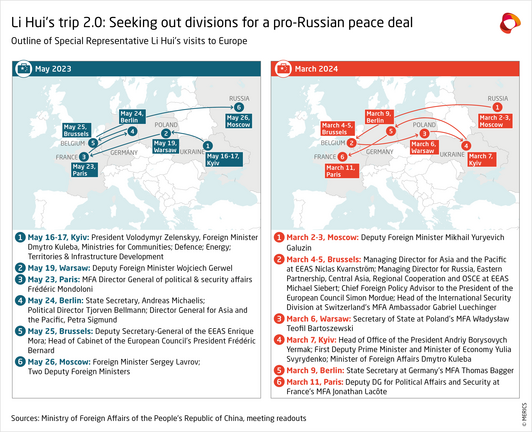
Li Hui’s Europe tour and Beijing's position on the war in Ukraine are the topic of Grzegorz Stec's analysis in our new MERICS Europe China 360°. Read a free excerpt: https://merics.org/en/merics-briefs/li-huis-europe-tour-20-beijings-mediation-seen-kyiv-market-distortions
“Sometimes we see arguments that #China is looking for new growth drivers and that science and technology needs to deliver those. … But we also see that there are more important considerations. And those would be in the space of national security,” says Jeroen Groenewegen-Lau: https://merics.org/en/podcast/science-and-technology-npc-barry-naughton-and-jeroen-groenewegen-lau
Science and technology at the NPC, with Barry Naughton and Jeroen Groenewegen-Lau

Merics
In this year’s government work report at the NPC, the issue of science and technology was mentioned more often than any other. Why does the Beijing put so much focus on S&T? Listen to our podcast with Barry Naughton (UCSD) and Jeroen Groenewegen-Lau: https://merics.org/en/podcast/science-and-technology-npc-barry-naughton-and-jeroen-groenewegen-lau
Science and technology at the NPC, with Barry Naughton and Jeroen Groenewegen-Lau

Merics
The high-level #EU-#China people to people dialogue is supposed to resume this spring. What is the relevance of the format and what can we expect from this first meeting since 2020? Listen to our podcast episode with Katja Drinhausen, Jean-Louis Rocca and Abigaël Vasselier: https://merics.org/en/podcast/resuming-eu-china-people-people-dialogue-jean-louis-rocca-katja-drinhausen-and-abigael
Resuming the EU-China people to people dialogue, with Jean-Louis Rocca, Katja Drinhausen and Abigaël Vasselier

Merics
🆕Read our latest MERICS China Essentials for our experts' key takeaways from the National People's Congress 2024. With contributions from Katja Drinhausen, Jacob Gunter, Helena Legarda & Wendy Chang. https://merics.org/en/merics-briefs/chinas-national-peoples-congress-2024
China's National People's Congress 2024

Top story Prioritizing tech, Beijing offers little substance on how it will fight current woes This year’s National People’s Congress (NPC) showed Beijing’s conviction that the Chinese Communist Party (CCP) knows best. However, the leadership offered domestic and foreign audiences little explanation about how it intends to balance the competing goals of realizing long-term strategic ambitions and addressing current economic woes.  China’s national legislature sent clear signals about ambitions to drive economic recovery – symbolized by an ambitious economic-growth target of five percent for 2024. This leaves the leadership with a mountain of homework: The government has to deal with a real-estate and stock-market downturn, stagnating incomes, unemployment, gaps in the social security and pension systems, and in parts stifling local government debt. A year after the end of the Zero-Covid restrictions, the country’s economy is still sluggish and business and consumer confidence weak. In his “work report” to the assembled delegates, premier Li Qiang pledged to respond to the “expectations” of citizens and enterprises alike. But a closer reading of the blueprint for the coming year and beyond reveals what the main priority will be. “High quality growth” and “new productive forces” are the current buzzwords (see graphic). Li focused on the potential of technology to become China’s main driver of growth, making his pledges to create jobs, safeguard the livelihood of citizens, ease internal migration restrictions and ensure basic social welfare seem more like afterthoughts. All of these will be difficult to achieve in a labor market transformed by increasing technology adoption – and will require additional funding to materialize. Despite paying lip service to reform and opening, the focus on party steering and decreasing responsiveness was illustrated by two procedural items. The NPC’s revision of the State Council Organic Law strengthened the party’s power over policymaking. And the Chinese government’s scrapping of its annual media briefing at the end of the NPC extended a recent trend of government information disappearing from public view and new legal barriers to information gathering, such as the newly revised State Secrets Law. MERICS analysis: “The scrapping of the government press conference was a detail that spoke volumes. Just like that, Beijing did away with a 30-year tradition that had been called into life to signal openness and transparency, especially to a foreign audience,” says Katja Drinhausen, Head of MERICS Politics and Society Program.  More on the topic: Tech-driven growth takes priority over public welfare in China’s vision for development, MERICS Comment by Katja Drinhausen and Max J. Zenglein The increasing challenge of obtaining information from Xi's China, MERICS Report by Vincent Brussee and Kai von Carnap Media coverage and sources: Reuters: China passes law granting Communist Party more control over cabinet Reuters: China broadens law on state security to include 'work secrets' , Metrix 26.5 This is the percentage of women among the 2,977 delegates of the 14th NPC. Female representation has risen slowly but steadily over recent terms, putting the NPC within reach of the US House of Representatives’ 29.2 percent. But this improvement is countered by declining female representation in China’s top leadership – there are currently no women in the Communist Party’s Politburo and only one among government ministers. Although Xi has emphasized China’s commitment to gender equality, he a few months ago called on women to focus on family and childbearing to contribute to China’s development. (Source: NPC Observer)   , Topics No relief for populace as Beijing fixates on geopolitical and financial risks An unbending loyalty to Beijing’s economic policy agenda at this week’s National People’s Congress suggests that the party-state recognizes China’s deteriorating economy but won’t adjust its strategy to alleviate strains on the populace. The NPC’s economic policy agenda exhibits much of the same wishful thinking as last year’s, with some new labels for old ideas (see graphic). Yet again, the growth target is “around 5%,” new job targets are around/over 12 million, and the unemployment rate target is around/under 5.5%. Officials must juggle prioritizing support for technology and innovation, upgrading industry, advancing green targets, cutting debt at the local level, supporting property prices while winding down the real estate bubble, and boosting consumption. Many of these goals involve tradeoffs that will impair other goals – officials will struggle to reduce debt while supporting both the supply (production) and demand (consumption) sides of the economy, just to take one example. Something has to give – and Xi’s words and deeds over the last year suggest that domestic risks like debt and the real-estate bubble and geopolitical risks like technology restrictions and military modernization will remain Beijing’s main goals. Socio-economic stress will be tolerated, as shown by the NPC’s lack of meaningful reforms to structural problems in areas like pensions and healthcare, the Hukou caste system that restricts social mobility, and the unchanging retirement age.   MERICS Analysis: “It is remarkable that Beijing’s response to huge stresses in China’s economy is ‘steady as she goes,’” says Jacob Gunter, Lead Analyst at MERICS. “It shows discipline and loyalty to Xi’s strategic goals have supplanted the party-state’s traditional responsiveness to the economic expectations and needs of China’s middle class.” Media coverage and sources: NPC Observer: Li Qiang’s “Report on the work of the government” AP: China’s congress ends with a show of unity behind Xi’s vision for national greatness Reuters: China's choreographed political meet carries message of control  , China keeps resources flowing to fund its forthright geopolitical ambitions The National People’s Congress (NPC) made clear that China’s leadership is satisfied with its assertive foreign-policy approach and it sees no reason to change course, despite the challenging international situation in which the country finds itself. Ever more resources are being dedicated to pursuing China’s global ambitions, even though they could usefully be allocated elsewhere to deal with pressing economic and social issues facing the country. This year China plans to spend CNY 1.67 trillion (about EUR 210 billion) on defense and CNY 60.78 billion on its diplomatic work – increases of 7.2 and 6.6 percent year-on-year, respectively. These expenditures effectively draw resources away from other areas, from healthcare and social security to tackling sizeable local-government debt. But Beijing seems intent on doubling down on its geopolitical goals, as shown by the government’s “work report” to the NPC. It called for an “equal and orderly multipolar world” and for the reform of global governance. This forthright presentation of China’s broad foreign policy included not-so-oblique references to the US (and its partners) and “hegemonic, high-handed and bullying acts,” clearly identifying which country the leadership sees as its main adversary in the international arena. Meeting “the centenary goal of the People’s Liberation Army” (PLA) was named as key to achieving China’s global objectives – fully modernizing everything from equipment and training to strategy and combat readiness in time for the PLA’s 100th birthday in 2027.   MERICS analysis: “Even as Beijing is increasingly having to prioritize its spending, China’s military budget is not feeling the squeeze,” said MERICS Lead Analyst Helena Legarda. “This shows how important foreign policy and geopolitical goals are to Xi Jinping’s long-term plans.” Media coverage and sources: NPC Observer (EN): Government work report Ministry of Foreign Affairs (CN): Readout of Central Foreign Affairs Work Conference MFA (CN): Wang Yi’s press conference at the NPC , Beijing banks on AI and digitalization in industry to boost growth The government’s work report presented to National People’s Congress showed just how much China is counting on technology like artificial intelligence (AI) to boost growth and revive its economy. The top item on its list of major tasks for 2024 bundled the goals of modernizing industry, developing the digital economy and promoting emerging industries such as electric vehicles. This shows the importance Beijing is placing on integrating technology into existing industries to achieve its economic growth strategy. Even if China continues to lag in critical technologies like chip making, European firms could see more competition in smart manufacturing and other areas they dominate. The work report unveiled the initiative “AI Plus” which will push AI applications to aid key sectors – those the government has in recent years made clear it wants to support. In manufacturing, for example, this could mean digitalizing factories and introducing more robots. Healthcare could come to use big data to improve diagnostics or generative AI to aid in drug discovery. The focus on “New Productive Forces” and “New Three” sectors – electric vehicles, batteries, and solar panels – are evidence of the Chinese leadership’s emphasis on high-end manufacturing over digital service sectors such as gaming.  MERICS analysis: “Boosting the real economy – the production and trade of goods and services – is the target of Beijing’s high-tech focus,” says MERICS Analyst Wendy Chang. “Even though China continues to trail behind rivals in many cutting-edge technologies, the state’s concerted effort in high-tech sectors like industrial AI and cars could still pose a threat to European firms who currently enjoy leadership positions.” More on the topic:  Whole-of-nation innovation: Does China’s socialist system give it an edge in science and technology, MERICS & UCSD Policy Brief by Jeroen Groenewegen-Lau Media coverage and sources: Global Times: China to launch AI Plus initiative: Government Work Report The Register: China pushes ‘AI Plus’ initiative to integrate technology South China Morning Post: ‘Two sessions’ 2024: China’s lawmakers call for more AI development to catch up with US, while keeping it under regulatory control , MERICS China Digest Article 23: What you need to know about Hong Kong’s new national security laws (Reuters)  Hong Kong authorities recently proposed new national security laws that will update and extend rules prohibiting treason, sabotage, sedition, the theft of state secrets and espionage. Known as Article 23, the package could be passed within weeks. (24/03/08) What does China’s Two Sessions mean for climate policy in 2024? (Carbon Brief) The National People’s Congress set China only modest climate targets for 2024, as Carbon Briefs writes in an article about the country’s plans for coal power, clean energy technology and meeting climate targets. (24/03/13)

Merics