Michael Engen, PhD

@mengen
31 Followers
73 Following
56 Posts
Software developer and mathematician based in the US.
My websitehttps://michaelengen.com

By starting with an initial tetrahedron with some radius and affixing tetrahedra around both sides, the unique-valley shapes with an odd number of peaks are realized! The shapes with an even number of peaks just have a different initial configuration.

In this GIF, I've varied the initial radius from 0 to 10, adding new tetrahedra as they fit.

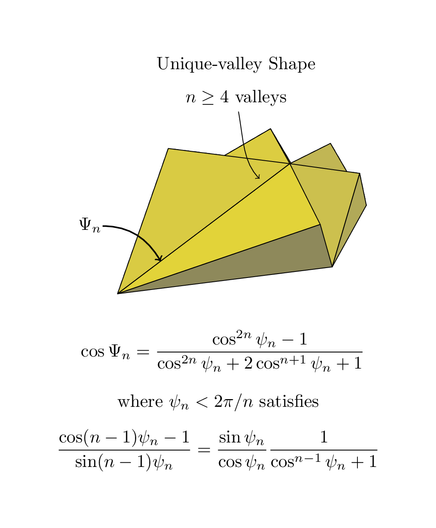
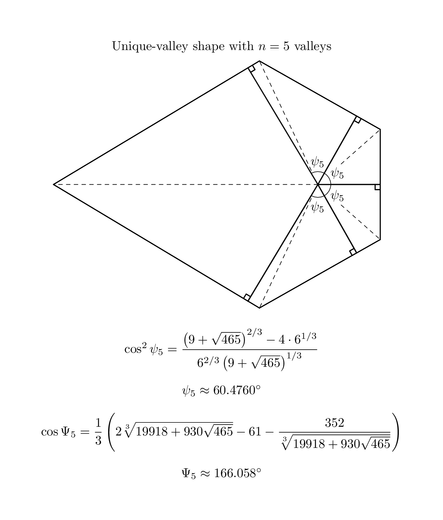
The key ingredient in all this is the relationship between the adjacent tetrahedral components. To maintain right angles, subsequent tetrahedra must be rotated by an amount that depends on the inter-peak angle.

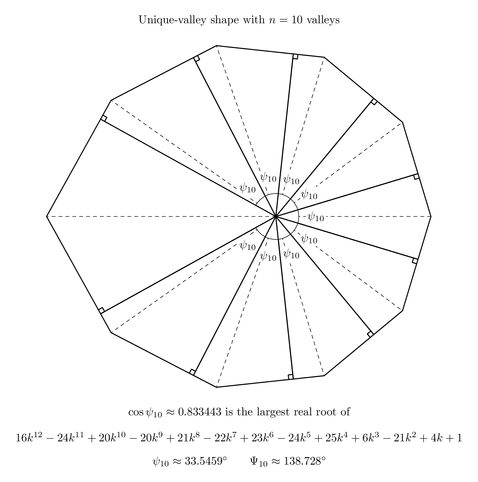
As the number of peaks/valleys grows, the shapes become more circular, and the defining angles become more complicated. For the unique-valley shape with 10 valleys, the inter-peak angle can be expressed as the root of a 12th-degree polynomial.

I wonder if there's a closed-form expression for this shape’s unique dihedral angle!

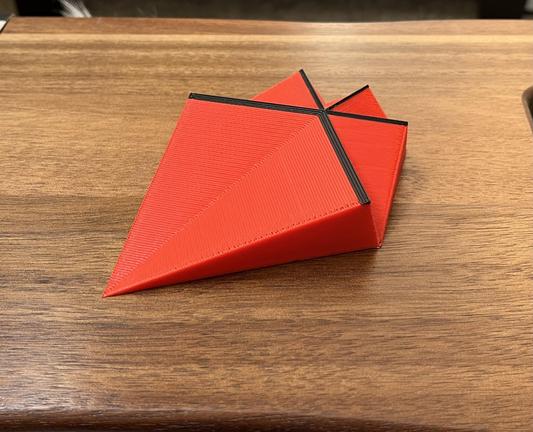
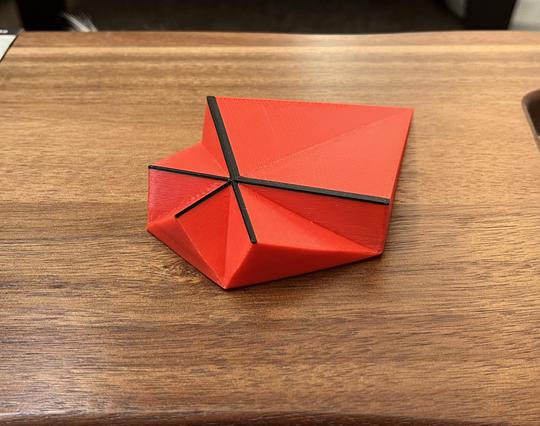
I call the edges that lie in the "upper" plane the "peaks”, and the concave edges that lie between the peaks the “valleys". For these "unique-valley" shapes, one valley has a non-right dihedral angle Ψ, while each other dihedral angle is right.

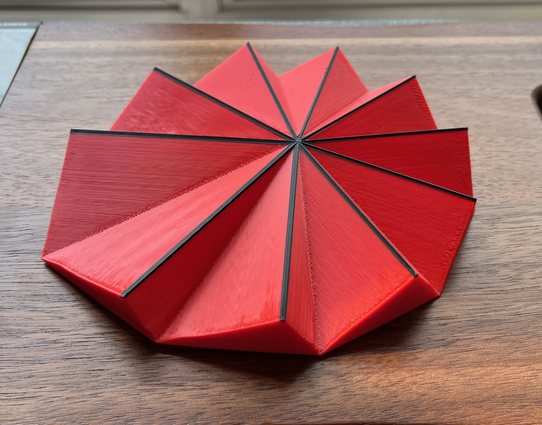
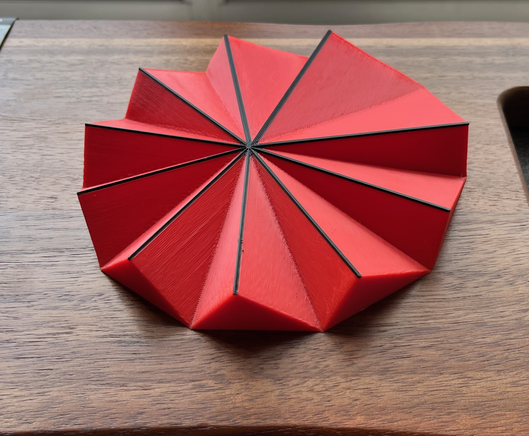
For the unique-valley shape with 5 peaks/valleys, the unique angle is around 166.06º. I've 3D-printed a version of this shape with a few top layers of black filament to accentuate the peaks and have attached a diagram of the shapes downward projection.

@robinhouston Great news! I've generalized my original single-angle polyhedron into an infinite family of polyhedra, each realizing a smaller single-angle than the last.

The vertices still lie on the planes $z=0$ and $z=1$, and the radii increase with $n$. I'll be sharing 3D-printed versions all this week!