Matthias Wagler

59 Followers
151 Following
337 Posts
👋 Hey, I live in Stuttgart, Germany. I'm a human, father, product owner, frontend engineer, and web technology enthusiast that believes in interdisciplinary approaches.
Websitehttps://gedankentank.com
Githubhttps://mattwagl.github.io
Workhttps://helio-hmi.com/en

@matthiasott While I like the technical direction this thing is taking, I'm really having a hard time grasping the ethical implications of the latest "forks/rewrites" coming out of Cloudflare. 🤔

What will this mean for free software? Honestly, I don't know. But I surely don't want to live in a future where big tech is burning tokens in order to slop-copy the work of an entire community. Might be the end of the Open Source era…

@matthiasott At first, that sounded like an April Fools' joke. Turns out it's true. 🤦😁
@codepo8 I really do wonder what that means for society as we work towards reaching a Star Trek-like level on the utopian scoreboard!? 😂 Probably a huge achievement.

„As always, when the world shifts and changes, we can look back and see the one group that saw just a little bit further than everyone else. In this case: it's SQLite. Though the entire core is open-source, they keep much of their rigorous test-suite closed-source…“

„Tests Are The New Moat“ by Daniel Saewitz
👉 https://saewitz.com/tests-are-the-new-moat
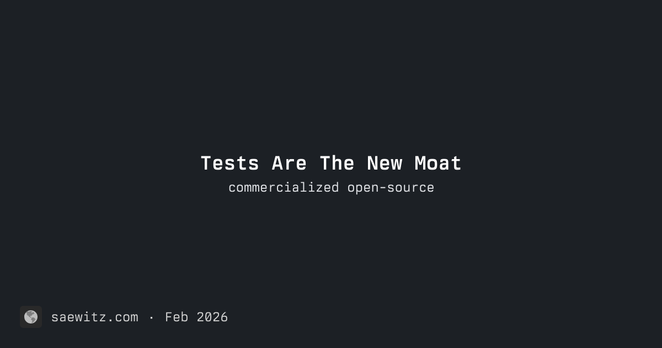
Tests Are The New Moat | Daniel Saewitz

As AI becomes better at cloning people's open source work, what ends up becoming most valuable are software contracts, tests, and API surface area. This clashes the incentives of clearly defining your commercialized open source software with protecting it.

Warum Benzin keine Freiheit bedeutet | Fun Facts mit Luisa Neubauer

YouTube

Togetherness, trust, deep connections, empathy, and community. So extremely difficult to create and build. So incredibly easy to tear down. We need more of all of these things at every level. So one important step is to sharpen our tools and skills so that we can plant them and let them flourish.

And maybe even simpler: we should first stop falling into the psychological traps that make ourselves tear those things down so easily.

OK, I will say this later and perhaps more polished-ly on my blog, but here goes:

I will refuse to review any academic paper that credits a chatbot in the acknowledgements. Why? For much the same reason that I would refuse to review a paper that studied conflict diamonds just because they were convenient.

The human cost is unacceptable:

https://www.theguardian.com/global-development/2026/feb/05/in-the-end-you-feel-blank-indias-female-workers-watching-hours-of-abusive-content-to-train-ai

The industry has no line against using the output of the Nazi CSAM generator and calling it "training data".

https://www.theguardian.com/technology/2026/jan/24/latest-chatgpt-model-uses-elon-musks-grokipedia-as-source-tests-reveal

https://www.theverge.com/report/870910/ai-chatbots-citing-grokipedia

Any marginal benefit that an individual scientist thinks they see is just saying, "Wow, the bus to the conference runs so much better on leaded gasoline."

‘In the end, you feel blank’: India’s female workers watching hours of abusive content to train AI

Women in rural communities describe trauma of moderating violent and pornographic content for global tech companies

The Guardian

„The programmers of the future may write less code directly. They may work at higher levels of abstraction. They may use tools we cannot currently imagine. But they will still be doing the essential work of translating human intent into software that works. And that work will continue to require skill, judgment, and understanding that no tool has yet replaced.“

https://www.ivanturkovic.com/2026/01/22/history-software-simplification-cobol-ai-hype/

The Eternal Promise: A History of Attempts to Eliminate Programmers

From COBOL in the 1960s to AI in the 2020s, every generation promises to eliminate programmers. Explore the recurring cycles of software simplification hype.

Signal Through the Noise

„Perhaps the most important lesson from six decades of promised simplification is this: there is no substitute for understanding.

The tools change. The languages change. The platforms change. But the need for people who deeply understand what they are building, and why, remains constant.“

https://www.ivanturkovic.com/2026/01/22/history-software-simplification-cobol-ai-hype/

The Eternal Promise: A History of Attempts to Eliminate Programmers

From COBOL in the 1960s to AI in the 2020s, every generation promises to eliminate programmers. Explore the recurring cycles of software simplification hype.

Signal Through the Noise

RE: https://toot.cat/@ceejbot/116149718909141919

„The hard part of software development has never been typing code. It has always been figuring out exactly what the software should do, and ensuring it actually does that under all circumstances. This is why specification languages and automatic code generation repeatedly fail to eliminate programmers: they simply move the complexity from code to specification, and specification is at least as difficult.“

https://www.ivanturkovic.com/2026/01/22/history-software-simplification-cobol-ai-hype/