
Martin Hölzer

103 Followers
51 Following
52 Posts
Bioinformatics, nextflow, whisky, scout. Researcher at RKI.
Here is the publication where POCP was proposed and defined: https://pubmed.ncbi.nlm.nih.gov/24706738/
A proposed genus boundary for the prokaryotes based on genomic insights - PubMed

Genomic information has already been applied to prokaryotic species definition and classification. However, the contribution of the genome sequence to prokaryotic genus delimitation has been less studied. To gain insights into genus definition for the prokaryotes, we attempted to reveal the genus-le …

PubMed

Want to calc the Percentage Of Conserved Proteins (POCP) for your bacteria?

I re-implemented my scripts as @nextflowio pipeline: https://github.com/hoelzer/pocp

POCP is a widely accepted parameter for seq similarity & delimiting genus boundaries in prokaryotic genome-based taxonomy.

GitHub - hoelzer/pocp: Calculation of the Percentage of Conserved Proteins following Qin, Xie et al. 2014

Calculation of the Percentage of Conserved Proteins following Qin, Xie et al. 2014 - GitHub - hoelzer/pocp: Calculation of the Percentage of Conserved Proteins following Qin, Xie et al. 2014
GitHub
RT @rki_de
1/3
Hier mit Daten vom RKI
100 60+-Jährige: 88👬geimpft, 12👬nicht
10 kommen mit Corona ins🏥: 5🧍‍♂️geimpft & 5🧍🏻‍♂️ ungeimpft
Medien: In den🏥liegen 50% Geimpfte
👉Prävalenzfehler
Impfquote berücksichtigen!
👉 42% der Ungeimpften im🏥& nur 6% der Geimpften
Danke @WorldWideWohnzimmer! https://twitter.com/twintvofficial/status/1460505904751812610
World Wide Wohnzimmer on Twitter

“Huhu!👋🏼 100 Einwohner-Dorf. 99👬 sind geimpft, 1🧍🏻‍♂️nicht. 2 kommen mit Corona ins 🏥: 1🧍‍♂️geimpft und 1🧍🏻‍♂️ ungeimpft. Medien: „In den 🏥 liegen 50% Geimpfte!“ 👉Prävalenzfehler👈 Im Beispiel landen 100% der Ungeimpften im 🏥 und nur 1,01% der Geimpften. Tschüssi👋🏼”

Twitter

In the past, we applied RIBAP in a couple of studies (and more to come):

https://www.mdpi.com/2076-0817/9/11/899

https://www.sciencedirect.com/science/article/abs/pii/S0723202021000230

https://www.biorxiv.org/content/10.1101/2022.11.10.515926v1

We're also working on a RIBAPreprint - stay tuned!

Comparative Genome Analysis of 33 Chlamydia Strains Reveals Characteristic Features of Chlamydia Psittaci and Closely Related Species

To identify genome-based features characteristic of the avian and human pathogen Chlamydia (C.) psittaci and related chlamydiae, we analyzed whole-genome sequences of 33 strains belonging to 12 species. Using a novel genome analysis tool termed Roary ILP Bacterial Annotation Pipeline (RIBAP), this panel of strains was shown to share a large core genome comprising 784 genes and representing approximately 80% of individual genomes. Analyzing the most variable genomic sites, we identified a set of features of C. psittaci that in its entirety is characteristic of this species: (i) a relatively short plasticity zone of less than 30,000 nt without a tryptophan operon (also in C. abortus, C. avium, C. gallinacea, C. pneumoniae), (ii) a characteristic set of of Inc proteins comprising IncA, B, C, V, X, Y (with homologs in C. abortus, C. caviae and C. felis as closest relatives), (iii) a 502-aa SinC protein, the largest among Chlamydia spp., and (iv) an elevated number of Pmp proteins of subtype G (14 in C. psittaci, 14 in Cand. C. ibidis). In combination with future functional studies, the common and distinctive criteria revealed in this study provide important clues for understanding the complexity of host-specific behavior of individual Chlamydia spp.

MDPI

1st full release of RIBAP!

https://github.com/hoelzer-lab/ribap/releases/tag/1.0.0

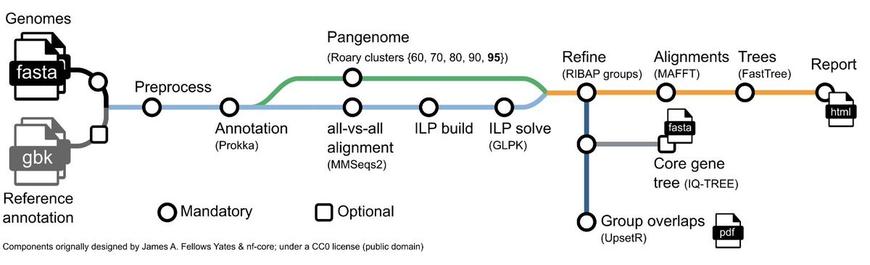
RIBAP combines sequence homology info from Roary (kudos to the devs!) w/ clever pairwise ILP calcs (kudos to @klamkiewicz!) to produce a more complete microbial core gene set - even on genus level.

Implemented in @nextflowio

Release Release 1.0.0 · hoelzer-lab/ribap

What's Changed First full-release of RIBAP. Since the last pre-release: We have rewritten our ILP modules to be less harddrive-demanding. per default: ILPs and their solutions are not stored anym...

GitHub
RT @robdfinn
Are you experienced in comparative genomics? We are recruiting a new project leader to drive the development of the comparative genomics team, part of @ensembl, based at @emblebi. Closing date at the end of April https://www.embl.org/jobs/position/EBI02116
EMBL Jobs

We offer a wide range of challenging scientific and non-scientific positions at all of our European locations and encourage applications from international candidates at all career levels.

RT @GeorgesVis
Extended deadline April 30. Please RT. 🍃 https://twitter.com/GeorgesVis/status/1639374360203993088
Georges Hattab on Twitter

“Four PhD positions available in my group. Deep and unsupervised learning, proteomics, NLP, data visualization, antimicrobial resistance. 🔁 Join us on our mission 🚀 https://t.co/5wyKsybeo7 #ArtificialIntelligence #MachineLearning #visualization #Bioinformatics #DataScience #PhD”

Twitter
RT @ewyler
Job opening! For a project on biotechnological engineering in the @landthaler_m lab at the @MDC_Berlin / Germany, we are looking for a Postdoc with a background in experimental cell and molecular biology. Please check https://www.mdc-berlin.de/career/jobs/wissenschaftlicher-mitarbeiterin-postdoc-mfd – or ask me for details.
Wissenschaftliche*r Mitarbeiter*in/ Postdoc (m/f/d)

The successful candidate (m/f/d) will work in a dynamic and collaborative research environment with access to state-of-the-art facilities and equipment.

RT @_JonasFuchs
Our second story regarding the evolution SARS-COV-2 in immunocompromised patients. Thanks for the great collaboration! @LenaJaki12 @fulleren1 @sandpiper_89 @wrobel_antoni @MartinSchwemmle
https://www.nature.com/articles/s41467-023-37591-w
Total escape of SARS-CoV-2 from dual monoclonal antibody therapy in an immunocompromised patient - Nature Communications

Antibodies against SARS-CoV-2 can be used to treat infections but there is a risk of driving viral resistance to antibodies. Here the authors characterise SARS-CoV-2 escape mutants from an immunocompromised patient treated with anti-SARS-CoV-2 antibodies using mouse protection studies and structural prediction.

Nature
RT @SystemsVirology
BREAKING🔔 A new preprint from G2P-Japan🇯🇵 is out @biorxivpreprint. We illuminated the virological characteristics of new SARS-CoV-2 lineage of concern, XBB.1.16, which is rapidly spreading in India🇮🇳 Please RT🔥 1/