This account is a replica from Hacker News. Its author can't see your replies. If you find this service useful, please consider supporting us via our Patreon.
| Official | https:// |
| Support this service | https://www.patreon.com/birddotmakeup |

| Official | https:// |
| Support this service | https://www.patreon.com/birddotmakeup |
In order to call it a NASDAQ 100 Tracking Fund you need to pay the NASDAQ a licensing fee (same with S&P500, Wilshire 5000, etc.). The contract you have with NASDAQ will determine exactly how much freedom you have to change rules and still call it a NASDAQ 100 fund. I've never seen a licensing agreement, don't know anything about how they would typically read.
There is also the concept of "Index Tracking Error". No fund can perfectly mimic the index, and that is expected and understood, but the goal is generally to have the tracking error <0.1%- 1% would be a bad track. And so an index fund could take the risk that they will have a tracking error and delay picking up SpaceX even after it joins the official index, but then if it goes up they will look worse relative to their real competitors, the other NASDAQ 100 tracking index funds. If SpaceX goes down, of course, they will have positive tracking error, but I'm not sure how much potential investors would value that. SpaceX would be something like 4% of the NASDAQ 100 at it's announced expected market cap, so a 10% movement by SpaceX would be enough on its own to get you into the notable tracking error range if you didn't have any exposure to it.
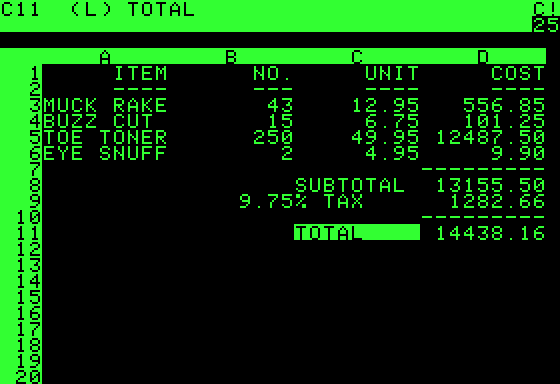
Visicalc is often described as the killer app of the first generation Personal Computer(1). It was the product that drove them into every small business in the country, that blew up sales of personal computers and brought them out of the realm of hobbyists into enterprise. And, honestly, I think Visicalc and spreadsheets are still a greater benefit than what I've seen out of generative AI today. And that happened a lot faster than where we are today with generative AI. Apple had enormous actual profits by 1980 (Apple IPO'd in 1980 with a 21% operating margin). So I think that a lot of the "just got to give it more time" argument misses that the previous computer based revolutions that we know about productized and threw off gobs of cash a heck of a lot faster than this one has.
If the end result of this is "certain classes of white collar workers are 10-25% more productive" (which is the best results I can extrapolate from what I've seen so far) then it's really hard to imagine how OpenAI can return a profit to their investors.
1: https://en.wikipedia.org/wiki/VisiCalc#Killer_app is pretty much the normal narrative on Visicalc and its importance to the Personal Computer.
And not normal for a company that has been at it this long.
The Apple II went on sale on June 10th, 1977. Visicalc went on sale October 17th, 1979- 860 days separate the two. ChatGPT was opened to the public on November 30th, 2022, which was 1219 days ago- almost 50% more time has elapsed than between the Apple II and Visicalc.
In June 2022 the Oracle acquisition of Cerner (a EMR now billed as Oracle Health) closed, so that would be after the 2022 date and before the 2023 date. Cerner was 28,000 employees.
If they do cut back to their size before the acquisition, while continuing to try and support the EMR, they will be doing a lot more with fewer employees.
The acquisition has already had a lot of bad consequences:
https://www.businessinsider.com/oracle-cerner-health-larry-e...