Spent a few hours on Sunday redesigning my personal site: https://luhr.co/
It's an intentionally simple site, so it's easy to work fast and make changes. But even a simple site always has room for improvement and further simplification.

| Website | https://luhr.co |
| YouTube | https://youtube.com/@buildux |
Spent a few hours on Sunday redesigning my personal site: https://luhr.co/
It's an intentionally simple site, so it's easy to work fast and make changes. But even a simple site always has room for improvement and further simplification.
Fun update: I've joined Kit as their Senior Design Engineer!
I'm building Kit's design system, helping bridge the product design and engineering teams, and exploring the frontier of design to code workflows. I couldn't be more excited for this opportunity and will be working public along the way.
Stoked how these data visualizations came together last week at Buffer. Lots of data science, content, design, and design engineering went into these social media engagement insights.
Check out the full page: https://buffer.com/insights/state-of-social-media-engagement-2026
Had a breakthrough recently with getting decent CSS from agents. Let's call it HTML-Driven Development:
- Craft unstyled HTML to control the structure, semantics, accessibility, and even class names
- Then, ask the agent to style it, using existing styles and variables CSS as reference
This is more or less my sequence anyway, but it's produced much better results from agents.
There's a disconnect with generating high fidelity designs with AI.
The bottleneck of design and engineering isn't ideas, it's gradually defining the right idea.
The challenges of design and engineering aren't creating high fidelity designs or writing the code. It's finding the value, making tradeoffs along the way, and knowing what still needs polish.
A single content section can be packed with animation, interaction, layout, and accessibility considerations.
I just published a behind-the-scenes of building Buffer's homepage hero: https://buffer.com/resources/how-we-designed-and-built-the-new-buffer-homepage-hero/
And here's a companion video: https://www.youtube.com/watch?v=1yDTV2BrxyM
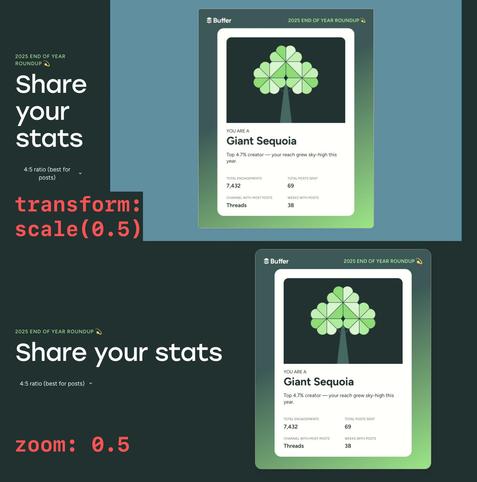
Today I needed to scale an element I couldn't directly style.
First I reached for `transform: scale(0.5)`. But, this doesn't affect layout, which left empty space around the element.
Then, I learned about `zoom: 0.5`, which is a newly supported CSS property that does exactly what I needed: scale an element and affect layout.
My team at Buffer is hiring a Senior Engineer – Growth Marketing.
We'll work closely together on projects like referral programs, internationalization, and tracking/experimentation systems.
- Fully remote
- 4-day work week
- $156.5K–$202.3K