Linnet Taylor

730 Followers
280 Following
96 Posts
I work on tech, justice and political representation. global issues, based in the netherlands.
websitewww.globaldatajustice.org/
publicationshttps://research.tilburguniversity.edu/en/persons/linnet-taylor/publications/
hi there folks - does anyone have leads for me on stats literature that compares randomised sampling with profiling methods in the context of detecting fraud and/or criminality?
And once again, tech folks use the fact that we collectively and purposely destroyed African public health provision, to posit use cases for dodgy tech. Stop with this, it’s historically ignorant and morally bankrupt.
Fairly mind-blowing deep dive into a big and widely used input data set in the AI/ML space, LAION-5B. Beautifully presented. Strongly recommended.
https://knowingmachines.org/models-all-the-way
Models All The Way Down

LAION-5B is an open-source foundation dataset. It contains 5.8 billion image and text pairs—a size too large to make sense of. We follow the construction of the dataset to better understand its contents, implications and entanglements.

Happy Easter from the newest resident of The Hague!
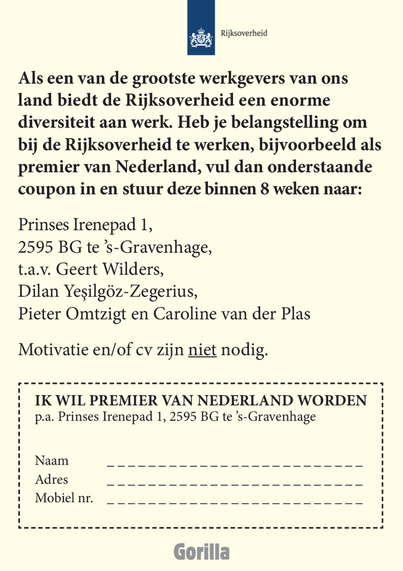
Premier van Nederland worden? Vul dan de coupon in! ✏️ door Gorilla. #formatie
Google's new 'ad privacy feature' on Chrome looks amazingly like asking users to help advertisers profile them more precisely:
our special issue on Decolonial Data Law and Governance is finally out, congratulations to our collaborators and to the marvellous Siddharth de Souza and Hellen Mukiri Smith who edited the collection! It can be found here: https://techreg.org/article/view/18931
Decolonial Data Law and Governance

In the introduction to this special issue, we propose a decolonial take on data law and governance across three aspects through the dismantling of hegemonic structures, the embracing of pluriversality and finally the decentering of data and technology. The special issue covers papers that discuss a) what decolonisation means in relation to data law and governance for the digital economy, b) what kinds of methods should be employed to develop data governance frameworks that account for different infrastructural, social, and political contexts, and c) vocabularies and imaginations for how to regulate data, from the majority world. The papers are written from different disciplinary backgrounds of law, science, and technology studies, governance and policy, as well as media studies and present different points of view, and different entry points into the debate. In this piece, we explore ways to place them in dialogue as a plural whole.

Technology and Regulation
hi everyone - does anybody have the text of ISO/IEC TR 24027:2021? it's the standard on bias in AI. if so I will pay you in memes and love.
what kind of regulatory object is data? how can community-level approaches to oversight complement national-level approaches? and what can we learn from comparing Indian with European approaches to enforcement? a policy paper from @GlobalDataJust paper with colleagues from CIS India and NLUD Delhi: https://cis-india.org/internet-governance/blog/reconfiguring-data-governance-insights-from-india-and-eu
Reconfiguring Data Governance: Insights from India and the EU — The Centre for Internet and Society

This policy paper is the result of a workshop organised jointly by the Tilburg Institute of Law, Technology and Society, Netherlands, the Centre for Communication Governance at the National Law University Delhi, India and the Centre for Internet & Society, India in January, 2023. The workshop brought together a number of academics, researchers, and industry representatives in Delhi to discuss a range of issues at the core of data governance theory and practice.

what are the rules when commercial tech providers become involved in mental health interventions? my colleague Tineke Broer and I are hiring a PhD at TILT, Tilburg University (NL) to work on sociolegal aspects of digital mental health. apply till march 31st here: https://tiu.nu/22135
please forward to anyone who might be interested!
Job opening: PhD in Socio-legal Aspects of Digital Mental Health (22135)