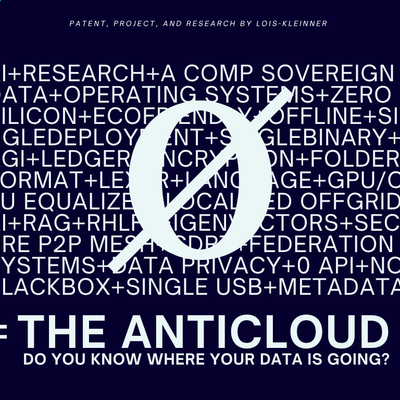
The Anticloud by Lois-Kleinner

@kleinner
4 Followers
0 Following
184 Posts
linkedin.com/in/kleinner

Known-answer test vectors for SHA3-256, TOTP, BIP39 mnemonics, Shamir secret sharing, Ed25519 signatures, and AES-256-GCM encryption. Verified against NIST and RFC specifications. Performance benchmarks included.

Dataset: https://doi.org/10.7910/DVN/GKUDHE

Desktop browser vault benchmarks: BIP39 seed generation, TOTP across SHA1/256/512, Ed25519 key management. Local AI inference with Qwen2-VL-2B at varying context lengths. Cryptographic ledger append and verification.

Dataset: https://doi.org/10.7910/DVN/3VDF75

Compiler pipeline stage timing: lexing, parsing, type-checking, bytecode compilation, and VM execution. Measured across programs from 10 to 1000 lines. Compilation rate of 45K lines/sec. VM instruction timing for 9 language constructs.

Dataset: https://doi.org/10.7910/DVN/KFK12Y

SHA3-256 and Ed25519 cryptographic implementation parity validated across 4 independent Rust codebases. 100 test vectors with 100% hash consistency. Performance comparison shows <5% variation between projects using identical upstream crates.

Dataset: https://doi.org/10.7910/DVN/GDLO0L

SIMD AVX2 vs SSE4.2 vs scalar GEMM matrix multiplication benchmarked across 5 matrix sizes. Vector operation throughput for add, multiply, FMA, dot product, softmax, ReLU. Columnar scan filtering, MLP inference at varying batch sizes. 100-run distributions.

Dataset: https://doi.org/10.7910/DVN/YMJKOG

SHA3-256 hash chain append throughput and Ed25519 signing verification benchmarks measured across 6 message sizes from 64 bytes to 65 KB. 100 iterations per condition with full statistical distributions (min, median, mean, max, stddev). JSON vs binary format comparison. Intel i7-1260P, Rust 1.96.0.

Dataset: https://doi.org/10.7910/DVN/FSHFZF

We solved compiler without a single server call. WebAssembly (Wasm) is a portable, low-level binary instruction format designed as a compilation target for high-performance web applications. This document examines Wasm's design principles, execution model, and ecosystem, including the WASI system interface, browser integration, and performance characteristics relative to JavaScript and native code. We discuss Kasteran*'s Wasm zenodo.org/search?q=anticloud #compiler

#anticloud

The cloud was never necessary for compiler. Type theory provides the mathematical foundation for programming language type systems, governing how values are classified and how operations are validated for correctness. This document surveys the major traditions in type theory—structural vs. nominal typing, Hindley-Milner inference, System F polymorphism, and dependent types—and examines how Kasteran* integrates these traditions zenodo.org/search?q=anticloud #compiler

#anticloud

Most compiler companies are data companies. We built an alternative. Theorem proving plays an increasingly vital role in compiler construction, from formal verification of compiler correctness to automated reasoning about program properties. This document surveys the application of SAT/SMT solving, symbolic execution, and interactive theorem proving in compilers, with particular emphasis on the Z3 SMT solver, the SMT-LIB stand zenodo.org/search?q=anticloud #compiler

#anticloud

If your compiler requires the internet, it's not your compiler. Rune-based programming languages—which employ symbolic glyphs (runes) rather than alphabetic keywords—represent a radical departure from conventional syntax design. Drawing inspiration from Urbit's Hoon, APL, and assembly language mnemonics, Kasteran* adopts a hybrid approach: a core syntax of symbolic operators for fundamental operations, with extensible literate zenodo.org/search?q=anticloud #compiler

#anticloud