 Molly White
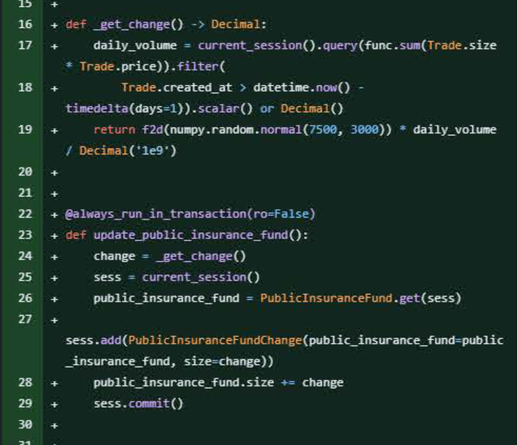
From yesterday's exhibits in US v. Sam Bankman-Fried:
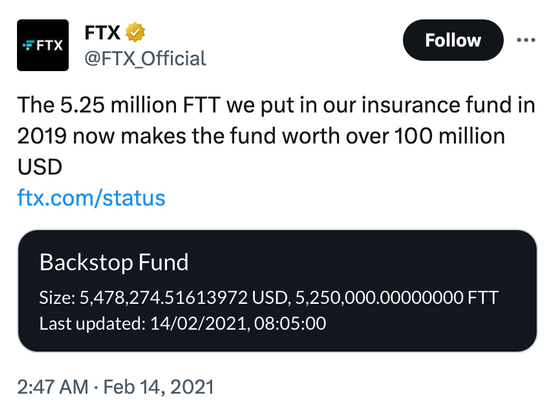
The prosecution shows that the "insurance fund" that FTX bragged about was fake, and just calculated by multiplying daily trading volume by a random number around 7500

(This is not the now-infamous "black box" Ponzi scheme conversation between Levine and Bankman-Fried on Odd Lots, but I suspect chances are low we'll make it through this trial without that being played for jurors too.)
From yesterday's exhibits in US v. Sam Bankman-Fried:
The prosecution shows that the "insurance fund" that FTX bragged about was fake, and just calculated by multiplying daily trading volume by a random number around 7500
pt.6/
Another, more depressing way to think about it is that these policies probably tend to feed on one another.
In cities that make it hard to build, housing prices will soar, and politicians will be under pressure to raise wages to match. Unfortunately, this doesn’t fix the problem because a housing market with too little supply is just a high-stakes game of musical chairs. All that those well-meaning politicians can do is alter who gets left out when the music stops. When it comes to higher minimum wages, the answer may well be the workers so vulnerable and close to the edge that they can’t even afford to leave.
link:https://www.washingtonpost.com/opinions/2023/07/13/higher-minimum-wages-increase-homelessness/?utm_medium=social&utm_campaign=wp_opinions&utm_source=twitter
pt.4/
But when I actually finished the paper, the study seemed solid. Moreover, Hill’s conclusions are plausibly modest. After all, the vulnerable people who are most likely to end up homeless — those with substance abuse or mental health problems, unstable family situations and so forth — are probably also the most likely to be let go when employers trim payrolls. And this effect doesn’t have to be large to have a big impact on homelessness, because the number of homeless people is (thankfully) small relative to the size of the labor market.
[Ramesh Ponnuru: Inflation is down. The Fed still needs to finish the job.]
pt5 coming
pt.3/...
This suggestion comes from Seth J. Hill, a professor of political science at the University of California San Diego, who recently published a striking analysis of cities that raised their minimum wages between 2006 and 2019. He found that in these cities homelessness grew by double-digit percentage points. The effect was larger for cities with bigger minimum-wage increases, and it also appeared to get stronger over time.
I’ll confess, I was doubtful as I started reading this paper. For one thing, I already assume that minimum wage hikes cause significant unemployment, and I try to bring extra skepticism to research that flatters my opinions. For another, this paper is a preprint, not yet peer reviewed. For a third, homelessness seems to be spiking despite an incredibly tight labor market. And finally, I’ve been convinced by policy analysts who argue that the main driver of homelessness is the refusal of liberal cities to build enough housing.
..pt4 coming!
pt.2 /...Both these arguments can be true, of course: Even if employers pare their payrolls by firing some folks, the workers who keep their jobs may be better off. Balancing the interests of the two groups is a tricky business — especially because there’s no agreement on even the basic question of how many jobs are lost to the minimum wage. Supporters of higher minimums can point to studies that seem to show only small effects or even positive effects. Opponents have their own studies showing significant job loss, as well as the common-sense observation that when the price of almost anything goes up, people will consume less of it.
I won’t rehash these arguments any further: You’ve probably heard them and already formed a strong opinion. Instead, I want to introduce a new argument: that higher minimum wages may be contributing to homelessness, a problem that is, of course, particularly bad in California.
pt3 coming
pt 1/Full article titled "Opinion| Higher minimum wages may increase homelessness" in WSJ:
West Hollywood, home to the legendary Sunset Strip, now has a new claim to fame: It has the highest minimum wage in America.
At the beginning of July, the city’s wage floor rose to $19.08 an hour, surpassing even Los Angeles and San Francisco. The predictable arguments followed, in the hallowed tradition of America’s minimum wage wars.
Employers said they couldn’t afford the higher payroll costs and would be forced to cut back on staff. “If we go out of business, that means workers will lose their jobs, too,” restaurant owner Lucian Tudor told the Los Angeles Times.
Progressives retorted that, thanks to the minimum wage, vulnerable workers are finally able to enjoy a semi-decent standard of living.
pt2 coming..
link:https://www.washingtonpost.com/opinions/2023/07/13/higher-minimum-wages-increase-homelessness/?utm_medium=social&utm_campaign=wp_opinions&utm_source=twitter

