
Associate Professor @UvA_ASCoR
& Adj. Associate Professor @NTNU
Starting Feb 23: Professor @BredowInstitut
& @JKW_UHH
Expert in bursting bubbles of all sorts
Associate Professor @UvA_ASCoR
& Adj. Associate Professor @NTNU
Starting Feb 23: Professor @BredowInstitut
& @JKW_UHH
Expert in bursting bubbles of all sorts
JOB ALERT
We are hiring! Assistant Professorship with Tenure Track in *Computational Social Science with a Focus on Communication*.
Join us at U of Zurich. Great opportunities, details below.
PLEASE TOOT AROUND
@communicationscholars #commodon @ICA_CAT @PolComm @computationalsocialscience
The University of Zurich invites applications for an assistant professorship with tenure track in computational social science with a focus on communication. The position should be filled by 1 August 2024. After two employment periods of three years each, promotion to a permanent professorship will take place in the event of a positive evaluation within a tenure procedure. Candidates should demonstrate outstanding, internationally visible research in the field of computational social science. The focus is on developing and applying methods for analyzing communication processes in the context of digital and social media. The position is based in the Department of Communication and Media Research (IKMZ) and is intended to investigate communication processes from an interdisciplinary social science perspective. Possible methodological approaches include agent-based or other computer-based modeling, simulations, network analysis, machine learning, artificial intelligence, natural language processing, analysis of large audio and/or video datasets, gathering and analysis of digital trace data, and the use of lab or field experiments. In teaching, the candidate should enable students to use innovative computer-based methods independently and in a research-oriented manner. Initially, the professorship will teach one to two courses per semester, mainly in communication science programs. Later, the teaching opportunities will expand. Candidates must hold a PhD degree in communication science (or related subjects such as computer science, statistics, political science or sociology) by the time of application and have excellent relevant publications. While courses may be taught in English, the administrative language of the University of Zurich is still German. Therefore, non-German speaking candidates are expected to acquire a working knowledge of German within the first years of their appointment. The Department of Communication and Media Research and the University of Zurich offer a stimulating research and teaching environment with a wide range of opportunities for professional exchange and cooperation. The University of Zurich is an equal opportunities employer and in particular strives to increase the gender diversity in leading positions. Therefore, qualified female researchers are encouraged to apply. Please submit an academic CV, including research plan for the next three years (two to three), publications, teaching experience, copies of academic transcripts, and contact details of two references. The closing date for applications is 1 March 2023. Details on the application procedure are available on the website of the Faculty of Arts and Social Sciences. In case of technical problems, please contact the Dean's Office of the Faculty of Arts and Social Sciences.
📣 Save the Date! 📣
Prof. Dr. Sonja Ganguin und Dr. Johannes Gemkow sprechen im ersten #LeibnizMediaLunchTalk des Jahres über mediatisierte Vergemeinschaftungen von Jugendlichen als Referenzpunkt gesellschaftlichen Zusammenhalts.
🗓️26. Januar ⌚️12 Uhr 📍via Zoom
➡️https://leibniz-hbi.de/de/veranstaltung-event/mediatisierte-vergemeinschaftungen-von-jugend
📣 Einladung zum #LeibnizMediaLunchTalk:
@hongmathias spricht mit uns über grundrechtliche Rahmenbedingungen der Regulierung von Hassrede und Desinformation im Netz.
🗓️7. Februar ⌚️12 Uhr 📍via Zoom
Moderation: @TobiasMast
Info & Anmeldung➡️ https://leibniz-hbi.de/de/veranstaltung-event/regulierung-von-hassrede-und-desinformation-im-netz
As the great philosopher of my generation Taylor Swift once said: I am "happy, free, confused and lonely at the same time. It's miserable and magical". But most of all, days like today make it all worth it.
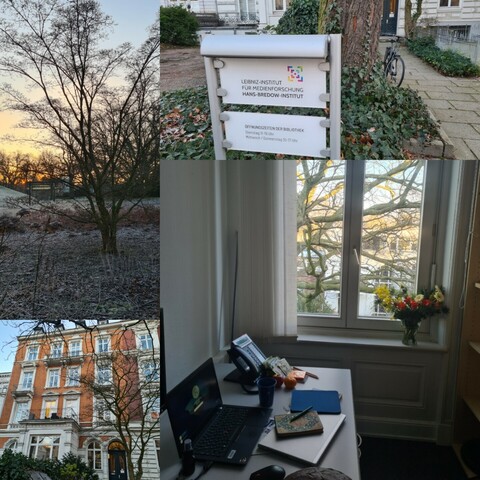
In the next few months I will be mostly working remotely, but starting this summer please come and say hallo when you are in Hamburg!
First day in the next chapter of my life. I am so excited to get to know and collaborate with the smart and innovative researchers at the Leibniz Institute for Media Research Hans Bredow
and the Institute for Journalism and Communication Science at the University of Hamburg. But I am also already missing my tribe in Amsterdam.
https://leibniz-hbi.de/en/news/judith-moeller-is-new-professor-at-hbi
🚨 Special Issue 🚨
The Humane AI team will edit a special issue on "Interdisciplinary perspectives on the (un)fairness of AI" at Minds & Machines.
CfP: https://resource-cms.springernature.com/springer-cms/rest/v1/content/23935772/data/v1
📌 Submissions are open until 31.05.
We look forward to working with @RosTaddeo !
I am happy to share the call for the Conference ”Conversing with artificial intelligence”
6-7 March 2023, Berlin
* Abstracts for poster session can be submitted until 1 Feb 2023
* Registration is until 10 Feb 2023
Participation is free of charge and possible in person or online via zoom. Poster presentations on topics related to interaction with artificial intelligence are invited.
Find more information and a form to register at www.impact-projekt.de/#conference.
Chatbots are not a good replacement for search engines
https://iai.tv/articles/all-knowing-machines-are-a-fantasy-auid-2334
The idea of an all-knowing computer program comes from science fiction and should stay there. Despite the seductive fluency of ChatGPT and other language models, they remain unsuitable as sources of knowledge. We must fight against the instinct to trust a human-sounding machine, argue Emily M. Bender & Chirag Shah.